Israel-Diaspora relations
Trip to Chicago offers ‘peace of mind’ to female IDF ‘tatzpitaniyot,’ who monitor Israel’s borders
During eight-day stay in the U.S., Israeli veterans unpack their traumatic experiences, with support from the local Jewish community
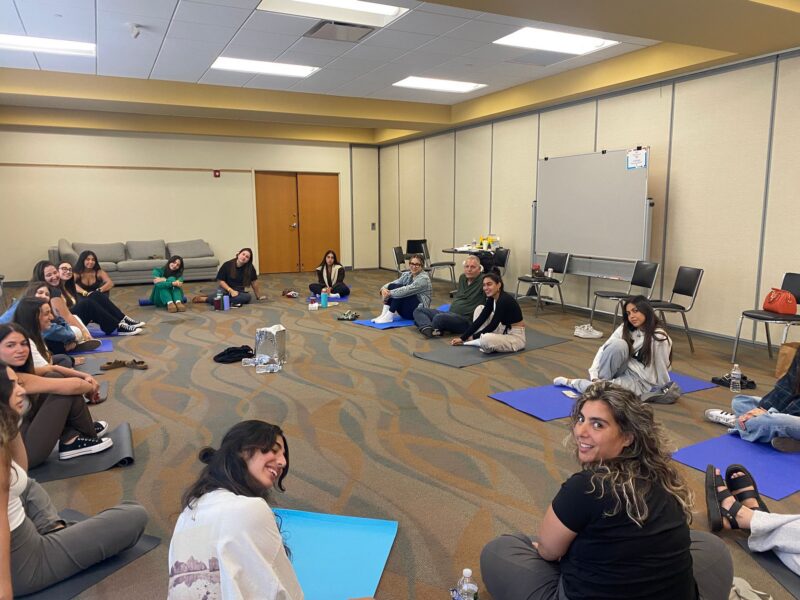
Courtesy
Former 'tatzpitaniyot' do yoga at a synagogue in Chicago as part of the Peace of Mind program in the summer of 2025.




 Add EJP on Google
Sitting on a bus in Chicago, thousands of miles away from her home in central Israel, Shirel Zafrani realized that for the first time in years, she had both of her earphones in. Zafrani, a former IDF tatzpitanit, or observer, never usually “allows” herself the privilege of fully immersing herself in her music — instead staying always alert, at least one ear open.
Zafrani, 26, was one of 17 former tatzpitaniyot — female soldiers who monitor surveillance cameras and other equipment — who were hosted by North Shore Congregation Israel in Glencoe, Ill., for eight days last summer as part of Metiv: The Israel Psychotrauma Center’s Peace of Mind program, which for the past 18 years has helped former Israeli soldiers cope with combat trauma.
The idea behind the program, which provides participants with 60 hours of group counseling plus individual therapy, is that the distance from Israel, combined with the love and support of Diaspora Jewish communities, plays a key role in creating a safe, quiet, and meaningful environment for former soldiers.
“I felt so secure in their area,” Zafrani told eJewishPhilanthropy. “You really feel in a bubble … you feel safe.”
This fall, several of the American hosts also visited Israel and the guests who had stayed with them. Bringing the encounter full circle, the Israeli participants organized a day trip for them in the Gaza border area, during which they visited the site of the Nova festival massacre and the Nahal Oz base where tatzpitaniyot were killed and kidnapped — there they were accompanied by the father of Noa Marciano, a tatzpitanit who was taken hostage during the Oct. 7 terror attacks and killed while in Hamas captivity. Marciano’s father took them inside the burned base and told the story of what happened there. The American group also went to volunteer with on-duty tatzpitaniyot.
The role of the tatzpitaniyot has drawn heightened public attention since the Oct. 7 terror attacks in southern Israel. In the days and months following the assault, stories of these observers stationed along the Gaza border — their warnings that went unheeded and the lack of protection that allowed 15 of them to be killed and seven to be taken hostage in the attacks — elevated awareness of the unit’s responsibilities and the immense pressure its soldiers face.
Before Oct. 7, the Peace of Mind program had primarily focused on soldiers from special combat units. Tzlil Aloni, founder of the Israeli Tatzpitaniyot Association, approached Metiv and recommended that tatziptaniyot be included in the program. Aloni, who accompanied the participants on the trip, told eJP, “For years, they have been the ‘eyes of the state.’ Those who sit in front of the screen, manage fateful events and shoulder an unbearable responsibility, without holding a weapon in their hands.”
“But behind the focused gaze on the screen, are hidden complex experiences, difficult sights and a sense of mission mixed with a heavy psychological cost. Since Oct. 7, the upheaval experienced by female observers in all sectors has deepened the understanding that they can no longer be left behind the scenes. They must move to the forefront. Thus was born the unique journey of 17 female observers to the Jewish community in Chicago,” Aloni said.
Racheli Brooks, the director of Peace of Mind and the mother of a tatzpitanit, said she was readily convinced that it was a good fit. “When Tzlil approached us, I had no shadow of a doubt that a mission fortatzipitaniyot would go ahead with Peace of Mind, even if there had never been one before,” Brooks said. “My daughter is today a proud tatzpitanit, she loves the role and its significance, it is a difficult and challenging role, but it is the eyes of our girls that watch over us, always.”
Aloni said that when the association first approached the women, they encountered a number of concerns: fear of opening wounds, and feelings of undeservedness to be on the program in comparison with combat soldiers. “It took time to convey to them the simple and essential fact: you too deserve focus.”
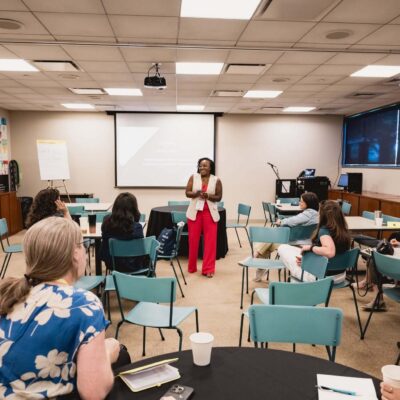
The North Shore Congregation Israel synagogue served as the space for group and individual therapy sessions — participants spent as many as six to seven hours in therapy every day — and community members organized an array of activities to help participants relax and lift their spirits during their evenings. There was a pickleball night and a spa night, as well as classic Chicago outings: an architecture boat tour on the Chicago River, shopping on the Magnificent Mile, a night at the theater. And no Jewish visit to the city would be complete without dinner at the local kosher ribs joint, Milt’s Barbecue for the Perplexed. The tatzpitaniyot and their therapists also spoke at a local synagogue’s Shabbat service and at a communal Shabbat dinner afterwards.

Ten families opened their homes as hosts for the young women, doing their best to strike a balance between surrounding them with warmth and care and giving them space and privacy. Johnny and Cheryl Seder hosted two participants in their Highland Park home, women in their early and mid-20s, whom they declined to name to protect their privacy. It was Johnny who first approached NCSI’s senior rabbi, Wendi Geffen, about hosting a Peace of Mind group after learning about the organization from another local supporter.
He even rallied three friends to join him in helping the synagogue cover the cost of the program. “All the fundraising took less than five minutes,” he said. “When I told them what it was about, they all wanted to help.”
“In the wake of Oct. 7, many in our congregation felt a profound sense of helplessness — grief and concern for Israel combined with the painful question of what, if anything, we could do that would truly matter,” said Geffen. “Hosting the Peace of Mind program offered our community a way to move from paralysis to purpose. It allowed us to live out the Jewish conviction that kol Yisrael arevim zeh bazeh — that we are responsible for one another — by showing up in tangible, human ways for a group of remarkable women who had endured significant trauma.”
Zafrani did reserve duty near the border with Lebanon during Israel’s war against Hamas, which Hezbollah supported from Lebanon, firing missiles into Israel’s north. A couple of weeks after the war broke out, Mitzpeh Adi, the IDF outpost in the Upper Galilee where Zafrani was stationed, was hit.
“I heard a shriek in the sky, and a missile landed next to me. I flew back and ran back to the operations room [chamal] like a cheetah,” Zafrani recalled. The soldiers fled through the forest in the dark to a different base where they set up a tent for their unit and built a new military operations room from scratch. For many of the tatzpitaniot, that night was a traumatic experience, Zafrani said, but they didn’t truly talk about it with one another until they reached Chicago.
“Suddenly — in Chicago — you’re talking about it, and everyone is sharing what they went through, and it was a crazy sense of closure,” Zafrani said.
Zafrani was already in individual therapy before she joined the Peace of Mind program, but she drew a different type of strength from the group therapy. “You learn things about it in the social setting that you have to cope with yourself in front of the mirror of people. I was the last that spoke, and I didn’t want to speak until the last moment, and I felt like I was a sponge.” Zafrani, who said she is used to putting other people first, only felt free to release her own emotions at the end of the overseas program.
Prior to the seminar abroad, Peace of Mind participants take part in a two-day overnight outdoor workshop to discuss personal and team goals and expectations. Six weeks after the weeklong seminar, they participate in a follow-up workshop to reflect on individual and group insights gained through the program. Over the next five months, participants who have requested individual care, as well as those whom therapists have identified as requiring further counseling, undergo individual treatment plans tailored to their specific needs. Nine months after the beginning of the program, a concluding workshop is held, during which participants are assessed once more to determine any needs for further therapy.
Zafrani learned from the experience that “you have to take care of yourself, because if you don’t, you’re brushing it under the carpet; and it made me understand that not everything is OK like I thought.“
The group of tatziptaniyot was one of the first all-female groups to be taken on this program, and Zafrani encourages more. “They [women] didn’t go through less than men … they need the tools,” she said.
“Landing in Chicago was a turning point,” Aloni, the Tatzpitaniyot Association founder, said. “The powerful silence, after years of intensity, was met with endless love from the local Jewish community. Within a truly safe space, they went for seven days between tears of processing and unloading and liberating laughter. Immediate connections were created, without words, between the girls and their host families. For many of them, this was the first time they felt that it was not only them who were watching and protecting everyone — but that someone saw them.”
“This journey was life-changing. Some of the girls closed circles in the face of bereavement and loss, others found the strength to continue therapy processes in Israel, and many received the courage to return to their dreams — to study, travel and live in the fullest sense of the word.”
Ori Sidi, who served as a tatzipanit on the Gaza border during the war, flew to South America after a year of reserve duty, thinking it was the solution to healing from the experiences she had been through. “But obviously it wasn’t,” Sidi, 24, told eJP. The 12-day war between Israel and Iran began soon after she returned home, and she realized, “what a lack of inner peace — even when we don’t necessarily feel it — we experience as citizens of this country.”
Because of this, she feels that it is important that the Peace of Mind program is abroad. “To fly abroad without this existential fear, in your conscious or subconscious — you have this automatic peace of mind that comes,” she said. Combined with the “endless love” that she said the host families heaped on the group, it enabled the women to “really go through the process, in a truer and deeper way.”
For the Seders, expressing that endless love included attempting to shield their guests from the hostility toward Israel in the American press at the time.
“We didn’t have the news on, we purposely didn’t have the paper sitting out, like the front page of The New York Times or something, because it really was almost anti-Israel sometimes, and I think it would have been difficult for them,” said Cheryl. “They probably see it on their cellphones and everything else all the time anyway, but from a U.S. point of view, we didn’t want them to feel like we weren’t behind them 100%.”
Hosts were advised not to bring up the participants’ experiences as soldiers, just to be available to them if they wanted to talk. Still, when Cheryl would pick up her family’s two guests at the end of their long days of therapy, she could tell “they talked through a lot,” she said. “They had a lot of heavy issues they were dealing with.”
“One girl who was with us, she wasn’t even going to come,” Cheryl said. “She was like, ‘I don’t need that.’ Turned out she was one that needed it the most, probably; and she was the first one to admit that at the end of the week, and realized that she was dealing with a lot more than she thought she was. These things that were brought up in these therapy sessions, you know, you just can’t walk out of there all smiley-face, so it was hard sometimes to transition from that to something else. I think that’s why afterwards they had a yoga session or something like that — a little bit of a transition for them before they came back to their families again.”
Prior to the program, Sidi said, she had never grappled in such depth with the impact that her military experiences had on her mental health. “You don’t reach the depths you reach when someone says to you ‘now you need to talk about this.’ Day to day that’s not what you do — even in a heart-to-heart with a friend you don’t reach these depths.”
“Suddenly you’re with 17 girls; everyone went through their own process but all in all it’s very similar to what you went through. So to hear everyone’s story, suddenly you find out through someone else’s story that something you felt you experienced, someone else experienced too — and you deal with things together with professionals, who helped us navigate our emotions and how you can function and tools you can use to ease it.”
“The last day, all of us had a day of closure, sort of, before they all got on the bus to leave to go back to the airport,” said Cheryl. The young women spoke “about how much they appreciated the opportunity and how much it meant to them, and how they didn’t even realize how much they needed it.”
“It was very moving at the end to have that experience with the girls before they left,” she said.
“Programs like Peace of Mind are essential because they transform abstract solidarity into lived relationship,” said Geffen. “They remind us that Jewish peoplehood is not merely ideological or political; it is relational and moral.”
For Johnny Seder, bringing the tatzpitaniyot to Chicago through Peace of Mind was the most meaningful thing he ever did in his life, he said.
As young soldiers, “do you think they know there’s millions of Jews in this country that feel for them every second?” he asked. “That’s the most important thing, I think, that happened. I wanted their parents and everybody to know, these American Jews — their kids are on the line, dying for us — there’s nothing that we won’t do.”
The next mission of tatzpitaniyot will likely take place in the fall. “This journey was just the first shot,” Aloni said. “We are already facing forward, and the next journey is already on the way. Because every Israeli observer deserves to know: We see you.”
Related News

PRESIDENTIAL REBUKE
Israel’s Herzog: Mamdani ‘makes no effort’ to hide disdain for Israel, Jews must fight back

MAGICAL EXPERIENCE
Shefa launches psychedelics retreat for Jewish professionals suffering burnout

EXIT INTERVIEW
Elizabeth Sokolsky, longtime EVP of Birthright Israel, to retire next year
CLOSING WORDS
In AZM address, Cosgrove links communal ‘orthodoxy’ on Israel to rising anti-Zionism among young Jews

MAJOR GIFTS
Center for Jewish History celebrates 25 years with a $25M matching grant