WHAT YOU SHOULD KNOW
The numbers that stand out as we remember 6 million: 109,000, 800,000 and 20
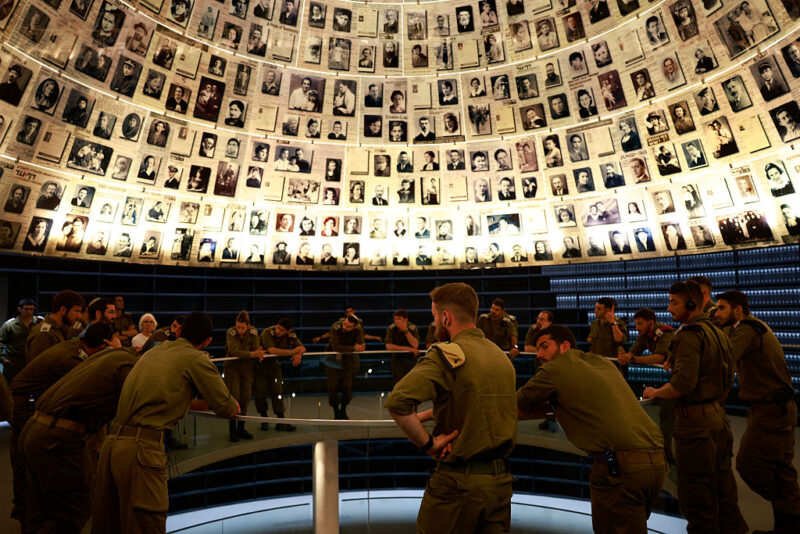
Israeli soldiers tour the Yad Vashem Holocaust Memorial museum in Jerusalem on April 23, 2025, on the eve of the Holocaust Remembrance Day, which commemorates the six million Jews killed in World War II. (Photo by Menahem Kahana / AFP) (Photo by MENAHEM KAHANA/AFP via Getty Images)




 Add EJP on Google
Three numbers stand out as Israel prepares to mark Yom HaShoah: 109,000, 800,000 and 20.
According to the latest figures from Israel’s Holocaust Survivors’ Rights Authority, some 109,000 Holocaust survivors are currently living in Israel, 12,000 fewer than a year ago. This represents slightly more than half of the roughly 190,000 survivors estimated to be alive today.
Of these, roughly a third of them, 33,057, require income supplements from the government — a welfare benefit that is granted to those living in poverty to ensure that they have the income needed for “minimal subsistence” — according to figures from the Welfare Ministry and Israel’s National Insurance Institute.
This year’s Yom HaShoah comes at a particularly trying time for those 109,000 survivors in Israel, after a month and a half of war and bombardment. While this has at least temporarily subsided in light of the ceasefire with Iran, Hezbollah continues to launch rockets and drones at northern Israel, even as efforts are underway to negotiate an armistice of some kind.
In an indication of the persisting uncertainty in Israel ahead of Yom HaShoah, which is traditionally marked in the morning with a two-minute nationwide siren that calls Israelis to a halt, the Israel Defense Forces’ Home Front Command issued a public announcement today that should there be incoming attacks at that time, the constant sound of the memorial siren will be interrupted by the oscillating air-raid siren, instructing Israelis to immediately seek shelter.
Over the course of the war, the Israeli nonprofit Lemaanam (meaning, “for them”), which provides at-home medical care for Holocaust survivors, reported a significant increase in requests for its services as the elderly and people with disabilities in particular struggled to travel in light of the constant risk of aerial attacks.
“We understand the psychological and physical difficulties that Holocaust survivors, who experienced terrible traumas in their childhoods, are feeling now in light of the missile attacks,” Ronit Rozin, the director of the Holocaust Survivors’ Rights Authority, told the labor newspaper Davar yesterday. “We are in constant contact with every one of them, caring for their every need, no matter where they are located.”
Alongside the number of Holocaust survivors alive today in Israel, the country’s Central Bureau of Statistics released the latest estimates for the number of Jews alive around the world, 15.8 million, alongside the pre-Holocaust estimate, 16.6 million. More than 80 years after the end of the Holocaust, the global Jewish population today remains 800,000 lower than it was on the eve of World War II. The CBS data also highlight the current centrality of Israel for the Jewish People, with 45% of Jews living in Israel today, compared to 1945 when 3% of Jews lived in then-Palestine.
This morning, Tel Aviv University’s Center for the Study of Contemporary European Jewry and Irwin Cotler Institute released their annual report on worldwide antisemitism for 2025, finding that Jew hatred has remained elevated — and deadly — in the wake of the Oct. 7 terror attacks. Last year, 20 people were killed in four antisemitic attacks outside of Israel — the largest of these being December’s terror attack at Bondi Beach in Sydney, Australia — representing the deadliest year for non-Israeli Jewry since the 1994 AMIA bombing in Buenos Aires.
The fact that antisemitism remains rampant two-plus years after the Oct. 7 attacks and even after the end of the war in Gaza indicates “that, rather than a backlash to a specific geopolitical crisis, high levels of antisemitism have become a normalized feature in societies with large Jewish minorities,” the report’s authors wrote.
The survey found that in some countries, the number of antisemitic incidents overall fell compared to 2024, while in others — such as Britain, Australia, Italy and Belgium — the number rose. “In some, like France, the overall number of incidents declined, but the number of physical assaults increased,” the authors noted.
Looking forward, the report’s authors warned that antisemitic discourse is becoming increasingly commonplace in the United States, which they said is not only a problem in its own right, but a worrying sign of things to come. Last year, for instance, the annual report highlighted the “dire state of the fight against antisemitism in Australia,” months before the Bondi Beach shooting.
“This was no prophecy, nor a wild guess. Where minor attacks are dismissed, major ones will ultimately follow, in one way or another,” the authors wrote. “Rather than act in hindsight, other countries should learn from the mistakes of Australia and combat antisemitism decisively before tragedy befalls them.”