Jew by Choice
Stacy Rosenthal believed to be first person to convert to lead major Reform group — does it matter?
To some, Rosenthal's installment as president of the Association of Reform Jewish Educators sends a message of inclusion to all Jews; for others, it maintains a distinction between types of Jews
lynnreneephoto[dot]com
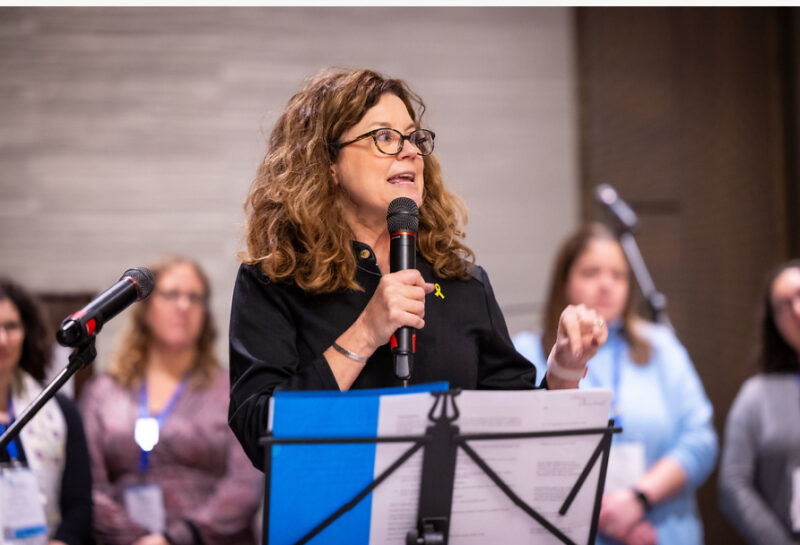
Stacy Rosenthal speaks at January’s conference for the Association of Reform Jewish Educators and Early Childhood Educators of Reform Judaism.




 Add EJP on Google
The speech began in a routine way, other than the first line, which was directed to the audience, but more so to the speaker herself.
“All of you are welcome here,” Stacy Rosenthal began her speech at January’s conference for the Association of Reform Jewish Educators and Early Childhood Educators of Reform Judaism. “As I stand here today, I am humbled and deeply honored to step into the role of president of this extraordinary organization.”
Rosenthal officially took office as president of the Association of Reform Jewish Educators on Sunday, and was about to reveal — for the first time in a public forum — that she had converted to Judaism. She is believed to be the first person to do so to take office as president of a major Reform organization. Some see this as something to celebrate, while others debate if it is news at all.
“When you convert, there’s always concern, ‘Am I good enough as a Jew? Do I know enough?” Rosenthal told eJewishPhilanthropy. “There’s sometimes this sense of, if they know who I am, or that I didn’t learn to read Hebrew until I was 35 years old, will they think less of me? Will they think that I am not capable of holding a role in leadership?”
She, like some others who have converted, prefers the term “Jew by choice” to describe herself. “A convert is someone who is in the process of change,” she explained. “Jew by choice is what happens after conversion.”
Ahead of her speech, Rosenthal decided that in order to cultivate a culture of belonging at the organization, she needed to be vulnerable. So before an audience of peers, she took a deep breath, then told her story: Born Baptist, Rosenthal felt like an outsider at church camp. After choosing Judaism, she still felt like an “imposter” because she never attended Hebrew school or Jewish summer camps. But she spent her nights translating texts and gained confidence and met people who believed in her. Finally, she realized “You will have to work twice as hard, and you too belong here.”
Jews by choice are often put under a microscope by people born Jewish, Rabbi Tarlan Rabizadeh, who is director of American Jewish University’s Miller Introduction to Judaism program, told eJP. “As someone who grew up in a very traditional house, [my family] would always have one eyebrow up at the person who converted to make sure they’re doing things right, which is ridiculous, because [someone born Jewish] probably would mess half of those things up, but they forgive you because you’re Jewish.”
Rosenthal has a long list of service in the Reform Jewish community: She was religious school director at Congregation Beth Israel in Scottsdale, Ariz., for over two decades. She is the director of programs for Gesher Disability Resources and accommodations coordinator for Hebrew Union College – Jewish Institute of Religion, where she received a master’s in religious education in 2013. She has also taught Intro to Judaism classes for the Union for Reform Judaism for the past two years. Prior to becoming president of the Association of Reform Jewish Educators, she served as first vice president for the past two years.
“This is not a story,” Rabizadeh said of Rosenthal’s appointment. “This person is Jewish.”
It goes against Jewish tradition to remind someone that they converted, Rabizadeh added, referencing the Book of Numbers, which says that all Jews, born Jewish or not, all follow the same laws. The Talmud states you are not allowed to ask someone whether they converted. This is a sensitive subject for many Jews, especially ones who may not look stereotypically Jewish, speak with Yiddishisms laced through their sentences or have Ashkenazi last names.
Not only did Rosenthal put in the work to become Jewish, Rabizadeh said, she’s gone above and beyond to become a leader in the community. She pointed out that most people wouldn’t dedicate 80% of their time to working for Jewish causes. “But [Rosenthal] fell in love with it. [She] really fell in love with it,” Rabizadeh said.
The journey to becoming a leader in a professional organization, “tends to be a long ramp-up,” Rabbi Stacy Rigler, executive director of the Association of Reform Jewish Educators, told eJP.
The organization needs to “celebrate all of our firsts so that all of our members see that they can find their place in our organization,” she said, adding that it was Rosenthal’s decision to talk about it. “It’s a celebration of a journey, not a tokenization of an identity.”
One of Rosenthal’s strengths is that she sees people as individuals, Rigler said. She recognizes people’s strengths and what support they need. “Stacy is the first to say, ‘Remember, this person lives in this time zone, or their child has a B-mitzvah next week… It’s not surprising to me that Stacy’s first initiative as first vice president was to call every single member on their birthday, and she did that her entire first year, because she thinks that everybody deserves to be noticed and connected to.”
In her “heart of hearts,” Rosenthal said, pledging herself to the world of Reform Judaism is exactly what she was meant to do. Her passion is a testament to the teachers who inspired her.
“I’m a person who doesn’t watch a movie twice, and yet, I’m drawn to reading the Torah over and over again each year,” she said, wanting to find “what are the sparks that are going to excite [other] lifelong Jewish learners.”
During a period when Jews feel alone and need allies, putting a Jew by choice in a leadership position can cultivate opportunities to reach people the community may not traditionally, Rabizadeh said, bringing a new perspective to outreach and connecting with “our non-Jewish pals in the world.” They can also bring the passion and empathy that helped them fall in love with Judaism to their positions.
The prophet Moses walked in two worlds, said Rabizadeh. “He was the only one who grew up in the palace but also, low-key, knew that he was an Israelite because his mother was his nurse and fed him as a baby… a real leader is someone who speaks both languages, the language of their heritage and the language of… the society.”
Rosenthal also sees herself as “bilingual,” she said. People say to her, “‘Oh, you speak English and Hebrew.’ And it’s like, ‘No, I speak both Jewish and non-Jewish.’”
Although Rosenthal worried people would see her as less Jewish if they knew she wasn’t born Jewish, the discrimination she felt was self-inflicted, she said.
“I try to live a very authentic Jewish life,” she said. “And I surround myself with people who value my contributions. I certainly appreciate that there are lots of different ways to be Jewish, and if my way of being Jewish, of being a Reform Jew, doesn’t jive with their way of being Jewish, OK, all right, we agree on what we agree on.”
There is no way to actually be sure if she is the first Jew by choice in such a high position, Rabbi Rick Jacobs, the president of Union for Reform Judaism, told eJP. “We don’t actually ask people [their] Jewish background, can I see your birth certificate, naming certificate, can you bring witnesses? So on that level, it wasn’t clear to me that anecdotally we would actually know.”
There has been an explosion of conversions post-Oct. 7, Jacobs said, yet the stigma persists. Celebrating Rosenthal “says to the Jewish world, ‘there’s not a two-tiered membership of the Jewish people. [Whether you’re] born Jewish, [or] you choose to be Jewish, you’re Jewish,” Jacobs said.
As much as Rosenthal wonders what took so long for a Jew by choice to reach such a position, she is simply honored.
“The pride that I feel and of wearing the mantle, of leading this organization, in these really challenging and complicated times, I’m not sure that that is any different than someone who was born Jewish,” she said.
The reaction to her January speech has been “fantastic,” Rosenthal said. She watched emotions surge through the audience, and was rushed with an outpouring of support, especially from others who had family members who chose Judaism.
“Now I can be authentically me,” she said.
Related News
ADVANCING A VISION
N.Y. federation donates $1M toward building shared-society center named for peace activist killed on 10/7
HIGHER EDUCATION
As Jewish donors reconsider academia, Jan Koum doubles down, endowing Israel studies at Stanford
CLOSING WORDS
In AZM address, Cosgrove links communal ‘orthodoxy’ on Israel to rising anti-Zionism among young Jews

MAGICAL EXPERIENCE
Shefa launches psychedelics retreat for Jewish professionals suffering burnout

EXCLUSIVE
Detroit-based philanthropists Nancy, James Grosfeld donate $8M to renovate JDC’s Israel campus