LEAN IN
Orthodox social justice group Uri L’Tzedek expands to D.C despite, maybe because of, rising polarization
Armed with $100,000 in grants, group opens advocacy office in the capital, fulfilling a longtime goal of founder Rabbi Shmuly Yanklowitz
Courtesy/Uri L'Tzedek
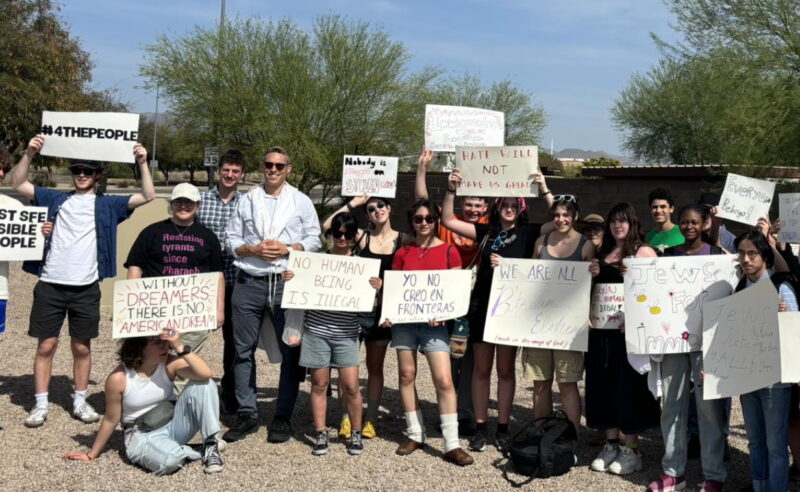
Rabbi Shmuly Yanklowitz (in tallit) and members of his Orthodox social justice group Uri L'Tzedek participate in an immigration demonstration earlier this year.




 Add EJP on Google
The Modern Orthodox organization Uri L’Tzedek, which has brought lessons from the Torah into the social justice ecosystem for nearly 20 years, is expanding into advocacy work in Washington, hoping to “lower the temperature” of the country’s partisan politics.
The group’s presence in the nation’s capital comes at a fraught moment for Jewish and Israeli humanitarian and social justice organizations in the wake of Hamas’ Oct. 7 terror attacks and the wave of antisemitism that has roiled politics and professional sectors. As many non-Jewish social justice groups have become openly antagonistic to Zionism, many Jewish organizations have felt pushed out of the space; and many American Jews have also turned away from the social justice field, focusing inward on Jewish communal issues.
Leaning in despite those tensions, and armed with just over $100,000 in grants, Uri L’Tzedek is looking to build coalitions and carve out a space for Jews within the social justice ecosystem.
“One of the big dreams was to expand nationally. We always knew that we wanted to have a seat at the table in the D.C. coalitions,” said Rabbi Shmuly Yanklowitz, the organization’s founder and president. “Given all of the turmoil of the last year, it became clear that this was the right time.”
The expansion takes the form of hiring an “Advocacy & Leadership Program Coordinator,” bringing the organization — founded in 2007 in New York City — to 10 staff members, according to Yanklowitz.
Two $50,000 grants from different undisclosed donors over the last few months made the expansion possible, Yanklowitz said. But with much of Jewish philanthropy’s funding redirected toward Israel advocacy and combating antisemitism, Uri L’Tzedek has been struggling to secure money in the aftermath of the Israel-Hamas war, he added.
“There’s two ways to combat antisemitism. One is directly, and we need to do that, but the second is to continue to live Jewish values on the global stage when there is hate towards our community. The hate against the Jews wins when all we’re doing is playing defense for our community and we’re not actually living our core values as well,” he said.
The nonprofit’s new role will be aimed at developing partnerships with other social justice organizations, faith communities and Jewish denominations. It will also be focused on pushing for coalitions to extend beyond partisan lines, and to make conversations about social justice less “political” and less “ideological,” according to Yanklowitz.
“In our experience, the groups in D.C. kind of are on one side of the aisle, largely,” he said. “We’re a social justice group, so we have very clear values of where we stand and who we support and who we’re in allyship with. But broader than that, we want to cultivate a space of understanding.”
According to Yanklowitz, since Oct. 7, 2023, Uri L’Tzedek has engaged in a tightrope walk familiar to many Jewish and Israeli organizations in the social justice ecosystem. Yanklowitz has been troubled by situations where Jewish organizations ignore antisemitism within social justice movements and remain involved in coalitions that harbor antisemitism, he said. Over the last two years, the group has distanced itself from organizations and coalitions that engage in antisemitic and anti-Israel rhetoric — and been iced out by others. On the other hand, he added, many Jewish organizations, feeling betrayed, have abandoned social justice causes.
“That makes me think they were never committed to those causes at all,” he told eJP. “We don’t do social justice work primarily for reciprocity. We primarily do it because it’s Torah. It’s Torah to stand up against racial injustice and to stand up against poverty and to stand up against hate and to support the marginalized.”
He also views the expansion as a unique opportunity to harness what he describes as a “burst of interest” from Modern Orthodox youth, disillusioned with the movement’s current leadership and direction.
“A lot of Modern Orthodox communities have been embracing political dogmas that don’t speak to those younger populations and are alienating them,” he said.
Related News
EXCLUSIVE
Detroit-based philanthropists Nancy, James Grosfeld donate $8M to renovate JDC’s Israel campus

MAGICAL EXPERIENCE
Shefa launches psychedelics retreat for Jewish professionals suffering burnout
CLOSING WORDS
In AZM address, Cosgrove links communal ‘orthodoxy’ on Israel to rising anti-Zionism among young Jews
PRESIDENTIAL REBUKE
Israel’s Herzog: Mamdani ‘makes no effort’ to hide disdain for Israel, Jews must fight back

EXIT INTERVIEW
Elizabeth Sokolsky, longtime EVP of Birthright Israel, to retire next year