Opinion
CALL TO ACTION
Diaspora Jews need an effective lobby in Israel




 Add EJP on Google
In Short
Israel’s politics shape Jewish life worldwide. It’s time Jews worldwide shaped Israel’s politics
The surge in global antisemitism over the past three years and the current elections in Israel reveal a painful truth: Israeli politics profoundly shapes how Jews are perceived and treated worldwide, yet the Jewish Diaspora remains largely voiceless in influencing Israeli policy.
A recent Jewish People Policy Institute poll found that 78% of Diaspora Jews follow Israeli elections closely, and majorities want change. Yet with only 8% of Diaspora Jews eligible to vote in Israeli elections — and an even smaller fraction able to travel to Israel to exercise that right — the Diaspora’s influence is negligible.
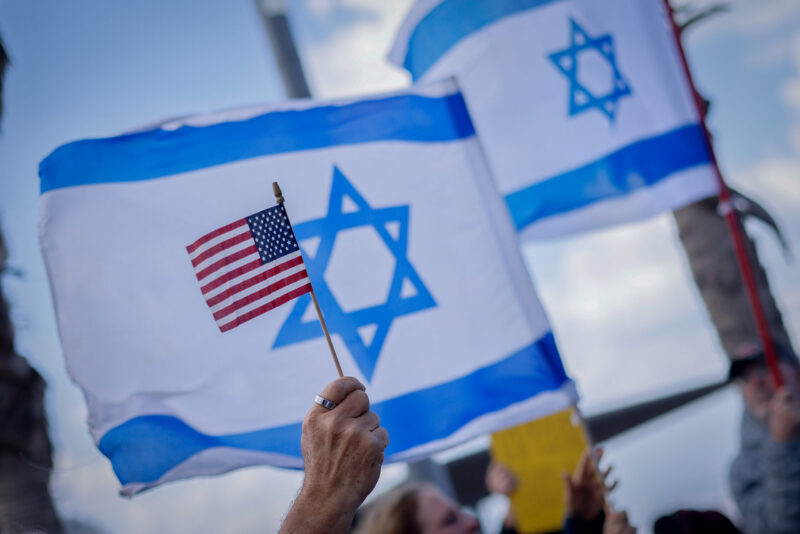
Photo by Erik Marmor/Flash90
Israelis protest against the Israeli government's planned judicial overhaul, outside the U.S. Embassy in Tel Aviv, March 30, 2023.
The exclusion of non-resident Jews from voting in Israeli elections has a clear justification: In a country where political decisions can determine matters of life and death, voting rights should be reserved for those who live under those consequences. However, the absence of Diaspora perspectives from Israel’s political discourse has no justification.
At present, Diaspora engagement with the Israeli government is largely ceremonial. A joint government–Jewish Agency committee convenes sporadically, and a short English-language briefing, often incomprehensible to many ministers, serves as a token gesture. Other channels include Israeli politicians who attend conferences — mostly to speak, not to listen — and educational programs aimed at increasing Israelis’ exposure to Diaspora Jews, the most well-known of which is the University of Haifa’s Ruderman Program for American Jewish Studies, which does admirable work, yet its impact on policy remains limited. Politicians are driven by constituency, money and power groups, not merely by knowledge.
Two additional relevant avenues are the recent Voice of the People initiative and the legacy World Zionist Congress. They hold, at least in name, the potential to do exactly what is needed — and the fact that they do not only amplifies the urgency of the problem.
Voice of the People, an initiative of the president of Israel, was conceived as a deliberative listening platform, but its mandate explicitly confines it to dialogue among Jewish communities, not shaping Israeli politics. The Zionist Congress, in contrast, should have served precisely this purpose, but it lost its way long ago and now functions largely as a mechanism for distributing resources and appointments to the politically connected.
All this leads to one conclusion: None of these mechanisms provides a structured, strategic way for Diaspora Jews to influence Israeli policy. It is time to establish an organization in the style of the American Israel Public Affairs Committee that will be dedicated to representing the diverse interests of Diaspora Jews within Israel’s political institutions.
This won’t be simple, of course. The Jewish People are famously diverse, speaking in many voices and spanning a wide ideological spectrum, so careful thought must go into designing the mechanism for determining the who, what and how of such an entity. In fact, we may conclude that a single organization is not only impossible but perhaps undesirable; maybe we need multiple organizations to ensure that the pluralism of our people is reflected. Alternatively — and perhaps preferably — we could reorient existing organizations to serve this purpose rather than create new ones.
In any case, priority should now be given to spreading the idea and building support for it. I am sure that once we agree on the need, we will overcome the challenge of designing the mechanism. History offers a precedent: The First Zionist Congress of 1897 began with little more than a controversial idea — Jewish peoplehood and statehood — yet ultimately gave rise to the State of Israel itself. A similar leap of imagination is now required.
If foreign governments such as Russia and Qatar can find pathways into Israeli politics, surely the voices of millions of Jews worldwide deserve a seat at the table.
Dan Lahav is a Zionist thinker and former senior Israeli government official now based in the New York City metropolitan area. As deputy director-general of the Prime Minister’s Office, he previously oversaw Prime Minister Benjamin Netanyahu’s Jewish Diaspora portfolio.