WHAT YOU SHOULD KNOW
Oklahoma Jews bristle at being thrust into brewing religion-and-state battle
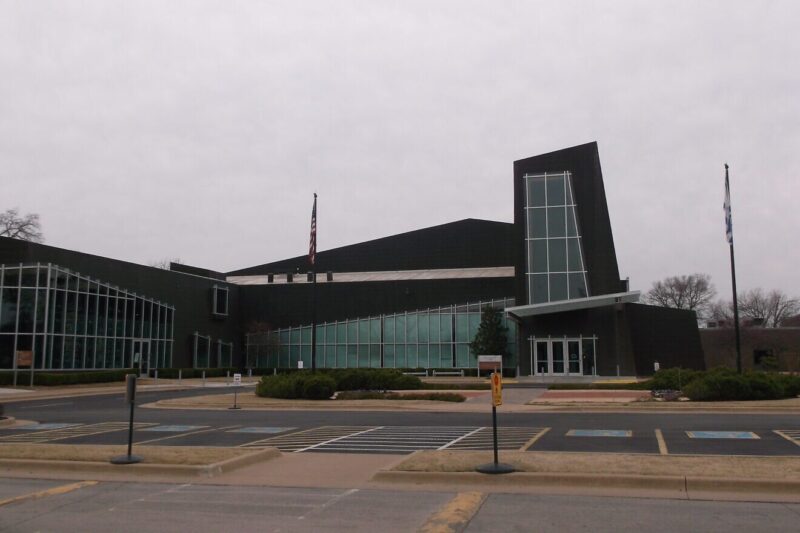
The Sherwin Miller Museum of Jewish Art in Tulsa, Okla. (Kiddo27/Wikimedia/CC BY-SA 4.0)




 Add EJP on Google
There’s a Supreme Court case brewing in Oklahoma, and the heads of the local Jewish community are annoyed to find themselves thrust into the middle of it.
In November, the National Ben Gamla Jewish Charter School Foundation submitted a letter of intent to establish a virtual charter high school in the state, and last week, the organization took its application to the state’s charter school board for approval. For Oklahoma’s relatively small Jewish community — comprising less than 9,000 people, according to the latest estimates, mainly in Tulsa and Oklahoma City — the Ben Gamla application came out of the blue and puts it in the uncomfortable situation of being on the front lines for a likely divisive legal battle on one of the most sensitive topics in American politics: the separation of church (or in this case Jewish day school) and state.
“It came on our radar about a month ago, when it came on everybody’s radar. We found out through the press that they had submitted this application,” Joe Roberts, executive director of the Tulsa Jewish Federation, told eJewishPhilanthropy. (Disclosure: eJP Managing Editor Judah Ari Gross is one of the federation’s Elson Israel Fellows.)
“I have concerns about our community being affected by this. It is going to become a national issue, and this is politicizing a Jewish community that had no input in the process and has no say in the outcome if we’re not consulted. That’s a concern to me,” Roberts said. “Why are they doing it in our name?”
Last week, Roberts, along with a number of other Jewish leaders in Oklahoma, including the executive director of its community day school, issued a statement against the charter school application, specifically on the grounds that it was submitted without a “meaningful consultation” with the local community.
Eric Baxter, an attorney representing Ben Gamla, told eJewishPhilanthropy that the group had spoken with families in the state and that it was acting out of a belief that “families in the Sooner State deserve more high-quality educational options for their children.” He added: “Though it is still early in the process, Ben Gamla has already received interest from multiple families in the state.” A spokesperson for the group also told JTA that it believed the local Jewish community was trying to block competition.
Until now, the Ben Gamla foundation has only operated schools in Florida — where its founder, Peter Deutsch, previously served as a Democratic representative — and while these charter schools taught Hebrew and Israeli and Jewish history, they were officially secular institutions. The charter high school that Ben Gamla seeks to open in Oklahoma is explicitly Jewish, integrating “general academic excellence with Jewish religious learning and ethical development,” according to its application.
In seeking state support for a religious charter school, the Ben Gamla foundation is widely understood to be teeing up a legal battle that is expected to wind its way through the state courts and to the Supreme Court. It is expected to follow the same trajectory as the St. Isidore of Seville Catholic Virtual School, which applied to open in Oklahoma in 2023. The Catholic charter school received approval from the state board before Oklahoma’s attorney general opposed it, eventually bringing the case to the state supreme court, which blocked its approval. The case was appealed to the U.S. Supreme Court, but the justices split 4-4 on the issue last year after Justice Amy Coney Barrett recused herself from the case because of her Catholic faith, leaving the Oklahoma Supreme Court ruling intact and blocking St. Isidore.
If Ben Gamla’s application indeed follows the same path to the Supreme Court, Barrett — a conservative justice — would not have to recuse herself and is likely to rule in favor of its opening, establishing a precedent for state funding for religious charter schools.
While topics like Israel and Zionism more frequently serve as sources of tension and division within the Jewish community, the issue of state funding for Jewish day schools also splits the American Jewish community. For the Orthodox world, which is far more likely to send children to Jewish day schools, the high tuition fees are a major hurdle and a constant source of communal frustration. This is less of a practical issue for non-Orthodox Jews, for whom a clear separation between religion and state is the more pressing matter.
This split is increasingly being brought to the fore following the passage of the so-called “Big Beautiful Bill” last year, which included a potential tax break for Jewish day school tuition fees, provided states opt into it. In November, Jewish Federations of North America Board Chair Gary Torgow highlighted this tax incentive during a speech at the JFNA General Assembly, saying that the organization would be lobbying for states to adopt the tax credit. Torgow called it “a step that can transform Jewish education accessibility nationwide.”
While the Oklahoma Jewish charter school proposal could, in the long term, provide a new way to lower costs of formal Jewish education by opening the door for additional state funding, its direct effects on the small local Jewish community would be minimal to nonexistent, according to Roberts. The initiative also does not appear to have the backing of any Jewish organizations, such as the Orthodox Union’s Teach Coalition, which declined to comment on the case.
For one thing, Oklahoma already has a tax credit, meaning Jews in the state — including Roberts — can receive a reimbursement for Jewish day school tuition. “We already have a tax credit in Oklahoma. It was established by the governor, and it does apply to Jewish day school. So I get a tax credit for my kids to go to Jewish day school,” he said.
Roberts also questioned the Ben Gamla foundation’s claim that an estimated 40 students would enroll in the charter high school when it opened. While the Tulsa Jewish community operates a day school, it runs only through fifth grade and has just a few dozen students. “We don’t see the demand for it. If there were a demand for a high school, we would have a high school,” Roberts said.
While some of the signatories on the Tulsa Jewish community’s statement against the school had specific issues with the proposal related to a state-funded religious charter school, for Roberts, that is a moot point.
“I’m not saying that we want it or don’t want it. I think our position is that this decision should not be made without consulting the local community about its needs and how it will affect it,” he said. “We’re not presupposing any outcome here. We’re just saying that the state charter school board should do their due diligence and then make a decision in good faith.”