SAFETY FIRST
Marking expansion, Community Security Service graduates 10th class of Advanced Academy students
Jewish self-protection organization, which went national with less than a handful of employees six years ago, now has 27 employees and has grown its budget to $6.2 million
courtesy/css
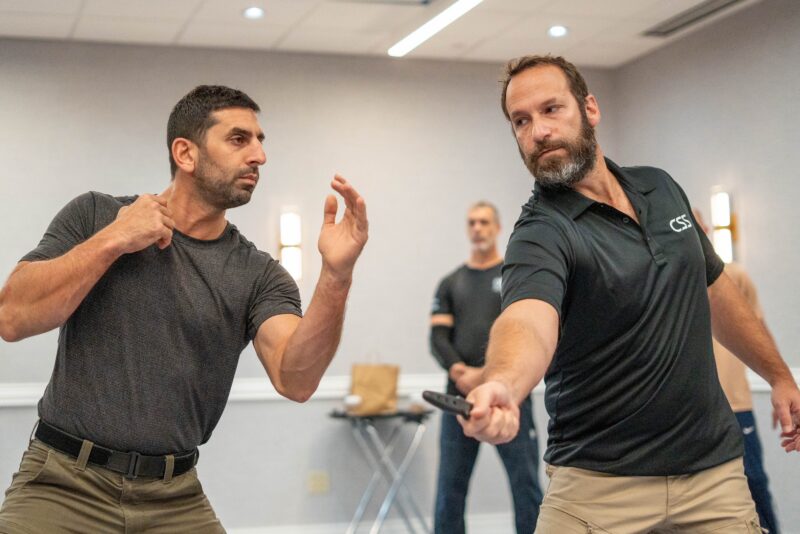
The Community Security Service runs a krav maga class for volunteers.




 Add EJP on Google
When Richard Priem started at Community Security Service as COO in August 2020, the organization had two and a half employees — Priem included — and was headquartered in his basement.
Today, the Jewish self-protection organization has 27 full-time staff. Its budget grew from $4.3 million to $6.2 million in the past year, and on Wednesday, CSS celebrated another milestone: graduating its 10th class of volunteer trainers through its Advanced Academy. The demand for the intensive program has skyrocketed as antisemitism and violent attacks against Jews continue to escalate.
When the nonprofit, which is backed by a number of Jewish federations and family foundations, held its first cohort of Advanced Academy students in February 2025, the plan was to hold quarterly multiday training sessions providing professional-grade training to volunteers who could teach what they learned to their home communities.
“We don’t give people fish, we teach them how to fish,” Priem, now CSS’ CEO, told eJewishPhilanthropy, but more accurately, the organization teaches volunteers to be fishermen who then train their communities to feed themselves.
“Instead of having to hire 150 trainers, we have 150 volunteers who can do the equivalent,” Priem said. “Our goal is to build a long-term, scalable, sustainable solution through our model… by training volunteers to protect their own [communities] and by creating the kind of leadership cadre that we can continue scaling and sustaining ourselves, even if [CSS] staff is not directly available to provide [training].”
Amid a litany of other Jewish groups focused on security and combating antisemitism — the Anti-Defamation League, Secure Communities Network, New York’s Community Security Initiative — CSS stands apart in its focus on volunteer training, as opposed to threat monitoring or coordination with local law enforcement.
Since the Advanced Academy opened, there has been a terror shooting in Washington that killed two Israeli Embassy staffers, a deadly firebombing in Boulder, Colo., a Yom Kippur car ramming and stabbing attack outside a synagogue in northern England and the massacre at Bondi Beach in Australia — just a few of the attacks on Diaspora Jewish communities over the past year. According to a March report from Tel Aviv University, 2025 was the deadliest year for Jews in three decades.
Because of demand, the Advanced Academy trainings are now held monthly. On Wednesday — the day two Jewish men were stabbed in an antisemitic attack in North London — the academy celebrated its 150th certified graduate.
“We will never be able to have enough paid guards,” Priem, who served as an IDF paratrooper and worked for the U.N. Security Council’s Counter-Terrorism Executive Directorate and the Anti-Defamation League, said. He also served at a Jewish self-protection agency in his native Netherlands.
“We will never be able to invest enough in cameras to protect every community, always, all the time,” Priem said. The only solution, he stressed, is self-defense.
Every training at the academy is based around specific topics and runs for two to four days. For instance, one month may center on securing events and the next will focus on securing synagogues. Courses are led by security professionals trained in American and Israeli security services. Curriculum includes working with law enforcement, security planning and recruiting and retaining volunteers. For the more physical training, including instruction in the Israeli martial art of krav maga, attendees need to be cleared by a physician.
The Advanced Academy runs out of a facility in Westchester County, N.Y., but the academy also utilizes nearby facilities, including synagogues and a government law enforcement training facility. Participants react to terror attack recreations, thinking through how to handle similar attacks. “We try to get people out of their comfort zone,” Priem said. “We try to build the muscle memory.”
Participants also learn to look for warning signs. “Attacks don’t just happen,” Priem said. “They require planning. They require attack preparations.” For instance, in the March shooting and vehicle ramming at a Reform synagogue in West Bloomfield, Mich., the terrorist sat in the parking lot for over two hours before attacking.
Graduates of the academy come from over 20 states. While many live on the East Coast, where CSS was launched in 2007 by members of a New York City synagogue, others traveled from Seattle, San Francisco, Los Angeles, Houston, Chicago and Miami. Participants included men and women across denominations and professions: surgeons, attorneys, college students, military veterans, first responders, teachers, parking lot attendants and retirees — ranging in age from 20 to 67.
The training is free for volunteers, and so is travel. “These are people who are dedicating their own time or they take PTO from their job to come to our academy to get trained,” Priem said. Anyone who is willing to put themselves in harm’s way to protect their friends, family and community, the CSS wants to support. But with the training comes expectations of graduates: “There’s a moral contract,” Priem said, that they will stand shift and train others in the years to come.
None of the graduates grew up dreaming of being security guards, Priem said. “These are people who are tired of reading every week that antisemitism is rising. Attacks are happening… They want to feel that I am doing something tangibly to keep my community safe.”
And they are, Priem said, pointing to a recent success story of a CSS Advanced Academy graduate who helped the FBI catch a man who sent threatening antisemitic letters and postcards to over 25 Jewish institutions.
Alongside the Advanced Academy, CSS, which is funded by UJA-Federation of New York, The Kirsh Foundation, Paul E. Singer Foundation, Rowan Family Foundation, Marcus Foundation and others, held over 700 shorter trainings last year, training 20,000 CSS community members with 7,000 standing shifts, protecting 440 synagogues and 100 Jewish events, serving 300,000 guard hours. The amount of money CSS-trained volunteers save their communities is astronomical, Priem said. As much as he wants antisemitism to disappear, it isn’t going anywhere, he said, and CSS plans to increase the number of Advanced Academy trainings, holding them multiple times per month over the summer.
“If we need to do this every week,” Priem said, “I will do everything I can, and we will do everything we can.”
Related News
PRESIDENTIAL REBUKE
Israel’s Herzog: Mamdani ‘makes no effort’ to hide disdain for Israel, Jews must fight back
HIGHER EDUCATION
As Jewish donors reconsider academia, Jan Koum doubles down, endowing Israel studies at Stanford

MAGICAL EXPERIENCE
Shefa launches psychedelics retreat for Jewish professionals suffering burnout
CLOSING WORDS
In AZM address, Cosgrove links communal ‘orthodoxy’ on Israel to rising anti-Zionism among young Jews

EXCLUSIVE
Detroit-based philanthropists Nancy, James Grosfeld donate $8M to renovate JDC’s Israel campus