Opinion
JEWISH VALUES
Holiness, the land and the resilience of the nation




 Add EJP on Google
In Short
The Torah portions Acharei Mot and Kedoshim ask us not merely to be good people, but to build a holy society — and they tell us, in language that is easy to miss but impossible to unsee once one has seen it, what happens when we do not.
Some years ago, during a period of great personal difficulty, I sat with an old mining engineer at the company I had built, Xstrata. He had spent 40 years underground, and we had just lost men in a catastrophic roof failure in South Africa. They had trusted me that their health and safety were my paramount concern, and we had failed them. I was looking for answers, and this man gave them to me.
“The rock looked strong,” he said. “It always looks strong. The day before a collapse, it looks exactly as it did a year before. But when the pressures change, and the structure has not been maintained because we did not pick up the signals of pending failure, brittle rock fails suddenly. It does not warn you. It just goes.”
Mila Aviv/Flash90
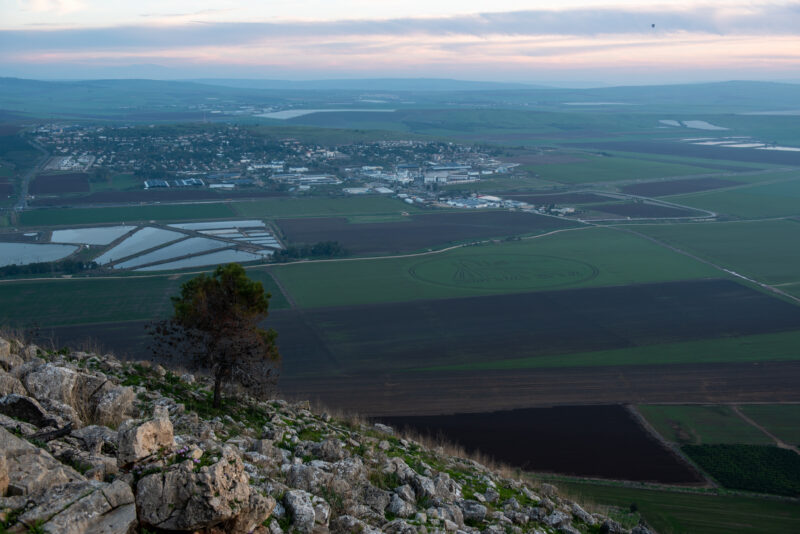
General view of Katef Shaul on Mount Gilboa in northern Israel on Jan. 7, 2022.
I have thought about that statement many times since — in business, in politics and in Jewish life. The risk is not that strong things decay slowly, but that they decay invisibly. And then one day, without warning, they go.
I begin with that memory because I believe it stands close to the heart of last week’s double parsha, Acharei Mot and Kedoshim.
In the middle of an extended discourse on what it means to be a holy people, the Torah says something that ought to arrest any serious reader. It says that if we get this wrong, the Land itself will vomit us out. (Vayikra 18:28); and a few verses later, it warns: “and the Land will be filled with depravity” (19:29).
The Torah could have said simply that these acts debase the people who commit them and violate the image of God in which every human being is made. But the Torah goes further. It says the Land will be filled with depravity. It says the Land will vomit us out.
I come to this text, I should say, as a student — not a teacher and certainly not a scholar — as a South African Jew of a certain vintage, more at home in the boardroom than the beit midrash, with the temerity to think that 40 years in the company of engineers and markets may yet have something to add to a verse in Leviticus.
This dvar Torah asks three questions: What does the Torah mean by “the Land”? What does it mean for God to be holy and for us to be commanded to be holy because He is? What is the parsha telling us, Jews of the 21st century, about the conditions under which a nation endures?
A nation is not a map. It is not a certificate issued by the United Nations, nor even an army mustered to defend a border. A nation is a living thing, constituted of three cores that cannot sensibly be separated from one another.
There is a physical core: a territory in which a people can plant a tree, build a house, bury their dead and bequeath an inheritance to their children. There is a social and institutional core: laws, courts, markets, schools and the habits of trust that allow strangers to cooperate. And there is a moral and values core: the stories a people tells about itself, the duties it recognizes and the things it considers sacred.
Throughout history, the architects of conquest have understood that the surest way to destroy a nation is to attack its physical core.
The Jewish people are the glaring exception — a fact so extraordinary that it is easy to take for granted. We were expelled from our Land, not once but twice. By every known rule of history, we ought to have ceased to be. Yet it did not happen to us. We endured because when the physical core of our nationhood was stripped from us, the other two cores held.
And because we did so — and because, after 2,000 years, we returned — it is possible for us to make the moral argument that the State of Israel’s Declaration of Independence makes. That document does not rest its claim of self-determination on military victory or great-power diplomacy. Its central claim is moral. It asserts that the Jewish People has a right to a sovereign home because of what the Jewish People intends to do in that home: to build a state that will ensure “complete equality of social and political rights to all its inhabitants”; to guarantee “freedom of religion, conscience, language, education and culture”; and to safeguard the holy places of all religions. The founders understood that self-determination on this Land could only be sustained by the kind of society we built upon it. The physical core would be held by the moral core, or not at all.
The Land of Israel as a living thing
With this understanding of what a nation is, we can return to the strange language of our parsha. The Torah is telling us — in the compressed poetic idiom of the ancient world — what we have just been trying to say in the discursive prose of the modern one. The Land is not inert geography. It is the living body politic of the people who inhabit it.
The Land is not holy because of its dirt. It is holy because of what a people does upon it. And it can be unholy, equally, because of what a people does upon it.
Rav Kook writes to the same effect in Orot Eretz Yisrael when he refuses to regard the Land as “merely a tool” and insists that it is “part of the very essence of our nationhood.” Land, people and spirit form one organic system, and each part conditions the health of the others.
At this point, I usually turn to the Ramban, who observes that the Torah speaks of the Land “vomiting out” its inhabitants only of Eretz Yisrael. His reading is grounded in the deepest conviction of Jewish tradition — that the Land of Israel is sacred by divine gift, and that her relationship with her inhabitants is a covenantal relationship unlike any other in the world.
I do not presume to set the Ramban’s reading aside. I wish only to suggest that alongside it, a complementary reading is available to the modern ear. Medieval commentator Abraham Ibn Ezra reads the verse in a more naturalistic register — the corruption of a society is itself what drives a people from its land — and something of that instinct, I think, is available to us. The question is where the exceptionalism resides. The Ramban locates it in the soil. I would respectfully venture that it may also be located in the people.
So when the Torah warns that the Land will vomit us out if we defile it, I do not read the warning as a description of a supernatural soil reaction. I read it as the Torah’s compressed way of saying what history has since repeatedly confirmed: a civilization whose moral and social core has rotted cannot, in the long run, hold its physical core.
What is holiness, and why does it matter?
If the Land is the body of a people’s covenant, the next question is what kind of covenant it carries. What does it actually mean that we must be holy because God is holy?
It is tempting to answer that holiness is a matter of constraint — restraint from forbidden food, forbidden relationships, forbidden speech. That answer is not wrong, and the parsha is full of such restraints. But it is not enough. When the Torah says “be holy for I am holy,” it cannot mean that God Himself is holy because He constrains Himself from certain forbidden foods. The Torah opens not with a description of God’s constraints but with a description of God’s activity. And that activity is creation.
Throughout the whole of the first chapter, God imposes order upon the chaos. And on the seventh day, He rests, and sanctifies the day of rest — the first thing in the Torah that is explicitly called holy.
God’s holiness, so far as we can glimpse it, is the creative, ordering, life-giving power that turns chaos into cosmos, that brings forth beings who can love and be loved. If that is what holiness is in God, then holiness in us must be the disciplined imitation of the same creative and ordering movement.
The constraints of the parsha are indispensable precisely because they are the scaffolding of this creative task. They are the disciplined limits without which the building power we have been given turns destructive. A sexuality untethered from the laws of arayot does not build family; it destroys it. An economy untethered from the laws of honest weights and timely wages does not build shared prosperity; it destroys it. A judicial system untethered from the laws of impartial judgment does not build social trust; it destroys it. A public life untethered from the command to love the stranger does not build a civilization; it destroys one.
The mirror of the parsha, today
We come now to the hardest part of the exercise. What does this mean for us — for Israel and for the Diaspora?
Israel, first. It is necessary to say at once that Israel is a miracle, and that I regard the fact of its existence as the single most important Jewish event since the destruction of the Second Temple. Everything that follows should be read against that fixed point. The debt we owe to the generation that built Israel is beyond our capacity to repay. But precisely because the achievement is so great, the question of what we do with it is so serious.
A physical core has been returned to us. Kedoshim‘s question is whether the moral and social cores that must sustain it are being built with the same vigor as the state itself. They are not, and any honest reader of the Israeli public square knows it.
Nearly 3 in 10 Israeli children now live below the poverty line — a figure that places Israel among the worst-performing developed countries in the world. An Arab citizen of Israel is, according to recent reporting, more than 17 times more likely to be murdered than a Jewish citizen — in a state founded on the promise of equal rights. The burdens of national service are distributed with an unfairness that has become a structural threat to the cohesion of the society. The courts and the democratic institutions have been subjected to sustained assault from parts of the governing coalition. The pursuit of secure peace with our neighbors has been treated in some quarters as naivety at best and treason at worst, when in truth it is the oldest demand of our prophets. And the most extreme voices — racist, messianic, anti-democratic — have been moved from the margins of Israeli public life to the very center of its government.
But the Diaspora must not imagine for a moment that the mirror is held up only to Israel. We are also on trial. Our particular temptation, in a world of rising antisemitism, is to seek shelter under banners that do not deserve our allegiance. On one side are those among us who have made our peace with right-wing populists and outright racists because such figures claim, for the moment, to be friends of Israel. They are not. They are friends, at most, of a narrow caricature of Israel that serves their own domestic purposes, and they would discard the Jews of their own countries in an instant if the political weather changed.
On the other side are those among us who have drifted towards the far left because it speaks the universalist language of justice to which, as Jews, we are properly and deeply committed. But the particular left ascendant in many Western cultural institutions has increasingly married those universal values to a specifically anti-Zionist — and often openly antisemitic — worldview in which the Jewish state alone is to be dismantled and the Jewish People alone is to be denied the right of self-determination that every other people is granted.
The banner under which we march matters. The book of Bamidbar tells us that the company we keep shapes the people we become.
I want to end on that one word: ve-erpa. And I will heal.
That is the vocabulary of medicine, not jurisprudence. It implies a wound that is reversible rather than a sentence that has been passed. The Torah, in the very moment of its severest warning, has quietly signaled to the reader that no moral decay of a civilization, however advanced, is beyond the reach of repair. The Land is a living body. And living bodies can be healed.
That changes what the parsha is asking of us. It is not asking us to avoid a disaster. It is asking us to honor a healing that has already begun. The return from 2,000 years of exile is not the end of the Torah’s story of the Land. It is the precondition for the next chapter. And the question Parshat Kedoshim puts to us is whether we will use the chapter we have been given to build the society the Declaration of Independence promised — or whether we will, through indifference or factional zeal, squander the miracle that has been placed in our hands.
The mining engineer who taught me about brittle rock told me one other thing that night, and I have kept it for the end. He said: “The signals are always there. The question is whether anyone is listening for them.”