WHAT YOU SHOULD KNOW
Let the Games begin! Maccabiah prepares to kick off after last year’s cancellation
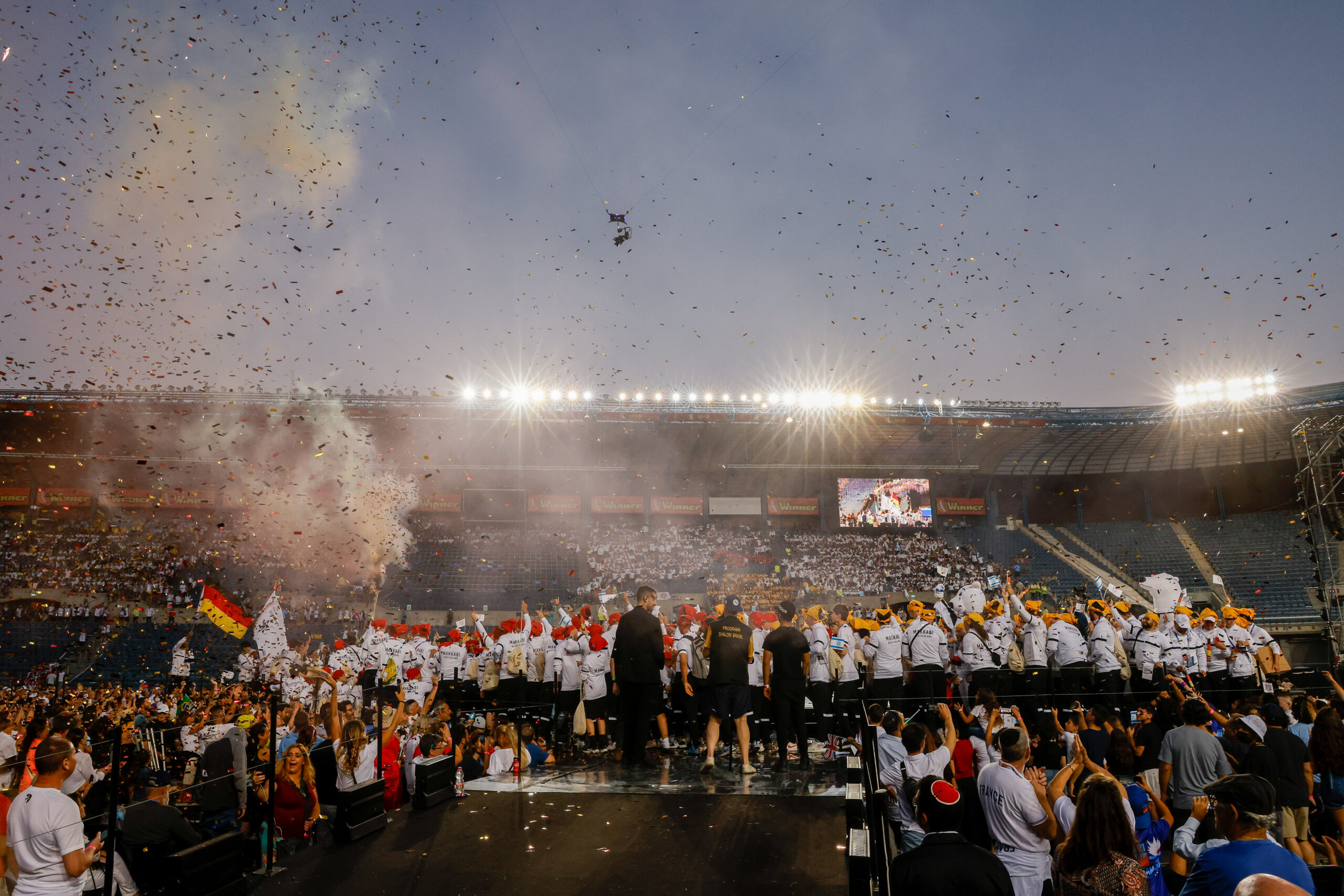
Olivier Fitoussi/Flash90
The opening ceremony of the Maccabiah Games in Jerusalem on July 14, 2022.




 Add EJP on Google
Let the Games begin — finally. Thousands of Jewish athletes from around the world, joined by thousands more screaming fans, will gather together in Jerusalem’s Teddy Stadium tonight to kick off this year’s improbable 22nd Maccabiah Games — a normally quadrennial event that was canceled last year due to war with Iran and nearly suffered the same fate this year for the same reason.
Coming after nearly three years of war in Israel and rising antisemitism globally, the Games, which run through July 10, offer an increasingly rare opportunity for, well, fun and Games, even as the weight of the current period will still be felt, with some events dedicated to athletes who were killed in the Oct. 7 terror attacks.
“We decided to postpone the games last year because of the situation with Iran, and today we are finally celebrating the opening ceremony,” Maccabiah CEO Roy Hessing told eJewishPhilanthropy. “It was the most difficult preparation period for an international event in Israel — flights weren’t coming in, there were travel warnings from different countries. But finally, we are here, and I truly believe we made the right decision.”
Under the banner of “More Than Ever,” the Maccabiah Games will be slightly more modest this year, with fewer participants, events and locations than the previous games, while still offering ample opportunities for visiting athletes and locals to compete, interact and revel in sporty Jewish Peoplehood. There are no equestrian events or squash, but, for the first time, there will be pickleball (this was only offered as an “exhibition sport” at the 2022 games).
Tonight’s Maccabiah 2026 opening ceremony — always a rowdy, grand affair — will feature a 70-meter stage, two massive LED screens, hundreds of dancers, pyrotechnics, the ceremonial lighting of the Maccabiah torch and a parade of thousands of athletes representing dozens of countries. Israeli President Isaac Herzog, Prime Minister Benjamin Netanyahu, Culture and Sport Minister Miki Zohar and Jerusalem Mayor Moshe Lion are all slated to attend tonight’s festivities, which were directed by Eldar Gohar Grossman and produced by Electra Target.
The performance lineup reads like a reunion of Israeli musicians alongside voices that shaped the global Jewish collective memory and spirit of resilience over the past three years. Hosts Assi Azar and Anna Aronov will open the evening, introducing a new musical arrangement from Oct. 7 survivor and Eurovision star Yuval Raphael. Netta Barzilai, Israel’s most recent Eurovision winner, will share a stage with Anna Zak for a rare joint performance. Idan Raichel will take the mic alongside two survivors of Hamas captivity, Daniella Gilboa and Edan Alexander. Closing the night, Itay Levy will lead a full-scale finale with a choir and hundreds of dancers behind him. Social media influencer Montana Tucker is scheduled to round out the bill with the debut of an original song.
For Hessing, the Games carry a message beyond sport. “We have to show the world that we are one — not only Israelis, but Jewish communities everywhere,” he said. “We have one nation, we have one Israel, and we have to show that to Israelis, to Jewish communities, and to our neighbors: we are here to stay.”
Roughly 5,000 athletes will compete over the coming weeks — 3,000 arriving from abroad and 2,000 from Israel — across more than 30 sports from traditional Olympic events like swimming, judo and weightlifting to newer additions such as pickleball, padel and 3×3 basketball. But Hessing said the true number of people the Maccabiah is bringing to Israel this summer is closer to 10,000 tourists, once Jewish community members and athletes’ family members who joined their delegations are counted.
Of the 3,000 athletes arriving from abroad, 900 will be coming from the U.S., Marshall Einhorn, CEO of Maccabi USA, told eJP earlier this week. For Einhorn, the delegation’s presence carries its own message. “We will keep showing up with our families, our flags, and our love of our homeland, no matter what,” he said.
“Our delegation represents the strength, diversity, and spirit of American Jewish life,” Einhorn added.”The friendships, memories, and experiences they will take home will last far beyond the games themselves.
This is the essence of Judaism,” he continued — “resilience, commitment to our community, and love of Israel.”
Pulling off an event at this scale, spread across cities from the center of the country to the north and south, is no small feat. “It’s a complicated event to arrange — logistically. It’s a miracle every four years,” Hessing said. “We’ve been working on it for years, and this time we even had an extra year to prepare. We’re ready.”
Making that readiness possible is a budget borne mostly by the athletes themselves as Maccabiah 2026 is funded primarily through athlete registration fees, which cover more than half the budget, with Israeli government support through the Ministry of Culture and Sport contributing roughly 25%; the remainder comes from philanthropic and corporate support from Keren Kayemeth LeIsrael-Jewish National Fund (KKL-JNF), the Azrieli Foundation, the Jewish Agency for Israel, the Olympic and Paralympic Committee, the World Zionist Organization, the IDF Disabled Veterans Organization as well as a roster of Israeli companies including Bank Leumi, EL AL, Eldan, Neviot, Toto, Mifal HaPais, Expo Tel Aviv, Colgate and Reebok.
The Games also arrive as a lift for Israel’s tourism sector, battered by repeated rounds of conflict and cancellations. “We’re happy to give the tourism industry an opportunity to work again after such a difficult time,” Hessing said.
Beyond the opening ceremony, the Maccabiah’s two-week run spans dozens of events across the country. Competitions include a multistage triathlon series held in locations from Emek HaMaayanot to Jerusalem, an open water swim in the Nahal Ha’Asi in memory of Eden Nimri — a Maccabi swimmer and IDF officer who was killed in the Oct. 7 attacks while saving fellow soldiers — and a “Day of Hope” at HaBsor National Park, held in partnership with KKL-JNF to support communities in southern Israel.
While there is a Kfar Maccabiah, or Maccabiah Village, which hosts the Iris Smith World Jewish Sports Museum, unlike the Olympics, the Maccabiah Games has no single host village housing its athletes. Instead, they will be spread throughout multiple locations — a fact Hessing offered as the clearest way to picture just how large the undertaking really is.
“We don’t have an Olympic Village,” he said. “The entire country becomes our Olympic Village.”