EXCLUSIVE
Jews connected to Chabad are ‘surging’ more than in other denominations, JFNA survey finds
Poll does not show why the Hasidic movement has seen more engagement, but JFNA’s chief impact and growth officer says there are lessons other groups can learn
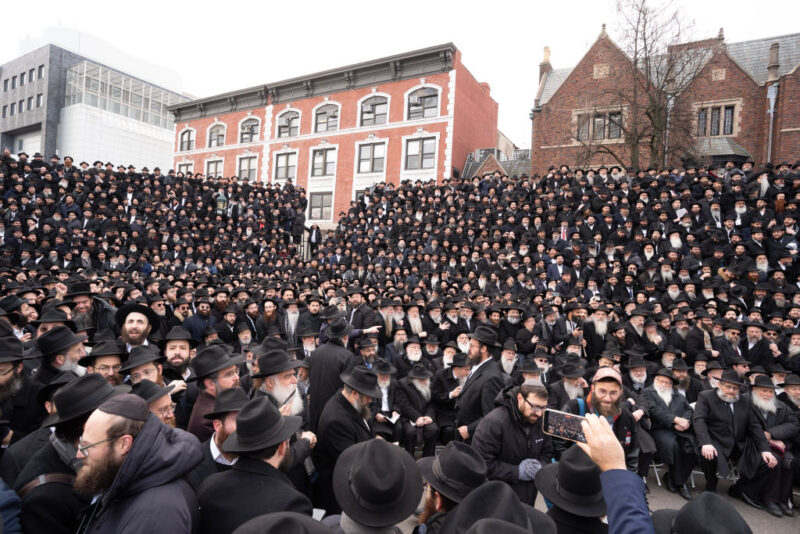
Photo by Lev Radin/Pacific Press/LightRocket via Getty Images
Thousands of Chabad rabbis gather for the Annual International Conference Shluchim of Chabad-Lubavitch Emissaries in front of Chabad headquarters in Brooklyn on Dec. 1, 2024.




 Add EJP on Google
As American Jewry overall has experienced an increase in Jewish engagement in the wake of the Oct. 7 terror attacks, in what has been deemed “The Surge,” the largest rise has been seen among those connected to the Chabad-Lubavitch movement, outpacing all other denominations and among unaffiliated Jews, according to survey data from Jewish Federations of North America that were provided exclusively to eJewishPhilanthropy.
According to the findings, which come from data collected by JFNA earlier this year, among the Jews affiliated with Chabad, 44% reported deeper involvement in Jewish life since Oct. 7. This can refer to both someone who was already engaged Jewishly but became more so or someone who was previously uninvolved who has started taking part in Jewish activities. This places the Hasidic movement above Orthodox Judaism (42%), Conservative Judaism (36%), Reform Judaism (33%) and those of “no particular denomination” (24%). The survey polled 1,877 self-identifying Jews who were recruited via text message from March 5-25.
There is, however, an overlap between these groups, as most of those who reported participating in Chabad activities also identified with another denomination. According to the poll, some 30% of the respondents said that they took part in Chabad activities in a typical year. Of these, 39% identified as Reform, 20% as Conservative, 21% as Orthodox, 4% as something else and 15% as no particular denomination.
In the months following the Hamas attacks and the resulting rise in antisemitism around the world, JFNA first identified “The Surge” in Jewish engagement, finding that 42% of survey respondents reported becoming more involved in Jewish life. Earlier this year, the organization conducted a follow-up study indicating that “The Surge” was continuing albeit at a slightly slower pace, with 31% of respondents now reporting increased engagement.
In general, the survey indicated that the two groups who have been “stickiest” — maintaining their increased levels of engagement — are people who were already “very engaged” and became more so post-Oct. 7 and people who were “not at all engaged” and started becoming involved in Jewish life post-Oct. 7. Collectively, these groups represent 50% of respondents, with 14% identifying as “very engaged” and 36% as “not at all.”
Since presenting those findings in April, JFNA has continued breaking down the data to identify additional trends that may inform the policies and initiatives of Jewish organizations in the U.S.
The survey data does not indicate why Chabad saw the greatest increase in engagement, though Mimi Kravetz, the chief impact and growth officer at JFNA, said there are indications of what may be driving the growth, principally Chabad’s many locations and the unintimidating atmosphere that Chabad leaders have cultivated. Kravetz said that these findings, particularly the latter, should be taken into consideration by other organizations.
“We often see in our local research that when we ask people why they’re not engaging, they say, ‘There’s nothing near me.’ So it’s accurate to say that one of the reasons that Chabad might see higher engagement is that they’re more likely to be local because they just are in lots of communities, including small communities. So that’s definitely part of it,” Kravetz told eJP. “There’s other quotes that we saw in our interviews that also indicate that often… people feel very comfortable and very welcome [at a Chabad house], in a moment when they’re looking for something. And there’s not that financial barrier to entry that synagogues sometimes [have, since people] think of them as membership organizations. So that’s something for our institutions to consider and think about.”
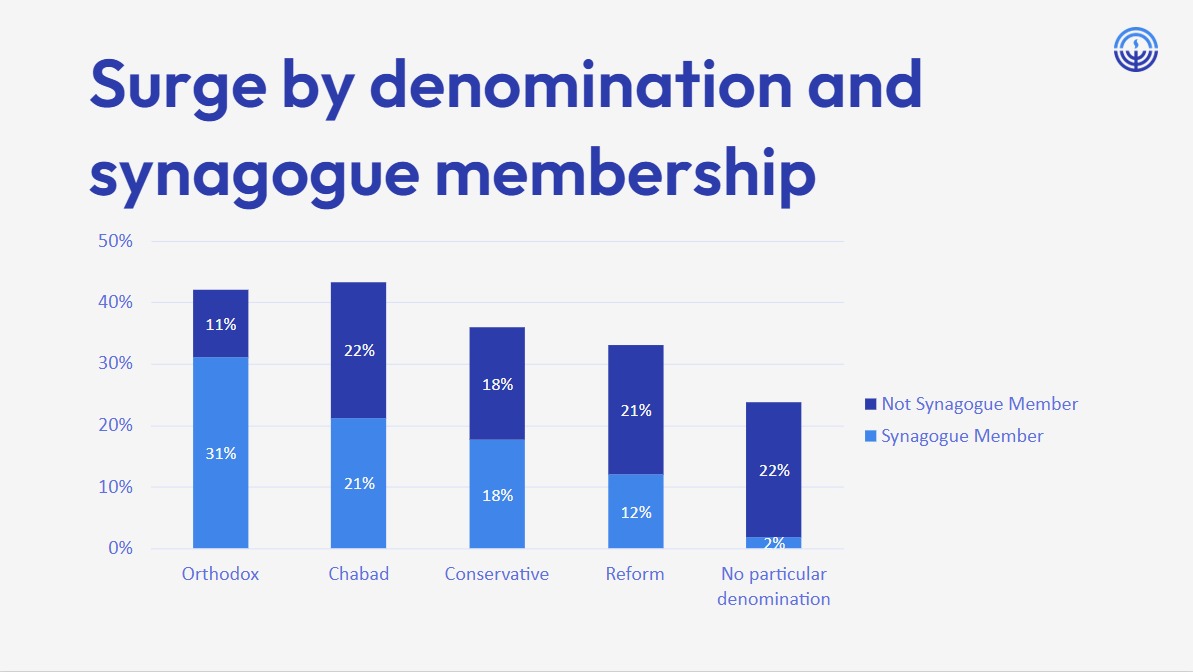
The survey found that, regardless of denomination, the overwhelming majority of increasingly involved Jews have had enjoyable experiences during those new activities, with positive responses being reported by between 83% and 93% of respondents. Negative experiences were rare, below 5% across the board. According to Kravetz, most of the negative or “anxious” experiences appeared to have more to do with the people reporting them than with the movements they were interacting with. For instance, people who are financially vulnerable, people with disabilities, LGBTQ respondents were more likely to report less positive experiences regardless of the denomination — an apparent indication that the Jewish community overall needs to improve welcoming such groups, but not an issue only for specific movements.
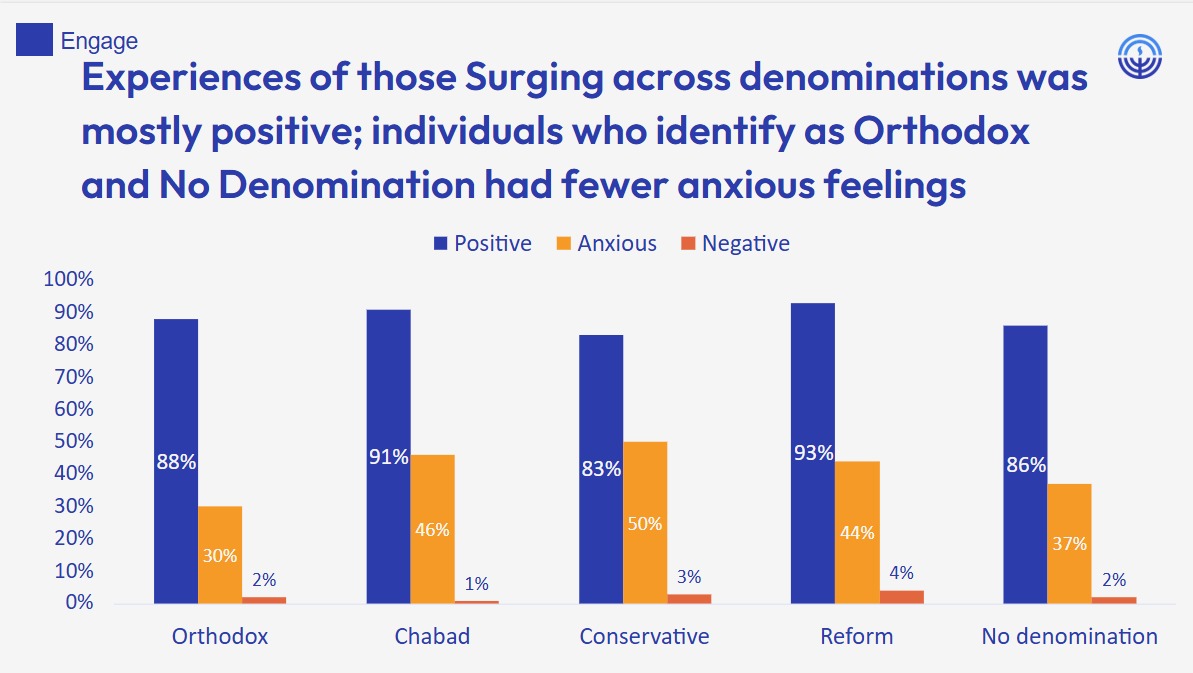
The denominational findings are broken down further by synagogue membership. For instance, the pollsters found that roughly three-quarters of the Orthodox respondents who reported increased engagement were already members of synagogues — an indication that they were part of the group of “very engaged” people who became even more engaged post-Oct. 7. Perhaps unsurprisingly, among respondents “of no particular denomination,” more than 90% were not members of synagogues. Among Chabad-affiliated and Conservative respondents, the breakdown was 50-50, and among Reform respondents, roughly two-thirds of those who said they were more engaged were not synagogue members.
According to Kravetz, there is a correlation between synagogue membership and Jewish engagement — synagogue members are more likely to be active in Jewish life — but it is imperfect. “Sometimes somebody will tell you that they are very engaged… [but] they do not have a formal synagogue membership or affiliation. So it’s not a proxy,” she said.
While the pollsters looked at the denominational breakdowns, they also found that much of the increased engagement among less-involved people is not necessarily happening at synagogues, Kravetz said.
“A lot of their engagement is in less formal ways, in social groups, on social media or other communal access points. For example, we saw that… oftentimes it was a local JCC, which doesn’t require any religious affiliation or denomination, and is a place where people might be most willing to show up if they don’t feel affiliated with any particular religious community or movement,” she said. “And so for federations, that’s really important because it means both that we want to be supporting some of these other ways people are engaging, reaching them on social media, reaching them in their WhatsApp groups… supporting JCCs and other institutions that are less affiliated, in addition to, of course, continuing to partner with synagogues, which are a core area for those who are already at all engaged.”
Related News

MAGICAL EXPERIENCE
Shefa launches psychedelics retreat for Jewish professionals suffering burnout
ADVANCING A VISION
N.Y. federation donates $1M toward building shared-society center named for peace activist killed on 10/7
EXCLUSIVE
Detroit-based philanthropists Nancy, James Grosfeld donate $8M to renovate JDC’s Israel campus
CLOSING WORDS
In AZM address, Cosgrove links communal ‘orthodoxy’ on Israel to rising anti-Zionism among young Jews
HIGHER EDUCATION
As Jewish donors reconsider academia, Jan Koum doubles down, endowing Israel studies at Stanford