Opinion
LUNTZ’S LESSON REVISITED
JFNA gets it right on ‘Zionism’: Words matter




 Add EJP on Google
A new Jewish Federations of North America survey delivers an uncomfortable truth communications experts have known for decades: most American Jews do not identify as Zionists, even when they support Israel. This is not a collapse of commitment to Israel. It is a collapse of language.
Communications strategist Frank Luntz saw this problem years ago, long before today’s campus upheavals and social media wars. In his work for The Israel Project (where I worked on enhancing
Israel’s image internationally), including his 2003 report “Israel in the Age of Eminem,” Luntz explicitly and repeatedly warned pro-Israel advocates not to use the word “Zionism” on college campuses. His reasoning was blunt and strategic. Whatever the word once meant to Jews, it no longer meant that to the audiences’ advocates were trying to persuade. On campus even then, “Zionist” functioned as a negative identity marker, not a neutral description. Once a word triggers hostility, Luntz argued, you have already lost the argument.
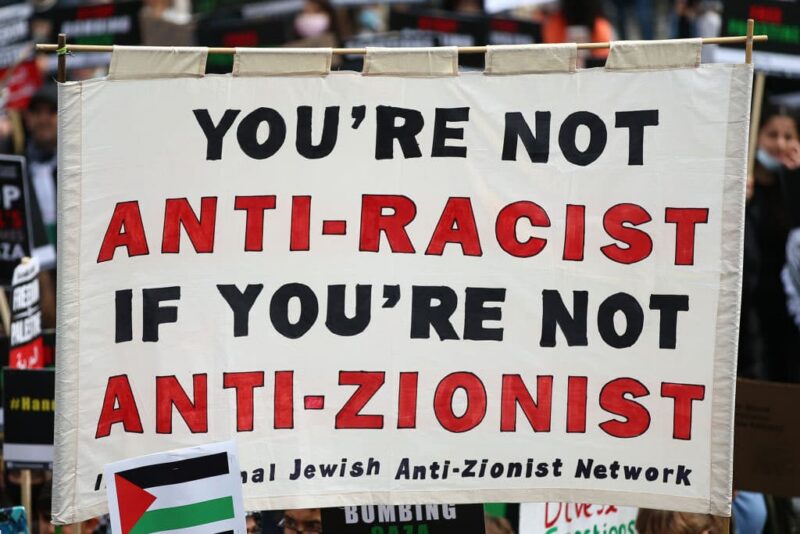
Hollie Adams/Getty Images
Sign from a rally in London, England, on May 22, 2021.
The JFNA survey confirms his diagnosis two decades later. Most American Jews still support Israel’s right to exist. Many feel deep emotional, familial, and cultural ties. But they no longer experience “Zionism” as a useful or accurate way to express those commitments—especially in public or contested spaces.
This has major ramifications for pro-Israel advocacy.
Words do not operate in a vacuum. They operate in ecosystems shaped by repetition, repetition, repetition, as well as media framing. Today, Zionism is widely understood — particularly among younger Americans — not as Jewish self-determination but as a synonym for occupation, oppression and/or racism. That definition is historically wrong, but Luntz’s core insight from his seminal book Words That Work still applies: It’s not what you say; it’s what people hear.
Some within the Jewish community have responded by trying to reclaim or redefine the term. We see earnest campaigns insisting that “Zionism simply means…” followed by careful lessons in Jewish history. These efforts are sincere — and largely failing. You cannot successfully rebrand a word whose public meaning has hardened, especially in hostile environments like college campuses and social media.
Luntz’s insight was not ideological; it was tactical. He was not arguing against Israel or Jewish self-determination — nor am I, having moved to Israel and raised a family here. He was arguing that clinging to language that alienates persuadable audiences is self-defeating. Defending a word is not the same as defending values, Israel’s legitimacy or Jewish safety.
Yet within much of the pro-Israel community, even raising this issue is often treated as disloyalty or being a “lefty.”
Luntz’s advice was not to abandon the idea behind Zionism, but to translate it. Both his work and the work of other top communications strategists who consulted with The Israel Project and the government of Israel recommended that activists and spokespeople lead with outcomes and values, not ideology and labels. His research showed that persuasion worked best when advocates spoke about “Israel’s right to exist in peace and security,” “a homeland for the Jewish people after centuries of persecution,” “a democratic state with equal rights” and “protecting civilians — Israeli and Palestinian alike.” Empathy first, values second, security third — and only then, if necessary, politics.
When the word “Zionism” had to be addressed, Luntz advised defining it briefly and narrowly — Jewish self-determination like that of any other people — and then pivoting immediately to peace, democracy and coexistence. Lingering on the term invited abstract debates about nationalism and colonialism, terrain where Israel consistently lost public sympathy. His rule was simple: explain Israel; don’t litigate Zionism.
The JFNA data suggests many Jews are already following this approach instinctively. They speak in the language of principles and outcomes — Israel’s right to exist, opposition to terrorism, concern for civilians on both sides and belief in national self-determination — without ideological branding. But too many do not; and unfortunately they are following the voices of some of Israel’s most extreme and unsophisticated leaders, who don’t seem to care about public opinion among their Diaspora brethren or the general population.
Effective advocacy adapts — that is the brave message JFNA is positing. Refusal to adapt is simply not working. If most American Jews who support Israel do not identify as Zionists, the lesson is not to shame them into using the word. The lesson is to ask what language persuades now.
Frank Luntz issued the warning years ago. The data has not really changed, but JFNA has brought the issue into the open at a moment when it can no longer be ignored. The question is whether the pro-Israel community is willing to stop fighting yesterday’s language battles — and start communicating for the world as it is.
Laura Kam is the president of Kam Global Strategies, a Jerusalem-based communications company.