HUMANITARIAN RELIEF
Israeli aid group Natan provides reusable menstrual pads to Gaza women, telemedicine for orphans
Led by famed Israeli aviator Alice Miller, the organization is stepping in to aid Palestinians even as other parts of Israeli civil society remain more domestically focused
Courtesy/Natan
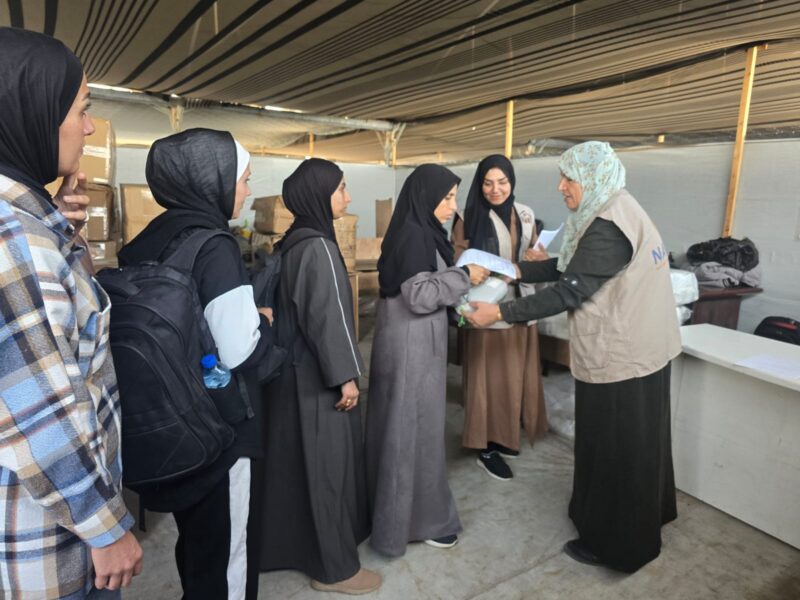
Aid workers connected to Natan distribute 'dignity kits' to women in the Gaza Strip, in an undated photograph.




 Add EJP on Google
For the past two years, Israeli society and civil society have been grappling with the humanitarian crisis next door in Gaza. Even as the ceasefire largely holds, Israelis know that Palestinian civilians are still suffering, particularly in recent weeks, as winter storms have brought punishing rain and whipping winds through the displaced person tent camps where many Gazans now live.
At the same time, Israelis also understand that the war began because of the terrorist actions of Hamas on Oct. 7, 2023, and many believe that the country’s own struggles — treating the thousands of war-wounded, rebuilding southern and northern communities and generally addressing collective trauma — trump those of Palestinian civilians. For some Israelis, Palestinian support for the Oct. 7 attacks and for Hamas meant that, in a phrase sometimes heard in public debates on the issue, “there are no innocents in Gaza.”
Yet for a small but growing cohort of Israeli humanitarian organizations, there is a pressing need to also assist innocent Gazan civilians.
“Let’s just assume for a second there are 1, 2, 3, 30, 300, 3,000 innocent people in Gaza,” Alice Miller, CEO of Natan Worldwide Disaster Relief, told eJewishPhilanthropy. “How can we cope with that knowledge of having innocent people in Gaza going through horrific conditions right now?”
She added: “If I say there are no innocent people in Gaza — easy. Easy life. The pictures of tents floating around in the puddles have nothing to do with me. I have no responsibility. Thank you, goodbye. I can’t do that. This is a choice. And the choice is to respond.”
That response has translated into Natan distributing 2,000 “Dignity Kits” containing reusable menstrual pads to women in Khan Younis, with plans to reach 20,000 more in 2026, alongside establishing a telemedicine clinic to serve 10,000 children in Gaza — many of them orphans.
She stressed that her focus is not on the murky territory but on the clear-cut cases of humanitarian need. “I’m talking about that child who’s 1, 2, 3, 4 years old, has got a very tough medical condition or living condition and has no way of coping with that,” she said. “That is something that just touches my heart.”
Molly Bernstein, who was previously a humanitarian aid worker for the Israeli relief nonprofit IsraAid in disaster zones from Greece to Morocco to Turkey, which focuses much of its work on hygiene, explains why something as seemingly simple as menstrual hygiene matters on a large scale.
“When you look at the bigger picture of menstrual hygiene management, there are a huge number of issues that also hang in the balance,” Bernstein, who no longer works in the humanitarian relief field, told eJP. “Poor hygiene is just the beginning. If an infection like a UTI develops, and goes undiagnosed or untreated during a subsequent pregnancy, this can cause low birth weight, which can be a driving force in childhood malnutrition. It’s critical to zoom out and see how such a seemingly small intervention can make a huge impact even way down the road.”
As a result, she said, “providing washable, reusable pads can make a huge difference for women and girls in humanitarian settings. It’s not only an issue of day-to-day — or month-to-month — dignity, but also can have a major impact in the life cycle of entire families.”
Miller, who holds a degree in Aerospace Engineering from the Technion and an MBA from Tel Aviv University, spent a decade as an officer in the Israeli Air Force and two more decades in aerospace and technology in the private sector. Following the Oct. 7 attack, she shifted her focus to humanitarian work.
For part of each year, she lives in a hut on stilts in the middle of a rice field in the Himalayas in India. It’s in that setting — in what she calls “big nature” — that Miller developed the philosophy driving her humanitarian work. Living close to the river, the jungle and animals refines “your understanding of the humility of us human beings, of the similarity of all of us,” she said.
“You see that you’re not separate from the fireflies and the leopard,” she said. “For me, this gives a very deep understanding of the connection between us human beings. I feel much more separate here in my beautiful house in Kibbutz Hukok with endless electricity and water. Over there, it brings you back to the essence of us sharing this unique experience.”
That perspective translates directly to her work in Gaza. Miller recalled a story that was told to her by a woman in Gaza whom she’d gotten to know through her humanitarian work, about a 14-year-old girl who got her first period while displaced in a tent. With nothing to use, the girl couldn’t leave the tent for three days.
“I’m just thinking about my daughter getting her period for the first time in her life. It’s a frightening thing, no matter who you are, and that too in a tent in Gaza, where you have nothing to use. I said, ‘This is crazy.’ I can help these women have a little more dignity. That is the reason we’re doing it. That is the sole reason.”
Professor Bruria Adini, who heads the Department of Emergency and Disaster Management at Tel Aviv University’s School of Public Health, sees Miller’s choice as both necessary and rare in Israeli society.
“What happened in Israeli society throughout the war — and that’s something very unfortunate in my opinion — is that the essence, or even the term, of humanitarian aid has gotten a very negative connotation,” Adini told eJP. “People would like to stop the trucks going in, or try to demonstrate against Israel providing for the needs of vulnerable populations.”
Yet Adini, who described her own feelings of fear and helplessness during the Oct. 7 attacks, argues that Israel has no choice but to engage in this work.
“We [Israelis] cannot be an island,” she said. “I think for our survival, we need to be part of the global community. If we want people to understand our needs and our concerns, then we need to be concerned with other populations’ needs and concerns. It cannot be one-sided.”
Natan has distributed 2,000 kits so far — a pilot program — with plans to reach 20,000 women in 2026. Each $18 kit contains four reusable cotton pads in different sizes, manufactured in India, designed to last approximately one year.
Distribution works through a token system: Children receive tokens, bring them home to women in their families, who exchange them at distribution points.
“There are a lot of problems with single-use period pads,” Miller said. “Sometimes they’re there, sometimes they’re not. There’s no garbage disposal system in Gaza, so they’ve got nothing to do with the used items. They’re all just floating around in the puddles. It’s really disgusting.”
Most families have established washing and drying areas near the pit toilets, typically covered with material for privacy — where women can manage the products discreetly despite living five or 10 people to a tent. Arabic-speaking Israeli volunteers communicate regularly with women in Gaza to improve the product based on feedback.
Both the Dignity Kits and Natan’s clinic project operate through Gaza Children’s Village, an American nonprofit that runs schools for orphans in Gaza. Miller met its founder, Dr. David Hassan, a neurosurgeon from Duke University, during a trip to the United States.
“When you’re working in Gaza, one of the major things for us as Israelis is finding somebody you trust that you can work with,” Miller said. “It’s really crucial in this situation. You don’t want to work with somebody who’s got bad intentions toward you.”
All Gaza Children’s Village staff working with Natan have been cleared by Israel’s Defense Ministry and the Israel Defense Forces.
Miller said that the program represents a “strain on our fundraising” and necessarily strays from the organization’s usual methods.
Natan’s model has always been hands-on: Deploy Israeli doctors, nurses, social workers, and mental health professionals directly to disaster zones. The organization spent eight months on the Polish border after Russia’s invasion of Ukraine, one year in Serbia serving Syrian refugees and, more recently, three months at the Dead Sea and Eilat serving Israeli evacuees after Oct. 7.
But in Gaza, that model doesn’t work. “Wherever we go, we bring our doctors, nurses, and social workers. We can’t do it in Gaza, so we have to support other teams working far away from us,” Miller said. That means “creative ways of raising funds.”
Yet some donors have moved in the opposite direction. Miller described an anonymous Israeli family foundation that decided: “The deeper the war in Gaza gets, the more they want to invest in programs of compassion in Gaza.”
International support has also materialized. A company from Nebraska donated $10,000 the day after hearing Miller speak. “They said, ‘We believe in our responsibility as human beings to human beings, and as women to women.’”
But the response from Israeli society is mixed. “One of my best friends said to me, ‘But it’s not your job.’ And it’s true, I don’t have to do anything. This is a choice.”
When asked whether the work is easier for American Jews to support than Israelis, Miller didn’t hesitate: “100%. It is a process that people need to go through to be able to help somebody who has hurt them. I think it’s easier for people in America to understand this than for people in Israel right now.”
The internal organizational debate was even more fraught. When Natan began discussing Gaza work, “there was a small minority of people inside the organization that said that even now, this is what we are here for. But it was too tough for us to negotiate being shot at and supporting [Gazans] while you’re being shot at.” Natan ultimately waited until the ceasefire went into effect in October to begin Gaza operations.
Miller said that she sees herself carrying on the legacy of Abie Nathan, the Israeli peace activist and humanitarian for whom the organization is named. Nathan, a fighter pilot in Israel’s War of Independence, became famous for his unauthorized 1966 peace flight to Egypt and his subsequent humanitarian work helping refugees from Biafra to Vietnam.
“He would have loved it!” Miller said of the Gaza work. “I think he’d be extremely proud of us carrying on his legacy.”
For Miller, visibility matters. “I feel that it’s important to show conspicuous acts of kindness. It has to be out there, has to be seen. We can’t have only one side of us shown to the world continuously. There is a lot of compassion in us as a people.” But she was quick to add: “This is not the reason we’re doing it. It’s a beautiful byproduct.”
Asked about the scale of this project’s impact, Miller is philosophical.
“It’s a drop in the ocean, you know what I mean? If you look at the amount of people in Gaza. But an important drop. Every single person that we treat, it might change their life, but it’s one person, one drop. We can’t do more than we can do. We’re not going to be one of these mega organizations — we’re Natan and we do drop by drop.”
She returns to the fundamental question: “It can’t all just be through the sight of a rifle. It’s not sustainable. We have to start somewhere else.” She paused, then added: “And where can we start if not by talking about reusable period pads?”
Related News

HIGHER EDUCATION
As Jewish donors reconsider academia, Jan Koum doubles down, endowing Israel studies at Stanford

MAGICAL EXPERIENCE
Shefa launches psychedelics retreat for Jewish professionals suffering burnout

EXIT INTERVIEW
Elizabeth Sokolsky, longtime EVP of Birthright Israel, to retire next year

EXCLUSIVE
Detroit-based philanthropists Nancy, James Grosfeld donate $8M to renovate JDC’s Israel campus
ADVANCING A VISION
N.Y. federation donates $1M toward building shared-society center named for peace activist killed on 10/7