SURVEY SAYS
State of Antisemitism in America 2025 report not just ‘data points on a screen,’ says AJC CEO
Alexi J. Rosenfeld/Getty Images
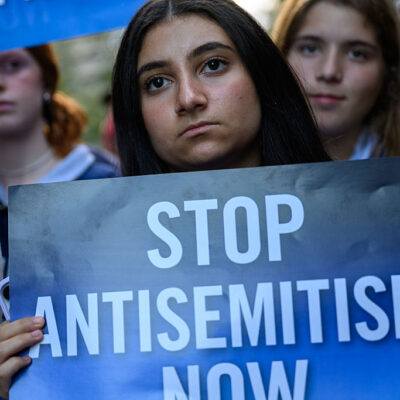
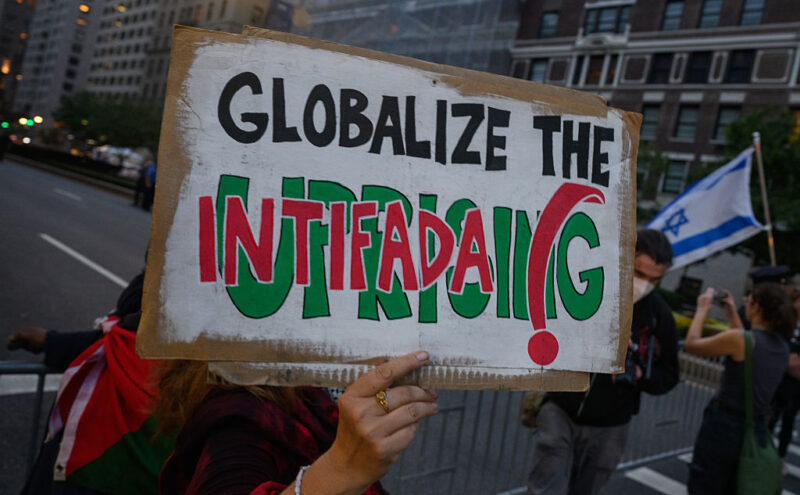
A protester holds a "Globalize the intifada" sign during an anti-Israel protest near Prime Minter Benjamin Netanyahu's hotel at the 80th session of the UN’s General Assembly on Sept. 25, 2025 in New York City.




 Add EJP on Google
As a heated debate plays out in the Jewish community over the effectiveness of throwing millions of dollars at the problem of antisemitism, the American Jewish Committee’s annual “State of Antisemitism” survey, released this morning, adds some ominous, though perhaps not surprising, data points to the discussion.
Thirty-one percent of Jews reported being the target of an antisemitic incident, 3% which were physical. Two-thirds of Jews felt that they were less secure in America than last year. And 93% of Jews felt antisemitism was a problem in America, compared to 70% of the general public.
“We want leaders across our society to understand that while these appear as data points on a screen or on a piece of paper, every one of them represents the lived experience of Jews and Jewish families in America right now,” Ted Deutch, the CEO of AJC, who formerly represented a heavily Jewish South Florida District in the House, told eJewishPhilanthropy.
The survey landed two days after Robert Kraft’s Blue Square Alliance Against Hate aired a $15 million ad on the Super Bowl, and less than a week after New York Times columnist Bret Stephens’ call to “dismantle the Anti-Defamation League.”
The seventh annual study shows that antisemitism remains elevated throughout America in the wake of the Oct. 7 terror attacks — even if at a similar level compared to the year before — and Jews feel less safe after a year of terrorism and deadly antisemitic attacks around the world. American Jews between the ages of 18-29 have borne the brunt of antisemitism, with 47% saying they were a target of antisemitism over the last year, compared to 28% among those 30 and over, the survey found. SSRS, which conducted the survey, polled 1,222 Jewish respondents between Sept. 26-Oct. 29; it separately interviewed 1,033 U.S. adults between Oct. 3-5.
Much of the data is not news in the post-Oct. 7 world — Jews continue hiding their Magen David necklaces, and 25% of Jewish college students said they have felt or been excluded from a group or an event. Artificial intelligence is only exacerbating the fears of American Jews, with 65% of study respondents worrying that the programming will allow conspiracy theories to flourish. There is also considerable ignorance about the issue among non-Jews: Twenty percent of the general American population have heard of the term “antisemitism,” yet have no idea what it means — 10% of respondents said they haven’t even heard of the word.
AJC was prompted to hold the first “State of Antisemitism in America” in 2019, soon after the October 2018 attack at the Tree of Life congregation in Pittsburgh, which killed 11 people in the deadliest attack on a Jewish community in American history.
“This is antisemitism, and it threatens our society as a whole,” Deutch said. He spoke with eJP about what he hopes funders take from this study, why antisemitism is a risk to all Americans and why threats to democracy put Jews at risk.
The interview has been edited for length and clarity.
Jay Deitcher: There’s been a lot of discussion recently about the idea that philanthropists are flooding money into initiatives to combat antisemitism without proof of their effectiveness as antisemitism surges. [As evidenced by a 2025 Jewish Funders Network study.] What do you hope philanthropists take from this data?
Ted Deutch: The reason it’s so important for us to share this information with leaders across the country, and for Jewish community members to be able to share this with their neighbors and their co-workers, is to highlight that these attacks against the Jewish community are not a series of one-offs. The attacks in Harrisburg [at the residence of Pennsylvania Gov. Josh Shapiro] and Washington and Boulder [Colo.] and Bondi Beach [in Sydney, Australia] and Manchester, [England,] and Jackson, Miss., these and all of the other many attacks against Jews in America and around the world are all connected, and the threats to our Jewish community are the tip of the iceberg.
If we allow the 2% of the population to continue to face this kind of antisemitic hostility, if we continue to experience these kinds of attacks, it’s dangerous for the Jewish community, but it’s also dangerous for American society as a whole.
We go about our work, first and foremost, reminding the world that we are proud American Jews, and that we will continue to stand strong in the face of all these attacks. It’s why we do so much to help train the next generation of global Jewish leaders. It’s why everywhere we show up, we do so as proud Jews. We’re going to continue to do that at the same time. We also need to help the leaders across the rest of society understand what’s at risk for them.
JD: Nearly 80% across the board — among Jew and non-Jew — felt the phrase “Israel has no right to exist” is antisemitic. That was a bit down from last year for non-Jews. Forty-five percent of the general population said that they saw or heard about antisemitic incidents, such as physical and verbal attacks on Jewish people or religious institutions. Twenty-seven percent spoke up about or reported the incidents, up 4% from last year. What do these statistics mean for the Jewish population?
TD: The 45% of adults [in the general population] who have seen antisemitism in the past year, pales in comparison to the percentage within the Jewish community who are seeing it or hearing it. We have to recognize that so much of what people are seeing and experiencing is based on what they’ve experienced on social media. For those non-Jews who know Jewish Americans, that number [who recognized antisemitism] was 54% and for those who don’t, it’s 32%.
Even when the data shows that people can identify it, the fact that the go-to response, time and time again after another tragedy, is to provide more security, which is necessary and which we welcome and which we advocate for, still, that’s not enough, and it isn’t normal in society for any group to feel targeted simply because they’re gathering together to pray or to celebrate or for a community event. That’s what we need people to understand.
For any other community, if a third of that community was experiencing this kind of hatred on a regular basis, being the personal target of an antisemitic incident, we wouldn’t tolerate it, and we shouldn’t tolerate it when it happens to the Jewish community.
JD: We’ve talked about security. We’ve talked about bringing up proud Jewish leaders. Now let’s talk about Bret Stephens’ comments. He called for the dismantling of the ADL specifically in an onstage interview following his 46th annual State of World Jewry address at the 92NY last week, and the AJC and other “sacred acronyms” were also referenced as organizations that are apparently misguided in focusing so much attention on combating antisemitism instead of cultivating Jewish identity and education. Where do you come down on the issue?
TD: The suggestion that we should focus on more Jewish education and creating proud and strong and resilient and knowledgeable Jewish leaders is exactly right. We should. It’s a big part of what we do. I was just in Washington with our largest high school gathering we’ve ever had, our campus global board, our Access program for young leaders, bringing together Jews from around the world to learn with one another and to become leaders with one another. [It’s] vitally important. But it’s not either-or.
The question isn’t, should we be committed to making sure that we’re providing this kind of education and training, or should we be engaging in the broader world? We have to do both.
We are 2% of the American population. That 2% of the American population has been involved at leadership levels in so many social struggles in our country throughout its history. Now is not the time for us to shrink from the responsibility to stand up for the group that needs us most when that very group is our own community.
JD: The AJC study shows that antisemitism is still high post-Oct. 7 at the same time that 77% of American Jews and 64% of the general public have less trust in the way democracy is functioning in the United States. When you talk about how we need to combat antisemitism while also educating and bringing up the youth, that can be read many ways too.
TD: Throughout our history, the Jewish community has fared the best in strong, well-functioning democracies, in countries where there is trust in government. Given that, having a strong democracy is absolutely something that we believe in. Just as fighting antisemitism helps to not only protect the Jewish community, but democracy as a whole, the flip side is also true: Having a strong democracy and democratic ideals also strengthens the Jewish community.
Related News
ADVANCING A VISION
N.Y. federation donates $1M toward building shared-society center named for peace activist killed on 10/7

MAGICAL EXPERIENCE
Shefa launches psychedelics retreat for Jewish professionals suffering burnout

EXIT INTERVIEW
Elizabeth Sokolsky, longtime EVP of Birthright Israel, to retire next year

EXCLUSIVE
Detroit-based philanthropists Nancy, James Grosfeld donate $8M to renovate JDC’s Israel campus
CLOSING WORDS
In AZM address, Cosgrove links communal ‘orthodoxy’ on Israel to rising anti-Zionism among young Jews