Jerusalem museum highlights local hero, actor-singer Yehoram Gaon, in new exhibit




 Add EJP on Google
When Jerusalem Mayor Moshe Lion approached the directors of the Tower of David Jerusalem Museum with the proposal to curate an exhibition honoring the legacy of his longtime friend, legendary singer, actor and public personality Yehoram Gaon, they felt both honored and torn, Eilat Lieber, the museum’s director and chief curator, told eJewishPhilanthropy as the museum prepared for the official opening last Wednesday of “Yehoram Gaon – The Exhibition.”
“We thought for a long time if it was even appropriate,” Lieber said. “It’s about music and it’s something happy. While on the other hand, this is a very difficult time, the news doesn’t let up. Each time we actually enter an… understanding that it is not over yet, and then, of course, there was the war with Iran.”
After long deliberations, they decided that, maybe especially because of the complex and difficult times Israel has been facing for the past 21 months, this was the right time to put together such an exhibit highlighting the cultural icon whose musical and theatrical works have spanned Israel’s history and been so intertwined with national events over the past 77 years.
“Yehoram Gaon is the soundtrack of Israeli life,” Lion said in a press statement. “This exhibition offers a moving and personal journey into his remarkable legacy and the collective memories of generations.”
In May, curating items from Gaon’s personal collections alongside archival materials, the curators began in earnest to assemble the exhibition. Like the museum’s newly installed permanent exhibit, whose renewal was completed last year, this one features immersive, interactive technology — requiring the setup of multimedia screens and historical recordings, including a rendition of the beloved Ladino song “Kuando el Rey Nimrod” sung by Gaon’s mother, Sara Hakim Gaon. Born in Izmir, Turkey, she preserved the tradition of Ladino poetry, inspiring and influencing her son’s work.
Gaon’s father, Moshe David Gaon, was born in Bosnia and was also of Sephardic heritage. Gaon himself became an early symbol of pride and solidarity for the Sephardic community.
Just a week before the exhibition was set to be completed, the 12-day war with Iran broke out, bringing everything to a standstill. With the Bein HaZamanim period, when Jews traditionally refrain from celebrations before the Tisha B’Av fast day quickly approaching, delaying the opening was not an option. As soon as the Israel Defense Forces’ Home Front Command allowed, the museum’s staff began working day and night to bring the exhibit to fruition with the close cooperation of both Lion and Gaon, with the last pieces installed in the new Angelina Drahi Entrance Pavilion the morning of the opening.
Included in the exhibit are personal artifacts from Gaon’s family home, original manuscripts and sheet music, as well as iconic stage props like his hat from the iconic Israeli play “Kazablan” and a previously unseen production book featuring original set sketches by artist Aryeh Navon and handwritten notes by lyricist Naomi Shemer. A specially designed audio guide, narrated in Hebrew by Gaon, brings his stories and songs to life for visitors through the galleries. All the films in the main exhibition have English subtitles.
“Yoram Gaon also reached the mainstream, but he didn’t forget where he came from and made a lot of connections to his culture, his family, the community,” said Lieber. “We should also be able to be proud that everyone comes from here, to sing it, to create, to write, each in his own field, but also, to see ahead [to the future]. This is definitely an interesting connection between something new and old, and of course also a kind of mirror to Israeli society to see how it has changed and how it has evolved.”
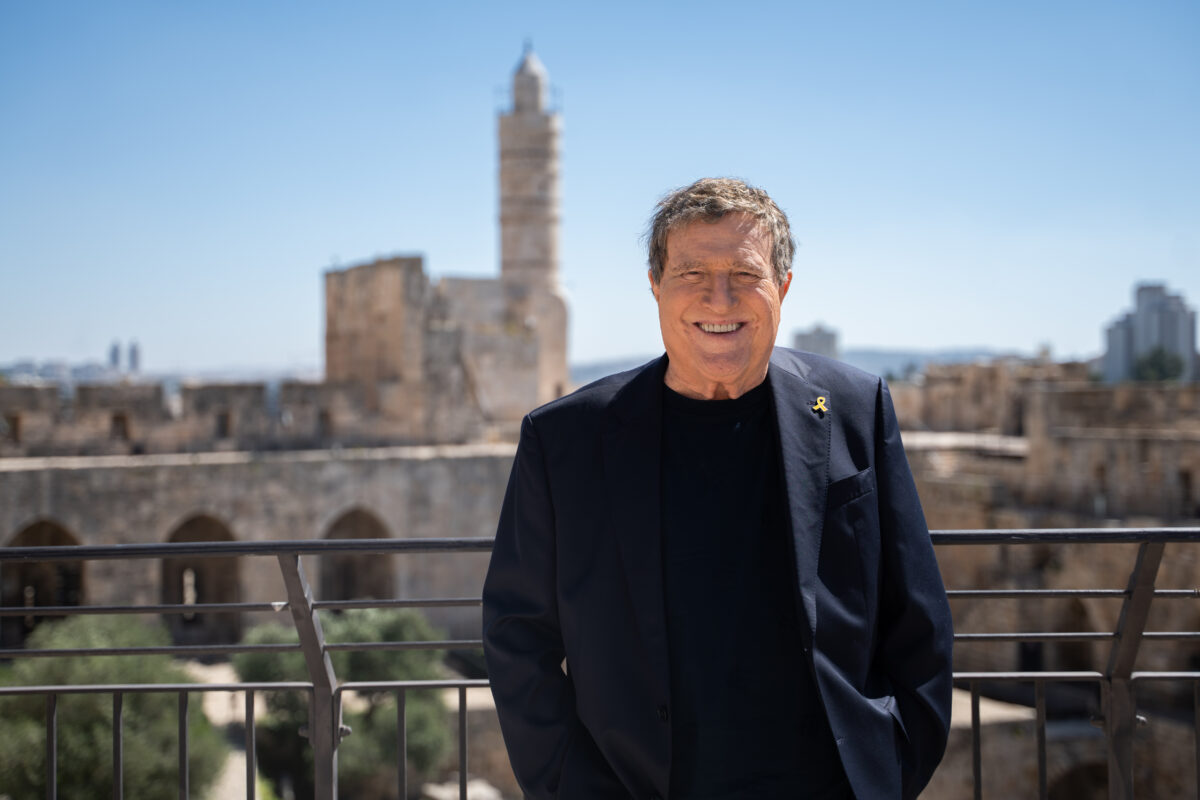
Through Gaon’s personal story the exhibition, presented jointly by the Tower of David Jerusalem Museum and the Jerusalem municipality, highlights key moments in the history of the Jewish Yishuv in Jerusalem, the struggle for statehood, and the founding of the State of Israel, along with ongoing social issues that continue to influence Israeli society.
With his distinctive voice and strong stage presence, Gaon has played a significant role in portraying aspects of Israeli society — through lead performances in “Kazablan” and the Raid on Entebbe film “Operation Yonatan,” as well as moments of humor in TV sitcoms and reflections in documentaries.
With its interplay between personal and collective memory, the exhibit is meant to help Israelis take a look at themselves in the mirror for a moment and remember who they are, said curator Tal Kobo.
“Especially in such tense times and periods of crisis, this is a kind of support where we can look back for a moment at our own past, at our own childhood, at the soundtrack of our lives, to the sights that we have seen, the plays that we have seen so we can remember who we are,” Kobo said. “In all the important crossroads of the history of the State of Israel, Yehoram has been there. This is one moment when we look back and tell ourselves that this is the journey we have passed.”
As Israel continues to face years of crisis, it is easy to feel lost or uncertain about where to turn or what to rely on, she said. So it is important for Israelis to reflect on the “amazing” journey they have taken and the rich set of values embedded in Israeli culture — a relatively young culture.
“Israeli society was formed by immigrants, with a small Jewish population living in the Land of Israel. Yet our roots and shared memory stretch back much further — to events like the destruction of the Temple and the expulsion from Spain. These deeper layers of identity are what Yehoram Gaon has come to represent for all of us over the years,” Kobo said.
She noted that in Gaon’s 1971 documentary in tribute to his love of the city, “I am a Jerusalemite,” which was screened in the exhibit, Gaon shares a wide vision of Jerusalem that includes its residents of all creeds and religions, despite the joy and euphoria that came with the victory of the 1967 Six-Day War.
“There’s a very pluralistic outlook here, because the truth is that this is Jerusalem. Jerusalem is multifaceted, and there’s so much… in the Jerusalem street. Just look at the people passing by,” Kobo said. “It’s not just all history, it’s all cultures, all languages, all religions, certainly the monotheistic religions that grew right here. So there is something in the city of Jerusalem and in the Israeli connection to Yoram Gaon that reinforces this theme of Jerusalem. He suggests looking at Jerusalem from a broader perspective. He wants to view Jerusalem from above — to see its history from a higher vantage point — not through the lens of our immediate issues, not through conflict or occupation. Rather, he focuses on how the spiritual places in Jerusalem sustain that deeper meaning. And we, too, need to hold onto that in order to preserve ourselves.”
Gaon became a member of the Jerusalem City Council in 1993, holding the culture portfolio, officially serving as the municipal authority’s cultural affairs representative until 2002, but has not lived in Jerusalem for decades.
Meeting with journalists on Wednesday prior to the opening of the exhibit, Gaon said that Jerusalem is not just a place where a person lives between one set of walls or another, but rather a spirit.
“The city of Jerusalem is in my heart, it will never leave, and it will remain there until the end of my days,” he said.
He said he had not yet visited the exhibit, and but did so later in the day, together with Lion. He was pleased, Gaon said, that the exhibit was curated during his lifetime.
“With my own eyes I will see all these things: the songs, the movies, everything that is on exhibit there. This is the greatest privilege that this gentleman has been granted: that I will see everything with my own eyes and that people won’t say later: ‘Once there was someone like that,’” Gaon said. “No, he’s alive and here now, and he sees everything with his own eyes and enjoys every moment.”
Related News
MAGICAL EXPERIENCE
Shefa launches psychedelics retreat for Jewish professionals suffering burnout
HIGHER EDUCATION
As Jewish donors reconsider academia, Jan Koum doubles down, endowing Israel studies at Stanford
PRESIDENTIAL REBUKE
Israel’s Herzog: Mamdani ‘makes no effort’ to hide disdain for Israel, Jews must fight back

MAJOR GIFTS
Center for Jewish History celebrates 25 years with a $25M matching grant
ADVANCING A VISION
N.Y. federation donates $1M toward building shared-society center named for peace activist killed on 10/7