ZEN AND THE ART OF JEWISH MAINTENANCE
Institute for Jewish Spirituality to mark $9M in new donations at 25th anniversary celebration
Once seen as fringe and at-odds with traditional Judaism, over the past 25 years, IJS' New Age practices have moved to the mainstream, bringing greater funding
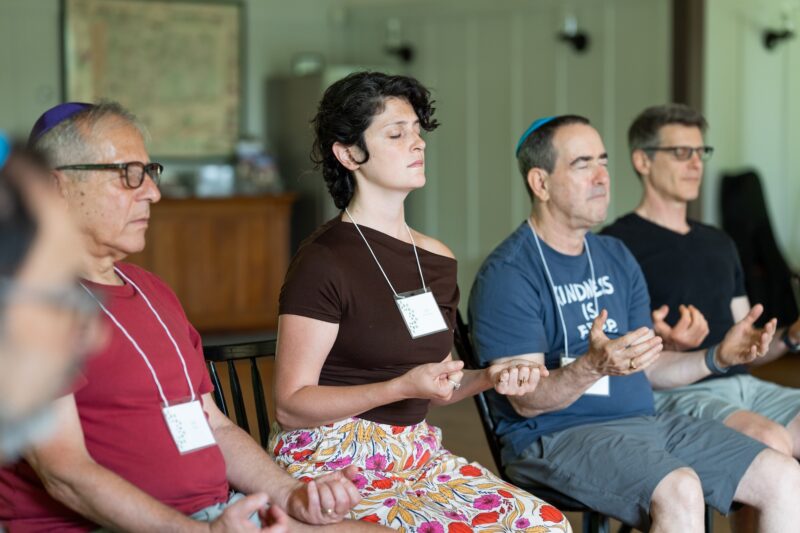
courtesy/IJS
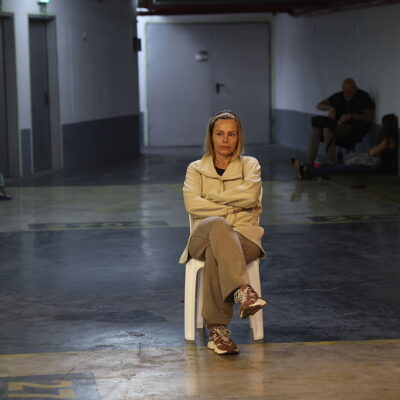
Participants take part in the Institute for Jewish Spirituality's Kivvun Retreat on June 19, 2025.




 Add EJP on Google
As mindfulness and meditation grew in popularity during the 1990s, many in the Jewish world feared that Buddhist practices were stealing the youth, assimilating their children into a tribe of so-called “JewBus.”
“There were tens of thousands of Jews who had grown up in Jewish families and communities. They went to college. They didn’t find what they were looking for spiritually, and they discovered Zen [Buddhism] and yoga and transcendental meditation,” Rabbi Josh Feigelson, president and CEO of the Institute for Jewish Spirituality, told eJewishPhilanthropy.
From this counterculture came an idea — formulated in November 1996 in the offices of the Nathan Cummings Foundation, where a group of heterodox leaders gathered, including Nathan Cumming’s president, Charlie Halpern, and its Jewish life program officer, Rabbi Rachel Cowan. The leaders conceived of an organization — the Institute for Jewish Spirituality — that would connect modern Judaism with mindfulness, something they believed the faith lost during the Enlightenment and the Shoah.
On Sunday, at Manhattan’s B’nai Jeshurun, the Institute for Jewish Spirituality will hold its 25th anniversary celebration, with the slogan “An Evening of Light. Celebrating 25 years of spiritual practice, mindfulness and connection.” At the event, IJS will announce that it has raised more than $9 million in its “Campaign for the Future.” For the organization, this milestone is emblematic of the shift in perspective in Jewish society where mindfulness and wellness are seen as positive practices, no longer viewed as foreign or hostile to Judaism.
The organization began planning its first moves in 1999 with a $200,000 budget and two part-time employees: founding Executive Director Rabbi Nancy Flam, who attended the initial planning meeting and served various roles at the institution from 1999-2019, and her administrative assistant. Flam could not have envisioned the growth the organization has seen in the past 25 years, she told eJP.
“It’s just been an incredible unfolding,” she said, especially how the IJS has adapted to a changing world, incorporating technology that was unimaginable when the founders rounded the new millennium. While much of the organization has changed, it continues to revolve around its inaugural program — an 18-month Jewish clergy fellowship that teaches leaders mindfulness practices with the belief that it will trickle down to their communities.
The fellowship, which consists of four retreats, is mostly silent, “which is kind of amazing, if you can imagine 42 rabbis and cantors meditating and being quiet for five days,” Feigelson quipped.
Since the inaugural cohort in 2000, the year the nonprofit recognizes as its launch, the program has taught 600 clergy members mindfulness practices, including prominent leaders, such as Rick Jacobs, president of the Union for Reform Judaism, and Angela Buchdahl, the senior rabbi of Central Synagogue in New York City.
In 2007, Rabbi Rex Perlmeter was part of the fourth rabbinic cohort. At the time, he was on the verge of transitioning out of his life as a pulpit rabbi and contemplating next steps. His experiences during the fellowship propelled him on a path to launching the Jewish Wellness Center of Montclair (N.J.) in 2012 and serving as the current board chair for the IJS.
“It transformed how I manifest in the world, both personally and professionally,” he said. “In addition to helping me chart the development of my career and now retirement, IJS also helped save my life at a time of family tragedy when we lost one of our four children to a sudden cardiac death [in 2011].”
There is no Judaism without mindfulness, Perlmeter said. “It just may not always, technically, be called that.” Jews have a custom of uttering 100 blessings a day, which is a way of “practicing mindfulness, constantly coming back to the center.”
Today, the IJS is more than a fellowship for clergy. It produces podcasts, including one that was hosted by Buchdahl, who ruminated on the weekly Torah portion and Jewish traditions. It also holds daily Zoom yoga and meditation sessions, as well as more than 20 classes and retreats.
When Feigelson began at the IJS in 2020, the organization’s email list had 8,500 subscribers, the budget was $1.9 million, IJS had 11 staff and counted on 14 donors who gave $10,000 or more. This year, the IJS email list has over 35,000 subscribers, the budget is $4.5 million, IJS has over 20 staff, and 47 donors gave $10,000 or more. While other wellness organizations surged during the pandemic and watched attendance drop as the world reopened, the IJS continues to grow, including online. “We’re Zoom’s best client,” Feigelson said about the 200 attendees daily in IJS online meditation sessions.
Rebecca Schisler, who leads IJS’s work with young adults, grew up in a Conservative Jewish community in Dallas. “Mindfulness was unheard of when I was a kid,” she told eJP. “It was not something that was mainstream at all where I lived and wellness was not really a part of Jewish life.”
Today, young adults are facing a “loneliness epidemic,” she said. “A lot of us work remotely and spend a lot of time on the screen or bombarded by social media and just constant overstimulation and difficult information to take in from media.”
Young Jews turn to mindfulness seeking to navigate “this increasingly chaotic world in a way that can help us to feel really rooted in and connected to what’s really important in life,” she said. Jewish mindfulness offers “wisdom and resources to help us navigate this challenging reality of the world as it is today.”
She helped IJS launch three weekly, peer-led in-person mindfulness groups in East Bay, Calif., Cambridge, Mass., and Brooklyn, N.Y., for people in (or near, the website says) their 20s and 30s. The goal is to go national with the program in the near future.
Over the next five years, IJS expects expenses of nearly $25 million as it expands digital offerings, continues to develop Torah mindfulness teachers and builds its cash reserve. Currently, a third of the IJS’s revenue is from earned revenue, a third from major donors and a third from foundations.
IJS launched the “Campaign for the Future” in the fall of 2024 with a $5 million goal for new multiyear grants and individual pledges. The campaign exceeded expectations, raising $9.3 million, with the money paid out over four to five years depending on the individual pledge or grant.
Twenty-five years ago, mindfulness, meditation and yoga were viewed as “hippie, marginal things,” Feigelson said. “They are now totally mainstream. Kids growing up today in schools have meditation as part of their curriculum.”
The practices taught by the IJS are not new, Feigelson said. Many of the spiritual practices were lost during the Holocaust and Enlightenment. “Modernity pushed us to become very intellectual, very in our heads,” Feigelson said. “We need the full-body experience, including the heart, including the emotions.”
The Jewish community is no longer worried about meditation stealing Jews, Feigelson said. “People realize these are wonderful tools. If you spend five minutes meditating, you feel the reduction in stress and you will feel more at ease and aware.”
Before starting his job at IJS in 2000, Feigelson “was not much of a meditator,” he admitted. Learning it “helped to transform my own life.”
Even his family is impressed with his growth. Last winter, the family was flying from Chicago when mechanical problems threw their plans off course, delaying their flight. Other passengers were worried they were going to miss connections, but “I was just cool as a cucumber,” he said, realizing the experience was out of their hands. “My oldest son and my wife were like, ‘Wow, that meditation stuff is really working.’”
Related News

MAJOR GIFTS
Center for Jewish History celebrates 25 years with a $25M matching grant
EXCLUSIVE
Detroit-based philanthropists Nancy, James Grosfeld donate $8M to renovate JDC’s Israel campus

EXIT INTERVIEW
Elizabeth Sokolsky, longtime EVP of Birthright Israel, to retire next year

MAGICAL EXPERIENCE
Shefa launches psychedelics retreat for Jewish professionals suffering burnout
PRESIDENTIAL REBUKE
Israel’s Herzog: Mamdani ‘makes no effort’ to hide disdain for Israel, Jews must fight back