Opinion
HOLOCAUST EDUCATION
I thought I understood the Holocaust — until I walked through Auschwitz




 Add EJP on Google
Before I traveled to Poland at the end of November, the Holocaust felt distant to me. Tragic, yes, but abstract. As an Afro-Latina high school junior from Success Academy High School for the Liberal Arts in New York City, I didn’t come to Holocaust history through family stories or religious tradition. I came to it through my AP World History course, which was rigorous and thorough. The numbers alone were horrifying — six million Jews murdered, millions more persecuted — but those facts stayed on the page. They never followed me home.
That changed the moment I walked into Auschwitz, a participant in an inaugural trip for students from Success Academy charter schools. Until then, I did not realize how dangerously incomplete my understanding had been.
Courtesy/Success Academy High School for the Liberal Arts–Manhattan
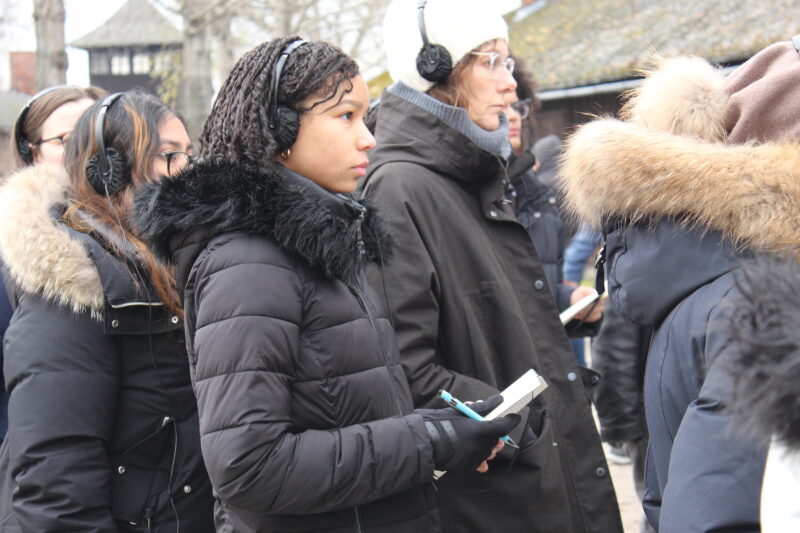
Dahlia Crawford at Auschwitz.
The first thing I noticed at Auschwitz were the outer walls of the concentration camp. They were so tall that I couldn’t see beyond them, cutting me off from the rest of the camp. It struck me as intentional, and a physical reminder of how prisoners were kept unaware of their fate.
Then I heard the sound over the loudspeaker. At first, it blended into the background, but as everyone around me fell silent, I realized what I was hearing: names. Two at a time. A pause. Then two more. An endless list of people who had been murdered there.
I didn’t need to know the statistics in that moment. The names were enough.
The sign over the camp entrance read “Arbeit macht frei,” “Work sets you free.” Standing beneath it, I understood how cruelty doesn’t always look violent at first. Sometimes it looks like hope. The Nazis used lies like this to prevent resistance, to make mass murder more efficient. That realization stayed with me long after we walked through the gate.
What affected me most were the photographs on display. They were taken by Germans and meant to look calm — photos of people arriving, families standing together, men and women being separated. But one image forced me to stop. I saw young girls clinging to their mothers and boys standing beside their fathers. Without meaning to, I imagined myself there. I thought about being separated from my dad and my brother, not knowing if I would ever see them again. That moment made the Holocaust painfully real in a way no lecture ever had.
At Auschwitz, I learned that genocide doesn’t begin with violence. It begins with language and indifference — with people being labeled as “anomalies” instead of neighbors. Later, during a group discussion, we traced how antisemitic propaganda and discriminatory laws slowly paved the way for the Final Solution. What disturbed me most wasn’t how extreme the ending was — it was how gradual the beginning seemed. That’s what makes remembrance urgent, not symbolic.
This trip also made me think differently about survival. My stepmother is Jewish, and her parents were Holocaust survivors. I never got the chance to know them deeply, but standing in Auschwitz reminded me how recent this history is. Survivors aren’t ancient figures — they are people whose lives overlapped with ours. That closeness makes forgetting not just careless, but dangerous.
International Holocaust Remembrance Day shouldn’t be about checking a box or repeating facts we’ve memorized for exams. It should push us to ask uncomfortable questions about how we respond to hatred today — especially when it doesn’t target us directly.
I left Auschwitz understanding something I hadn’t before: Remembering isn’t passive. It’s a responsibility. And if we only remember when history feels distant, then we aren’t really remembering at all.
Dahlia Crawford is a junior at Success Academy High School for the Liberal Arts–Manhattan.