OBJECT LESSON
How 5 women transformed items damaged in the Oct. 7 attacks into symbols of renewal
Through the project, Comfort Object, artisans and artists restore and transform household items, empowering their owners
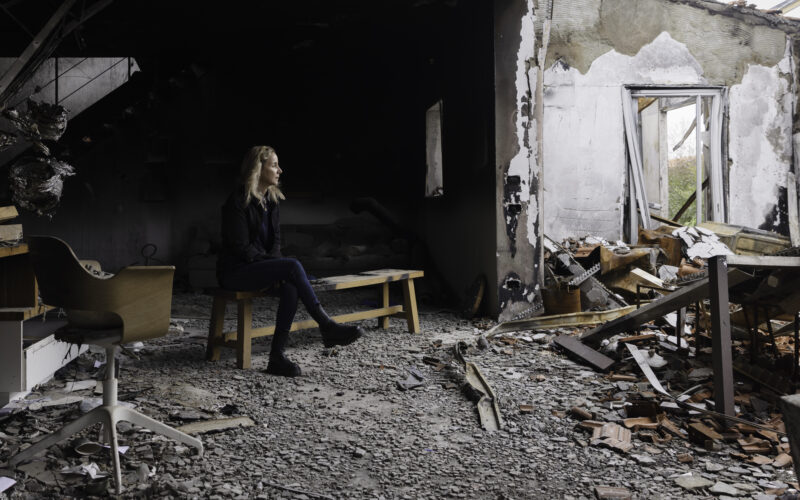
COURTESY/Shunit Flako-Zaritsky
Sharon Segev sits on a damaged bench that was later restored in her home that was destroyed in the Oct. 7 attacks in Kibbutz Beeri.




 Add EJP on Google
In September 2023, Tal Sterlin Halperin had just returned to Israel after her husband’s sabbatical year at Stanford University. “I was at a crossroads, just getting back to Israeli reality. And then came [the Oct. 7 attacks], which threw me into turmoil as a citizen, as a mother, as a woman,” she told eJewishPhilanthropy recently.
In the weeks that followed, she watched images of burned houses and thousands of Israelis being forced to relocate to temporary housing outside the Gaza border region.
“I saw the many people evacuating from the south, and the volunteerism happening throughout the country to bring people clothes and necessities, and furniture. I felt it wasn’t right that they had to leave valuables behind with no designated place to store them,” she said.
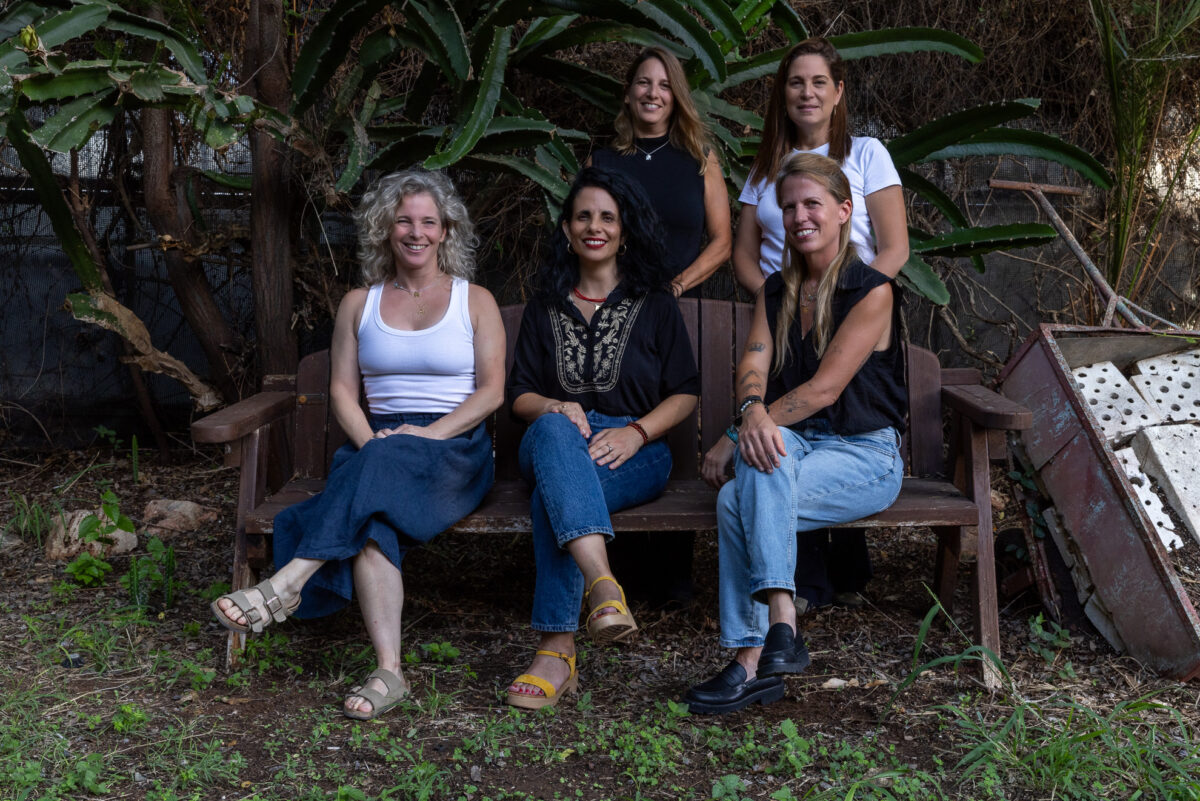
She had come from the world of career consulting and human resources. “The human spirit has always been present in my work,” said Sterlin Halperin. “I never did anything like this before. But certainly, I am sentimental about objects and I think they symbolize a lot more than serving a physical purpose.” The concept for the project, which was eventually named Comfort Object, slowly began to take shape in her mind. She consulted her husband, who thought it was a good idea, and then she approached her two childhood friends, furniture restorer and artist Maya Gal, and photographer and artist Shunit Flako-Zaritsky. Both were grateful for the opportunity to give back during this time.
“It was clear to me that our team would be all women, and we understood that we could not undertake this work without professional supervision,” said Sterlin Halperin. They recruited bibliotherapist Biri Rottenberg to lead a psychological framework and curator Michal Krasny to document and present what had happened to these families and the process they went through.
“I checked to see if anything like this had been done before,” Sterlin Halperin said. “I discovered research showing objects are very significant in forced migration, but no one had actually undertaken a process in which damaged objects were renewed from damaged homes.”
The five met in a cafe in Tel Aviv to form the concept. The name, Comfort Object, is taken from renowned psychologist Donald Winnicott, who coined the term to identify objects that children use to ease separation anxiety — usually dolls or blankets.
Two years later, the team has worked with dozens of families from Kibbutzim Kfar Aza, Be’eri, Nir Oz and Re’im, collecting over 100 objects.
Families learned about Comfort Object through community managers, social services, word of mouth and social media. “Each has had their own process, their own pace,” said Sterlin Halperin.
The team met the families at their destroyed homes. “We meet families in their most painful place,” Sterlin Halperin said. “Together we choose what’s left — objects damaged or broken, or even barely damaged but too painful to place in the new home the way they were previously used.”
“The families decide everything: which object, what it will become, which colors, what materials — everything. There are no surprises. They have already had surprises, they lost control. We give them back those feelings.”
The goal, Sterlin Halperin said: “Enable them to create some picture of what the future home would be like, to look forward while not giving up what was—the longing, the pain, the loss.”
Throughout, Flako-Zaritsky photographs everything: the selection among ruins, the renewal work, the finished object in its current home.
“I somehow thought it would mainly be chairs and tables,” Sterlin Halperin said. “But we have a quantity of objects that doesn’t repeat itself — it’s really fascinating what each family chose.”
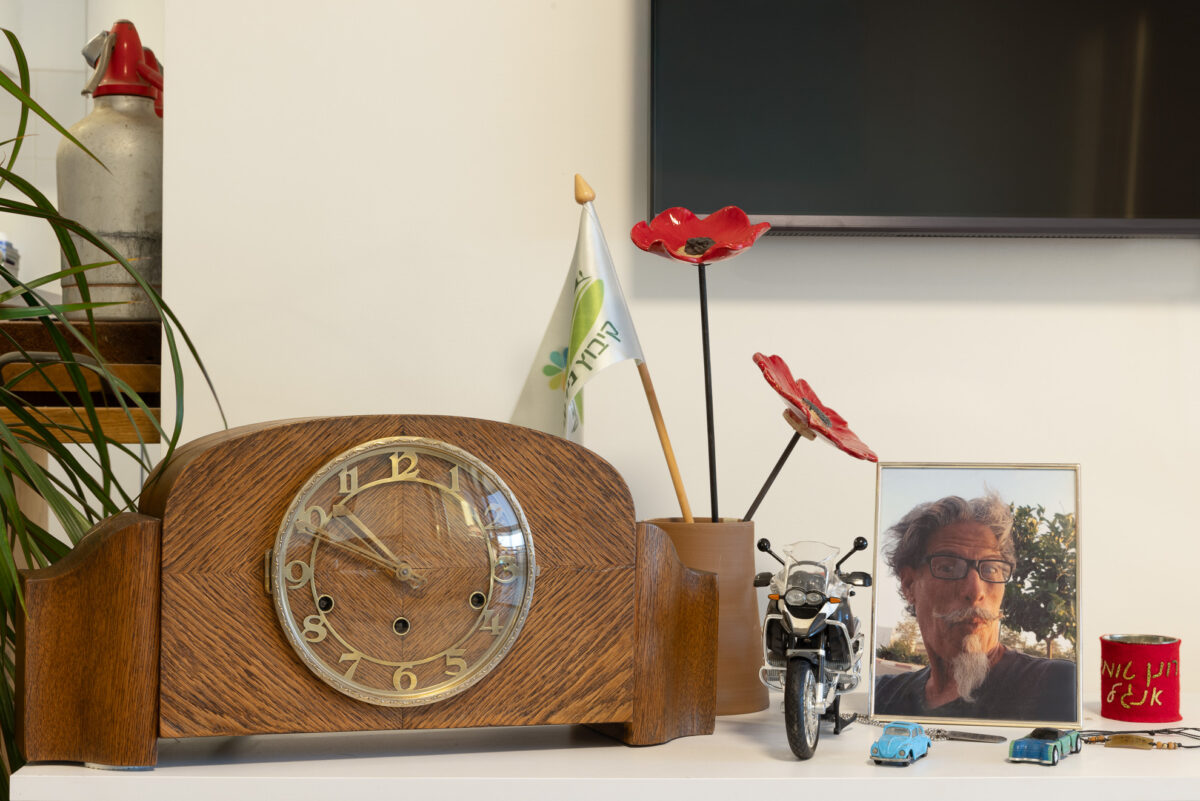
Only one object was chosen by multiple participants: clocks. “A clock has so much meaning for time,” Sterlin Halperin said, “for the time that was stopped, for the time that is left in life.”
One woman who is an archer chose to restore her bows, but they had been so warped from the heat in her safe room that they were impossible to restore. Instead, Gal was able to turn them into a decorative hanger for her replacement bows.
The team connected families to other artisans, who volunteered to help and restore objects that were not furniture. One family created a mosaic from broken plates, working hands-on alongside mosaic specialist Dina Meridor from the Yad Ben-Zvi Institute.
“We had a few participants who asked to take part in the hands-on work, and at first we had a dilemma. And this is where Biri [Rottenberg], as a professional, is a partner in thinking this through, whether it would be good for them.”
The emotional toll on the team, combined with the fact that most of the destroyed homes have now been demolished, led them to conclude their work. A final exhibition will be held in December at the Bat Yam Design Terminal, exhibiting the objects of nine families who chose to participate.
Comfort Object is a partner project of the Bearing Witness October 7 Archive, which is coordinated by the National Library of Israel and Israel’s Ministry of Heritage. The archival materials will also be held at the Yad Ben-Zvi Institute. “I feel that there really is a significant place for families and their stories. The basis of this initiative is emotional, documentary and artistic, and all three elements are given an important place,” said Sterlin Halperin.
The photographs and testimonies have been compiled into a catalog and book that will be published in January. Israeli writer Oryan Chaplin compiled the families’ stories, with producer and designer Anat Sacks. “Again, this is a women’s project,” Sterlin Halperin noted.
Most of the work undertaken by the five women was on a volunteer basis, but an initial significant investment from philanthropy enabled the project to get off the ground: the Jewish Agency’s Fund for Victims of Terror, the Azrieli Group and several other donors.
Shani Pitcho, a trauma researcher from Ben-Gurion University’s Department of Social Work, heard about the initiative and decided to study its impact on participating families and team members. Their research concluded what the team intuited: the process holds significant emotional value in rehabilitation. “For me, this was an important confirmation,” said Sterlin Halperin.
For Sterlin Halperin, the experience revealed a fundamental truth the chaos of survival obscures: “The story became survival, and people don’t give enough space to what a person creates. All our culture and objects — that’s what creates the person. Without it, what are we?”
Related News
CLOSING WORDS
In AZM address, Cosgrove links communal ‘orthodoxy’ on Israel to rising anti-Zionism among young Jews

PRESIDENTIAL REBUKE
Israel’s Herzog: Mamdani ‘makes no effort’ to hide disdain for Israel, Jews must fight back
HIGHER EDUCATION
As Jewish donors reconsider academia, Jan Koum doubles down, endowing Israel studies at Stanford

EXIT INTERVIEW
Elizabeth Sokolsky, longtime EVP of Birthright Israel, to retire next year
ADVANCING A VISION
N.Y. federation donates $1M toward building shared-society center named for peace activist killed on 10/7