Opinion
ASPIRATIONAL REALISM
How we built a CAD 50 million pan-Canadian coalition for the regeneration of Israel’s north




 Add EJP on Google
In Short
As we begin 2026, reflecting on our 18-month process establishing a strong coalition for the people of Israel’s Upper Galilee
For the Canadian Jewish community, Oct. 7, 2023, felt deeply personal. Each of our partnership regions — Sderot, Beersheva, and the Galilee Panhandle — suffered in different and devastating ways.
Through its federation system, Canadian Jewry’s intuitive, humane and responsible Zionism leapt into action. In record time, $140 million CAD was raised nationwide for the people and communities of Israel — the largest per-capita national funding for Israel during that period.
Moysh Levi/KKL-JNF
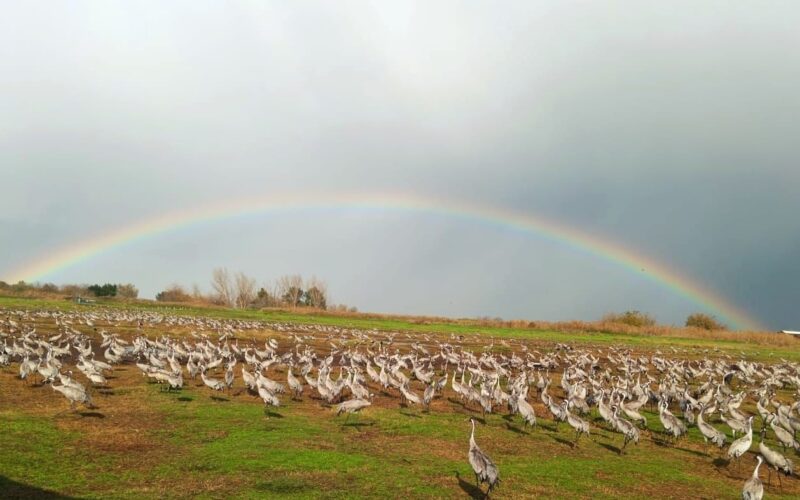
A rainbow is seen over a flock of migrating birds in the Hula Valley of the Upper Galilee in northern Israel on Jan. 13, 2026.
At first, each federation directed its emergency response toward its own region, while also contributing to national causes such as the Jewish Agency for Israel’s Victims of Terror Fund and the Joint Distribution Committee. But at Jewish Federations of Canada-UIA (JFC-UIA), we soon realized something: Israel’s north was becoming the silent victim of the war. Communities in the Galilee Panhandle had endured both the constant threat of fire and the pain of prolonged evacuation. Their resilience was remarkable — but their recovery would require collective care, and it would be JFC-UIA’s responsibility, as the convener of the national federation system of Canada, to do something about it.
So, we began to stitch together a coalition to support the north. This is the story, and the anatomy, of how it came together. We share this to offer insight into the back workings of the coalition-building effort as a model we invite you to join, adapt or replicate.
1.) Starting with a kernel
The idea was simple: Let’s do something together for the people suffering up north. But the minute we said together, the questions began. Who exactly is we? How much should each federation contribute — by size or by relationship to the region? Ought the funding be allocated immediately or for the long road to recovery? The idea had moral traction. But it needed clarity and structure.
2.) Aspirational realism: Aiming high but keeping our feet firmly on the ground
The Canadian federation system’s response to Oct. 7 emergency in Israel was made up of four campaign buckets: UJA Federation of Greater Toronto, Montreal Federation CJA, the Jewish Federation of Greater Vancouver, and the Coast-to-Coast Emergency Forum — an alliance of Winnipeg, Ottawa, Calgary, Hamilton, London, Edmonton, Victoria and Vancouver Island, Windsor, the Atlantic Jewish Council, and small communities across Ontario and Saskatchewan.
In consultation with the federations and with our JFC-UIA leadership in Israel and in Canada, we decided that each would contribute CAD 5 million to create a collective CAD 20 million fund. Equal buy-in from the outset signaled equal responsibility and respect. As I joked at the time, “Everyone’s slightly disappointed — and that’s a good sign.”
We knew our resources were significant — but nowhere near the scale of Israeli government funding. So, we had to be strategic and humble. We knew we would need to focus on where philanthropy could be transformative, not merely additive.
3.) Keeping people and needs at the center
Education soon became the heart of our coalition. Why? Because that’s what the people told us. Residents — both those displaced and those who had lived under fire — spoke unequivocally: after security, education is the key to the north’s vitality, and their own peace of mind. It’s what would allow their children and young adults to live full rich lives and to see a future worth staying for.
By listening closely to locals, we ensured our design was fit for purpose: rooted in real lives and real aspirations. For nearly three decades, Vancouver and Coast-to-Coast communities had invested in the Galilee Panhandle. Federation representatives in the region gathered the data and built trust that gave authenticity to our work. Our long-term philanthropic and people-to-people relationship became our strongest asset providing access, credibility and an intimate window into the lived experiences and hopes of the residents.
4.) Consultation without chaos
When we called for proposals, we cast the net widely and astutely. We asked specific questions of smart people and resisted the temptation to create noise.
We leaned on trusted partners — the Jewish Federations of North America (JFNA), Canadian foundations in the region, Keren Hayesod, informed Israeli government colleagues, and local thought leaders. Through the Regional Knowledge Centre (if you don’t know them, you should), we gained a clear, data-rich snapshot of the region’s real needs.
The exercise was far from sterile. It was an iterative learning process — informed by local experience, national perspective and knowledge of the philanthropic ecosystem. The allocation expertise and philanthropic know-how of Toronto and Montreal federation representatives complemented the regional understanding of Vancouver and Coast-to-Coast. Together they offered a 360-degree lens — both the close-up and the aerial view.
5.) From competition to collective ownership
Initially, we assumed each federation would select its own priorities from a list of approved proposals. It felt obvious and fair. But we quickly realized that it would fragment the vision. A “shopping list” of projects would reduce us to consumers, not partners.
So, we designed something different — a single, interconnected architecture of educational and academic regeneration. Every project reinforced another.
Kiryat Shmona Community Centers and Tel Hai University on the Rise, for example, became two ends of one continuum — the nurturing of young people in the north. University students volunteered in local community centres; children there, in turn, dreamed of becoming those students.
The federations surprised us: they all chose to invest in the full pie, each taking an equal quarter. The shared stake turned our collaboration from cooperative to collective.
6.) Leveraging the Levers
We built three types of leverage into the model:
- Financial: Each federation’s $5 million created immediate leverage — a shared $20 million pool. From the outset, we required grantees to secure at least 1:1 matching funds. That discipline, combined with additional partners — Canadian foundations, JFNA, the Jewish Funders Network, Keren Hayesod and others — grew the fund to $25 million. In total, the coalition leveraged $50 million CAD, delivering a 1:9 ratio for every founding federation.
- Organizational: Grantees collaborated to amplify one another. When Maoz and the Habayta Foundation worked together to advance educational leadership, with training, excellence and innovation feeding off one another, one plus one made three.
- Human capital: We chose to invest in the skills, knowledge, and relationships of influential leaders in the region to build deep capacity that stays in the system long after the funding cycle. This forged a sustainable resource for the region’s growth.
Together, these layers of leverage formed a durable engine for regeneration.
7.) Trusting the people and the process
Building a coalition isn’t simple, different actors have distinct interests that might, under some circumstances, clash and obstruct the process.
We chose to operate on a simple principle: assume good intent. As an example: What could have been misread as stalling was understood as professionalism, rigour and respect. And those who wanted to move faster were recognized instead for their high efficiency and get-it-done approach.
This ethos helped us avoid politics and maintain focus on what mattered: creating a high-impact, integrated portfolio that would leave Israel’s north stronger than ever — educationally and academically.
8.) Staying with our grantees
Once we committed, we stayed. Our grantees became partners in impact. We advocated for them, helped secure matching funds, and protected their expertise from well-meaning interference. We continue to stand behind them — bringing in new resources and ensuring full project funding. (Be in touch if you’d like to join us.)
9.) Building culture, ritual and community
Part of the reason I believe our coalition of initial funders grew and continues to grow is that we didn’t just technically build a coalition, we built a community.
We gave our collective a name — the Pan-Canadian Coalition — and the intervention itself: Project Regeneration. We established rituals of communication: regular updates, shared milestones, and a rhythm that kept Israel and Canada connected.
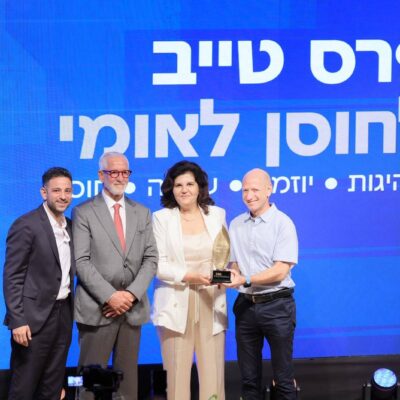
And we marked progress. In March, the coalition’s formalization in the presence of Israel’s first lady, Michal Herzog; and in October, the Cornerstone Ceremony for the Canada Graduate and Advanced Degrees Building at Tel Hai University on the Rise — where each community placed a piece of itself in a shared time capsule under the very place where our building will be built.
We realized we weren’t just designing an allocation model. We were building a movement — one that engaged smaller and larger federations with one another, inspired new donors and partners, and gave Canadian foundations a way to be part of something truly national.
10.) The result
Eighteen months on, what began as an idea has become a living model of aspirational realism. The Pan-Canadian Coalition isn’t just funding projects — we are working, together, humbly and alongside the people of the north, to build pathways toward strong futures for their children.
We’ve built a framework for impact and accountability, with a strong Pan-Canadian subcommittee and a process for measuring what matters most: educational achievement, community vitality and a north where young people can learn, live and thrive.
The stakes remain deeply human. A while ago, a teacher told me about a 10-year-old boy, recently back from evacuation, who she found in the school playground, fingernails thick with mud, digging by the fence. When she asked what he was doing, he replied, “So I have a way to escape, if I need it.” That image stays with me. This young boy deserves more than escape — he deserves a future. And that’s what this coalition is about.
Our founders feel it too: “This is the first time I feel part of something truly national,” one said. That’s the power of collective action — achieving more together than any one of us could alone. Aspirational and realistic. Exactly what this moment demands.
Sarah Mali is the director general of Jewish Federations of Canada-UIA Canada in Israel.