Opinion
SURVEY SAYS
The future of peacebuilding depends on bridging a growing generational divide




 Add EJP on Google
In the two years since Oct. 7, 2023, the peacebuilding field of Israelis and Palestinians has been wrestling with a question we never wanted to confront: Is this work still possible, and if so, what needs to change for it to matter?
Some practitioners, especially younger ones, are unsure whether the old approaches still meet the urgency and pain of this moment. Others, who have spent decades building relationships across borders, believe that steady, incremental work is more important than ever.

Arava Institute for Environmental Studies/Facebook
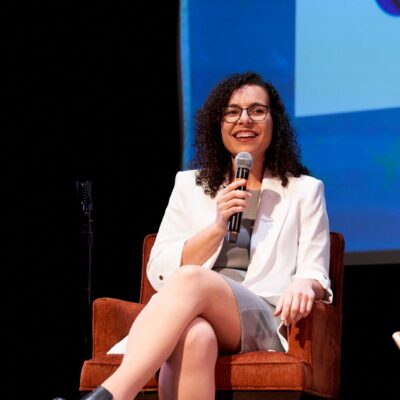
Arava Institute for Environmental Studies researcher Miri Lavi-Neeman (second from right) and executive director Tareq Abu Hamed (second from left) speak at the People’s Climate Conference in Tel Aviv as part of the conference's “Climate and Peace” panel on Jan. 4, 2026.
These differences are real, and they have created noticeable tension inside a field that already carries enormous emotional weight.
The Arava Institute for Environmental Studies set out to understand these dynamics more clearly. A new white paper, “Adapting for Impact: Intergenerational Strategy in the Peacebuilding Sector,” draws on conversations with more than 100 professionals at different stages of their careers, representing Israeli, Palestinian and regional organizations.
The findings are clear. Younger and older professionals share the same long-term goal of peace, but they differ sharply in how they understand the path to get there. Early- and mid-career practitioners — what we call “NextGen”— are more likely to stress the need to address root causes, power structures and systemic injustice. Many described a strong desire to bring political framing and structural analysis into their work, especially in relation to the occupation and inequalities that shape daily life. Some told us that after Oct. 7 they questioned whether their work was unintentionally sustaining the conflict rather than helping to resolve it.
Veteran professionals, or “LegacyGen,” tended to emphasize trust-building, continuity and incremental progress within the systems that already exist. These practitioners carry decades of cross-border relationships and are often responsible for running institutions, managing donor expectations and safeguarding programs that have survived political shocks before. They felt the trauma of Oct. 7 deeply, but fewer said it led them to reconsider their overall approach. Many believed that staying the course — focusing on cooperation, dialogue and practical projects — was more important than ever.
These differences come into sharper focus when looking at willingness to engage in cross-border work after the war. The Arava Institute surveyed NextGen peacebuilders, Israelis, Palestinians and others, in early 2024 and found that 58% still said yes, they were willing to stay engaged — though with more caution and a clear insistence that the work acknowledge people’s trauma and immediate needs. Another 28% said they were “maybe” willing to engage, but only under the right conditions. Fourteen percent stepped back completely.
When we checked in again in early 2025, the picture had shifted. The “no” group dropped from 14 to 10%. The “maybes” dropped from 28 to 12%. Seventy-eight percent said they were once again willing to engage. But nearly all emphasized that this willingness came with a new seriousness: they were not willing to return to business as usual. They wanted work that is honest about the moment we are in, that creates space for both cross-communal and uni-national efforts and that does not minimize the trauma communities continue to experience.The opportunity is there.
This generational divide is not simply about politics or personality. It reflects different approaches to change. NextGen professionals tend to start with the question of how: what values, language and organizational culture guide the work. LegacyGen tends to start with the question of what: what programs, outputs and deliverables keep cooperation alive. Both approaches matter, but they can clash if they are not intentionally brought together.
Now nearly 30 years old, the Arava Institute for Environmental Studies is engaged in stewarding this generational collaboration. Just last month, the Institute brought together Palestinians, Israelis, Jordanians and others for an alumni conference. Some participants attended the Institute 25 years ago and others only two years ago. One Palestinian alum, now a researcher who studied at the Institute more than 25 years ago and had not joined an alumni gathering in many years, explained why she returned: “I needed to be with people who believe there is a possibility for a positive peace. I needed hope.”
Our job now is to bridge these approaches.
To that end, “Adapting for Impact” lays out some clear strategies. Peacebuilding organizations should make intergenerational collaboration an explicit operational priority, not an informal aspiration. That means assigning staff time, budget lines and leadership responsibility to managing intergenerational dynamics, just as organizations already do for fundraising, partnerships, or program delivery. When collaboration across generations is treated as “extra” work, it predictably falls apart under pressure. When it is resourced and expected, it becomes part of how institutions function, even during crises.
Organizations must also invest in real leadership pipelines rather than improvised succession. This means formal mentorship paired with gradual transitions of authority, clear expectations about leadership development and training that prepares NextGen professionals to manage teams, donors and public scrutiny. Without this intentional handoff, institutions risk losing both hard-earned institutional memory and the next generation of leaders capable of carrying the work forward.
There is clearly a next generation of Israeli, Palestinian and other Middle Eastern environmental and other peacebuilders who are ready to engage. For funders and supporters, this is a moment of opportunity. Long-term, multiyear investments are essential for sustaining collaboration across generations.
Philanthropic investment will support intergenerational engagement, allow early-career professionals to deepen their involvement over time, build trust and take on increasing responsibility. Peace work cannot be treated as a series of short-term projects, especially now. It requires patience, humility and a commitment to both innovation and continuity.
Across the region, there are Israelis, Palestinians, Jordanians and others who continue to reach for partnership even when the public climate discourages it. Their voices are steady but often drowned out, and they rarely receive the recognition or backing that more polarized narratives attract.
The future of peacebuilding and environmental diplomacy will belong to those who can hold both memory and change at the same time. If we can bring generations together, we can create a peacebuilding architecture strong enough to meet this moment and flexible enough to adapt to what comes next.
Rachel Kalikow is the CEO of Friends of the Arava Institute, the U.S.-based, nonprofit fundraising and awareness arm that supports the Arava Institute for Environmental Studies.