Opinion
AFTER THE ATRA REPORT
We finally have data on the rabbinate. The reactions are a dataset, too.




 Add EJP on Google
In Short
New data has exposed both strain and opportunity in the rabbinic pipeline and contemporary rabbinate. The next test is whether the Jewish communal field can move from urgent reaction to coordinated, system-level change.
When our community gets data it has lacked for decades, the findings matter. But how our field reacts may matter even more.
Our release of “From Calling to Career: Mapping the Current State and Future of Rabbinic Leadership” offered something unprecedented: a shared, empirical portrait of the non-Haredi rabbinate and the rabbinic pipeline. It gave us common language for questions that have simmered for years about training, sustainability, leadership and the future of the profession.
Shulie Seidler-Feller
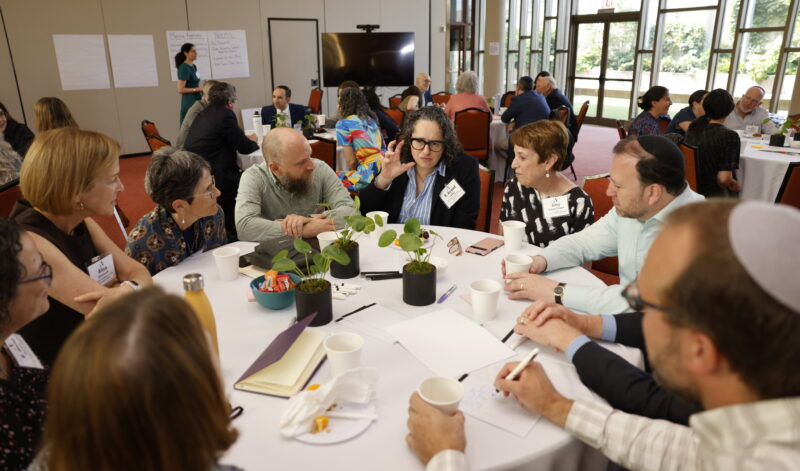
Leaders of Seminaries and Jewish Organizations gathered on June 11, 2025 as a part of Atra’s Rabbinic Pipeline Initiative. Attendees pictured include Alisa Doctoroff, board chair of Atra; Rabbi Sharon Cohen Anisfeld, president of Hebrew College; Rabbi Ayalon Eliach, chief ideas officer, Lippman Kanfer Foundation for Living Torah; Rabbi Ayelet Cohen, dean of the Jewish Theological Seminary Rabbinical School; Amy Skopp Cooper, CEO of the Ramah Camping Movement; and Rabbi Jason Herman, executive director of the International Rabbinic Fellowship.
What followed was swift and intense. Within days, we heard from seminary deans and early-career rabbis, foundation executives and synagogue presidents, interpreting the same data with urgency and conviction, often drawing sharply different interpretations about what it means and what should happen next.
As we watched the reactions unfold, we realized that we were watching a second dataset form in real time. Not a dataset about rabbis, but about us: our systems, our instincts and the way the Jewish community responds to urgency, uncertainty and change.
And this dataset, we believe, is as valuable as the report itself. Here is what we find the reactions reveal about the Jewish communal system:
1.) We move fast — and we often mistake motion for progress.
Within hours of publication, people were naming solutions, launching initiatives, debating interventions and debating what should happen next. This instinct comes from a beautiful place. We care deeply. We want to fix what hurts, amplify what works and secure a Jewish future that feels vibrant and meaningful.
But the challenges before us are structural and systemic. Burnout, tuition costs, compensation, geographic mismatch, institutional misalignment and outdated training models are not solved by inspiration alone. They require planning, coordination and a shared sense of direction.
When faced with complexity, our communal reflex is often to act quickly by building new programs. But a single program does not change a pipeline, and isolated interventions do not transform a profession.
Systems change requires a different skill set: shared metrics, coordinated strategy, communication infrastructure, and long-term alignment. These are not muscles our field has historically exercised together—and that gap is now visible.
Urgency is not the enemy. Acting before we have alignment can be.
2.) Much of the debate is not just about rabbis — it’s about change, belonging and legitimacy.
Some of the most charged reactions to the data have focused on demographics, “fit,” rabbinic quality and the degree of Orthodox participation. These visible markers carry so much weight because they are easier to debate than the deeper questions the Jewish community is struggling to articulate. Questions like: Who are we becoming? Whose leadership feels legitimate? What kinds of authority, identity and institutions can sustain Jewish life in a period of rapid cultural and generational change?
Focusing on demographics and representation allows us to treat these tensions as technical problems rather than invitations to deeper reflection. But when we stay at the surface, we miss what these debates are actually revealing: widespread unease about change, belonging, legitimacy and who gets to define the future of the community.
Critiques about how Modern Orthodox students and rabbis were or were not captured in this research, including questions about Yeshiva University-Rabbi Isaac Elchanan Theological Seminary participation, bring this dynamic into sharper focus. These responses reflect concern about representation given the central role Modern Orthodox rabbis play in many Jewish communities, and they surface deeper questions about legitimacy and relationship across denominational lines. Who gets studied. Who gets funded. Whose leadership models are treated as central rather than peripheral. This study cannot resolve those questions, but it helps bring them into clearer view, especially at a time of rising antisemitism that does not distinguish between denominations and calls for strong rabbinic leadership are consistent across the Jewish world.
Strengthening the future rabbinate will require more than settling any one representational or demographic debate. It will require a field-wide process capable of holding complexity and difference, and of building shared responsibility across communities that do not always assume one another’s legitimacy.
Our work at Atra is grounded in deep relationships across the Jewish ecosystem and a commitment to working with rabbis, institutions, and communities across denominations who care about strengthening rabbinic leadership in all its forms. To those in the Orthodox community who may wonder if there is a place for them in this field-wide process, our answer is unequivocally yes. We approach this work with humility, guided by the teaching of Pirkei Avot, “Who is wise? One who learns from every person” (4:1). The future we need will be shaped only if we are willing to learn from one another, make mistakes together and lead together.
3.) The field is ready — and eager — to get to work.
This may be the most important finding of all.
The intensity of the reactions reveals a field hungry for alignment, clarity, and direction. Rabbis, funders, seminaries, institutions and lay leaders are not apathetic or disengaged. Many are already engaged in serious, thoughtful work, often through parallel efforts that have been developing quietly and diligently for years.
What they are asking for now is not permission, but path: shared goals, greater coordination and a way to connect existing efforts into something coherent and durable. They want to help shape a rabbinate that is sustainable, meaningful and leads us into the future.
This energy is a gift.
But it needs a container.
Both of us have built organizations — Base (now a part of Mem Global) and Atra — because we saw gaps in the Jewish ecosystem and felt a deep responsibility to act. Neither of us is wired to sit back and wait for systems to change on their own.
And yet, what experience has taught us is this: urgency without strategy burns out leaders and fails to shift reality.
If we want to build the rabbinate the Jewish future requires, we cannot sprint alone. We must move together with clarity of purpose, shared methodology, and patience for complexity. That means slowing down just enough to ask better questions, to understand what is already in motion across the field, to allow disagreement to deepen understanding rather than fracture relationships, and to build trust across institutional and denominational lines. The path will not be easy. We must be prepared to give one another grace, question long-held assumptions, and open ourselves to an emerging future we cannot fully predict.
We have data. Now we need coordination.
For the first time, the field now has a robust dataset on rabbinic identity and pipeline trends, a loud, unvarnished set of communal reactions revealing stress points and aspirations and a shared recognition that something must change.
This is the moment when systems change becomes possible — but that only happens when people align around a shared goal, a common methodology and a coordinated plan.
The K–12 STEM ecosystem learned this through the work of the Starfish Institute and the national initiative 100Kin10. Hundreds of organizations aligned around a single objective, mapped systemic barriers and coordinated interventions, rather than launching scattered programs. Over ten years, they helped create 110,000 new STEM teachers.
We don’t need 100,000 new rabbis. We need a field in which every community can access the rabbinic leadership it needs, and in which rabbis can thrive across roles, geographies and stages of life. This is an achievable goal if we work together with focus and discipline.
As Atra enters its next phase of work on strengthening the rabbinic pipeline and the contemporary rabbinate, it is partnering with the Starfish Institute to bring proven systems change frameworks to this field. Together, this work aims to:
- Define a shared, achievable field-wide goal
- Map the systemic challenges revealed by the data
- Coordinate interventions across organizations
- Build durable communication and learning loops
- Create lasting rather than episodic change
This is how systems shift: not through urgency alone, but through urgency aligned with strategy.
This moment feels consequential not just because we finally have data, but because the field is paying attention. We are inspired by the energy this study has ignited and grateful for the serious, and sometimes provocative, responses it has inspired. We are listening carefully to critiques. Most of all, we are encouraged by a field that is already doing serious, thoughtful work and is ready to connect those efforts into something more aligned and systemic.
Before rushing toward the next shiny intervention, we invite the Jewish communal world to pause briefly and intentionally and anchor its efforts in shared purpose and shared methodology. We are ready and excited to partner with rabbinic schools, training programs, funders and institutions across the Jewish ecosystem to help shape a future rabbinate that can truly meet this moment with depth, courage and collective responsibility.
Rabbi Shira Koch Epstein is the founding executive director of Atra: Center for Rabbinic Innovation.
Faith Brigham Leener is the senior strategist for Atra’s Rabbinic Pipeline Initiative. The founder of Base (now a part of Mem Global), Brigham Leener was most recently the chief innovation officer of The Pardes Institute of Jewish Studies.