COLD CASES
New Claims Conference grant helps Center for Jewish History solve Holocaust-era family mysteries
With a new grant from the Claims Conference, researchers can use social media and archives to shed light on family histories and educate people about the Holocaust
Courtesy
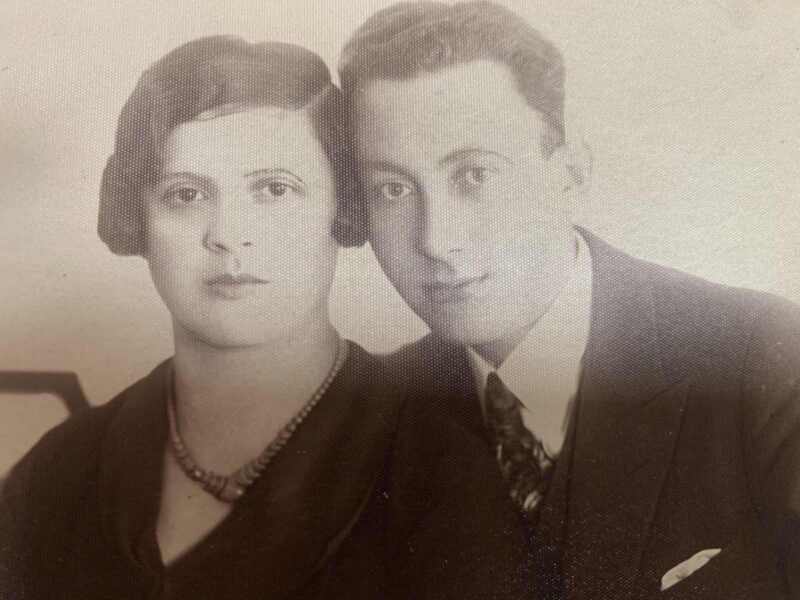
Renia and Chajim Rosenbluth.




 Add EJP on Google
When the Nazis seized Poland in 1939, Ilana Rosenbluth’s family fled to Uzbekistan, where her grandfather peddled bolts of fabric used to make suits. Four years later, he boarded a train to Andijan, a city known for textiles, and never returned.
What happened to her grandfather has plagued her family to this day, but a new initiative, Histories and Mysteries, launched last week by The Ackman & Ziff Family Genealogy Institute at the Center for Jewish History, where Rosenbluth is director of communications, offers her hope of finding out.
The initiative, backed by a nearly $300,000 grant from the Conference on Jewish Material Claims Against Germany, more commonly known as the Claims Conference, looks to solve Holocaust-era family mysteries, posting the research journey across social media, using both Jewish and non-Jewish influencers to educate new audiences about the Holocaust. Rosenbluth hopes it will provide closure to her family and the legion of others with unanswered questions.
To Rosenbluth, growing up with three grandparents seemed like the norm. Any talk of her grandfather was spoken around the household in Polish or Yiddish to shield her from the truth. Only later in life, in 2009, when her father was dying of cancer, did she press him for answers: Why was the only remnant of her grandfather a single photograph?
“I’m so sad that my father died never knowing what happened to his father,” she told eJewishPhilanthropy.
After receiving an online inquiry, CJH’s experts dive into archives, some online, such as the Arolsen Archives, the largest archive on victims and survivors of Nazi persecution, and sometimes contact other experts as far as the Buchenwald Memorial Archives in Germany or the Archives de Vienne in France.
“I like to view it as a puzzle,” Jenny Rappaport, CJH’s head genealogist, told eJP. “You’re never going to have all the pieces of a Holocaust story, unfortunately, just due to record loss, because things were destroyed. There aren’t all the pieces left. But I try to put it together as much as possible.”
Still, there’s hope, Miriam Malka Frankel, CJH’s social media coordinator, told eJP. “People think that 81 years ago, when the Holocaust happened, is just so far away, but it’s alarmingly closer than we realize, and there are so many answers that can still be found.”
The answers may even come from a simple online game of Jewish geography. CJH plans to pose questions across social media platforms to see if its followers may be able to help. A picture posted on Instagram may lead to someone who knows details about the people in them.
Already, over 20 people have sent in mysteries for CJH to solve, including a woman seeking to find out what happened to her great-grandfather’s sugar-making factory in Poland, which had been taken over by the Nazis. She is also seeking to find the factory workers who put their lives in jeopardy to hide her family.
“I would love, ideally, to get a broad range of submissions,” Rappaport said. “For example, people don’t often know that Sephardic Jews were incarcerated in concentration camps, and I would love a submission about that.”
Submissions so far have been sent by people with zero genealogical research experience to others who come to CJH with well-formed family trees.
“No question is too small, and no question is too big,” Frankel said. “If someone is having a mystery and they’re feeling shy because they feel it’s not as impactful or important as someone else’s, we are here to say that every story matters, every question matters.”
A question about a lost ring or a stolen necklace could lead to incredible discoveries, Frankel said.
Histories and Mysteries is funded through July 31, with the Ackman & Ziff Family Genealogy Institute continuing its regular work exploring Jewish family history both during and after the funding ends.
Beginning next month, CJH will share the discoveries across their social media platforms — Facebook, Instagram, X, Tiktok and LinkedIn — partnering with Jewish and non-Jewish influencers, hoping to reach new audiences at a time when some seek to erase the truth about the Holocaust.
“It’s one thing to keep promoting things within your own community,” Rosenbluth said. “Most Jews know about the Holocaust and know the ramifications of hate, so one of the important things is to push it to a wider audience.”
Holocaust stories that once were told through memoirs are now being told through 90-second posts, Gideon Taylor, president of the Claims Conference, told eJP.
“The biggest challenge for Holocaust education is, how do you make it relevant for a younger generation now, and how do you use the forms of communication that didn’t exist 20 years ago or 10 years ago?” he said. “This is a really good example of how Holocaust education has changed, and we changed with it.”
Quality Holocaust education isn’t about just stating facts, Taylor said. It is about making people ask questions about why people reacted the way they did and what led to these horrors.
“It has to be individual, because the scale [of the Holocaust] is so massive and so huge that, by far, the most effective way for people to learn about something like the Holocaust is through an individual story,” he said.
During an age when people ingest information with short attention spans, short-form content allows CJH to reach new demographics, Frankel said.
The findings of the initiative may be bittersweet for many, she said. Participants are “finding out details that might cause discomfort. It might, of course, be sad because they’re hearing these horrible details,” but learning answers can also provide comfort and closure.
“The Nazis tried so hard to erase us, and just by doing this project, it’s a form of resistance,” Bonnie Elkaim, lead museum educator and guide at CJH, told eJP.
As an educator for over 27 years in New York City, Elkaim taught students about the Holocaust, but she could never share the story of her great-grandfather because she knew so little about him. When she retired last year, she dedicated herself to learning more about his history, and this project is offering her the opportunity to. “My grandparents were survivors, thank God, but my great-grandfather didn’t [survive],” she said. “I do feel that I need to be his voice.”
While there is hope that people’s mysteries can be solved, “this might be the very last time you can get a firsthand account” of what occurred, Rosenbluth said.
The CJH has been deep in the archives, searching for information about Rosenbluth’s grandfather’s disappearance. During their work, they discovered the wedding date of Rosenbluth’s grandparents, a detail she never knew.
“It was an amazing feeling,” learning the date, Rosenbluth said. Suddenly, her grandparents’ story opened before her. They lived a youth filled with optimism that was severed, leaving her grandmother alone with two young children.
Learning the details about her grandfather was learning about herself, she said. “My life didn’t begin in the 1970s. It really began in 1939 because everything that happened during World War II, it affects me today.”
Related News
EXIT INTERVIEW
Elizabeth Sokolsky, longtime EVP of Birthright Israel, to retire next year
PRESIDENTIAL REBUKE
Israel’s Herzog: Mamdani ‘makes no effort’ to hide disdain for Israel, Jews must fight back
HIGHER EDUCATION
As Jewish donors reconsider academia, Jan Koum doubles down, endowing Israel studies at Stanford

MAJOR GIFTS
Center for Jewish History celebrates 25 years with a $25M matching grant

MAGICAL EXPERIENCE
Shefa launches psychedelics retreat for Jewish professionals suffering burnout