Opinion
LOOKING AHEAD
From ‘Surge’ to strength: Rebuilding our community connection to Israel




 Add EJP on Google
For two years, the unspeakable atrocities of the Oct. 7 attacks and the events that followed upended Jewish life around the world. The focal point of this reorientation has been Israel — its people, its land, its pain and its wars.
In Israel, every day since has felt like Oct. 7, 2023: an unending nightmare of loss, fear and trauma, met with grit, resilience and an unshakeable commitment to life. Our community’s transformation in North America has also been profound — “the Surge” we’ve been tracking at Jewish Federations of North America highlights a powerful and significant increase in Jewish engagement.
Yaron Geller
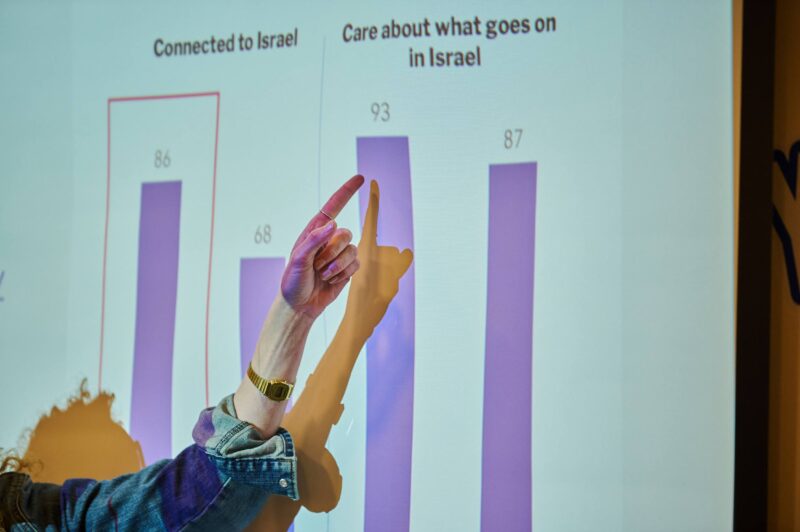
From a presentation during the Israel Educational Travel Alliance's tour educator training in April 2025.
This Surge has shown remarkable staying power, with 31% of Jews reporting deeper involvement in Jewish life even 18 months after the Oct. 7 attacks; and it’s been marked by emotional intensity and tangible impacts: increased connection to Israel, more time spent with other Jews, greater participation in communal programs and renewed interest in Jewish learning. It’s driven by a powerful mix of care, concern and complexity around Israel and its impacts on us.
More than two years later, we face crucial questions:
How can we retain, strengthen and deepen these enriched connections to Israel as the fog of war begins to lift?
And how can we move forward with education and conversations that forge new and renewed relationships with Israel and Israelis to build the future we wish to see?
The Surge research offers important insights into the path ahead.
Our data shows that 71% of Jews feel emotionally attached to Israel, up from the 58% recorded by Pew Research Center in 2020. An overwhelming majority — 88% — believe in Israel’s right to exist as a Jewish and democratic state, and 87% believe Israel has had valid reasons for fighting Hamas. And while anti-Zionist protests may dominate headlines, only 7% of Jews identify as anti-Zionist — including just 14% of young adults. Most Jews, across generations, are even prouder of and more connected to Israel today.
At the same time, talking about Israel in Jewish spaces has become increasingly fraught. One in three Jews say that conversations about the war are negatively impacting their sense of belonging. Thirty-five percent feel they wouldn’t be welcome in their Jewish community if they shared their views on Israel. Nearly half — 49% — believe the Jewish community doesn’t allow for nuanced conversations about the war. And 37% are simply tired of talking about Israeli politics in Jewish spaces. Even as the vast majority support Israel and believe its reasons for fighting Hamas are justified, just 55% think it has been carrying out its response in an acceptable way.
These tensions are not one-sided. The feeling of not being able to express one’s views is shared by Jews across the political spectrum: Thirty-nine percent feel the community is too hardline in its support of Israel, while 34% feel it’s not strong enough. The critique comes from both ends, and often from those most driven to engage. In fact, those who express discomfort or disconnection around Israel conversations are more likely to be part of the Surge than not. They are showing up, not walking away. Only 7% of Jews say they are avoiding Jewish institutions more because of these issues. Oftentimes, they are seeking like-minded and safe spaces for connection and expression.
The Surge data tells us that the challenge isn’t disengagement: it’s how to hold space for a community that is both deeply connected and deeply divided, and how to give people the confidence to enter learning with all their questions.
This moment demands action. So, what can we do now at this critical juncture?
As Jewish leaders, we must respond to the call to serve our communities by doubling down on what works and opening paths to ensure that these now connected Jews find homes within our communities. As Eric Fingerhut recently shared, “Here at home [in North America], rebuilding means strengthening and restoring where necessary the connections between our Jewish communities in North America and Israel.”
At the upcoming Jewish Federations of North America General Assembly, we will explore what this looks like with experts in the field. To begin, here are our data-backed recommendations:
Proudly support Israel
This looks like Jewish leaders publicly and legislatively standing with Israel in a time of vilification. Jewish North Americans overwhelmingly believe in Israel’s right to exist as a Jewish and democratic state and support our leaders protecting and representing this.
Create internal space for complexity
At the same time, leaders and educators must work to create diverse spaces for honest, nuanced and educational conversations about Israel — as a part of Jewish identity, as a country and as a place of deep conflict. Philanthropy has a vital role to play in encouraging and supporting institutions to dig into this hard and necessary work to ensure we sustain connection with these formerly unengaged Jews we’ve all sought to bring into community for so long.
Reinvigorate Israel travel
We also must encourage any community member and non-Jewish peer who is curious about Israel to get on a plane and go see it for themselves. Israel educational travel is among our most proven and longest lasting opportunities to build and deepen Israel connection and support among Jews and non-Jews alike and ignite Jewish identity among Jews of all ages. It’s time to recommit to these journeys and their new potential — incorporating stops to nations now normalizing relations, extending opportunities to teens, lay and professional leaders, educators, allies and people of all ages — to reinforce and revitalize our foundations.
Cultivate diverse Israel offerings
Welcoming these individuals is not as simple as providing one program. As the broader Jewish community becomes increasingly diverse, we know that people engaging for the first time, those showing up more, or those who feel unsure about articulating their views are looking for spaces with like-minded peers. This gives them a homebase and a micro-community, from which they can have the comfort to enter broader Jewish spaces. We must provide offerings as diverse as those we serve.
Center joy and spirituality
We also need to hold space for Jews of all backgrounds to come together in spirituality, joy and wellbeing — sometimes without Israel at the center — so we can connect through our shared humanity.
Jewish Federations of North America are doubling down on our commitment to support the federation movement in leading through this time of rebuilding connections to Israel by helping federations build future-facing Israel education strategies, connecting them with programs and content that meet their education and engagement needs, developing new offerings to fill gaps and maximizing participation in transformational Israel educational travel.
The extraordinary challenges of the past two years have shown us that we can navigate a time of extraordinary complexity with extraordinary commitment. The Surge has been real. Now, we must meet this moment — with empathy, clarity and courage — to ensure this end becomes a new beginning, and this surge becomes sustained strength. JFNA and individual federations are here to set the table for the professional and lay leaders who will shape our next chapter.
Anna Langer is the vice president of North American Israel strategy for Jewish Federations of North America and acting executive director of the Israel Educational Travel Alliance.
Mimi Kravetz is the chief impact and growth officer for Jewish Federations of North America.