Opinion
MA'ASEH AVOT SIMAN L'BANIM
From pyramids to skyscrapers: Lessons of our ‘Great Diasporas’




 Add EJP on Google
This article is part of a series expounding on key ideas raised at AJ2026, a conference on the future of American Jewry organized by Reut USA in Miami on March 4, 2026.
Jewish Encyclopedia
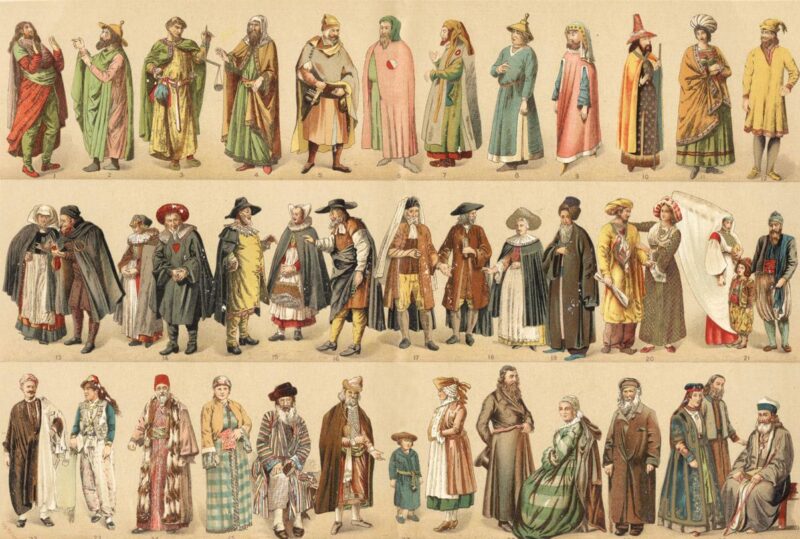
French Jews of the Middle Ages. From the 1901-1906 Jewish Encyclopedia.
Pesach is our annual commemoration of the Exodus from Egypt, which launched us into Jewish Peoplehood and ended our first centuries-long “Great Diaspora.” While we tell the story of the Exodus every year, there is also much to learn from the archetypal story of the Israelites’ time in Egypt, which has many relevant lessons for American Jewry. The following are a few of them.
Diaspora is a feature, not a bug
Genesis describes multiple journeys of our Patriarchs and Matriarchs from the Land of Israel to Egypt or Haran (an ancient city in modern-day Turkey) to find food or seek shelter. In Deuteronomy, Moses refers to exile as a permanent possibility when our sovereign society turns morally corrupt.
Indeed, since the destruction of the First Temple in 586 BCE, we have had uninterrupted diasporic communities. Even after the return to Zion in 538 BCE, Jews lived in Babylon, as well as other places; and from the second to the 20th century CE, nearly all Jewish life was outside Israel. Since 1948, a thriving Israel has existed in parallel to a prosperous world Jewry. Against this backdrop, American Jewry, as the Great Diaspora of our time, may have a long future ahead of it.
Great Diasporas have a great mission
Some diasporas enjoy such prosperity, influence and institutional strength that they become a dominant Great Diaspora. The community of Israelites in Egypt led by Joseph was the first such diaspora, and American Jewry is the current one. The mission of these diaspora communities is to ensure the security and well-being of the Jewish People. Joseph himself acknowledges that a divine mission was bestowed upon him: Though his brothers didn’t have his best interests at heart when they sold him into slavery and he descended to Egypt, “God intended it for good, so as to bring about the present result — the survival of many people” (Genesis, 50:20).
American Jewry has followed in these footsteps, absorbing millions of Jewish refugees, calling for freedom for Soviet Jewry, fighting antisemitism and supporting Israel. That mission is long-lasting and should continue to inspire American Jews.
No American Pharaoh
The political shift against the Israelites happens after two centuries of life in Egypt. A new Pharaoh ignores past favors by Joseph, incites against the Israelites and then weaponizes law and police to oppress, enslave and exterminate them.
Many contemporaries conclude that America too could “turn on its Jews.” But the lesson is actually the opposite: American political power is decentralized, with checks and balances among the three branches of government, among federal, state and local governments and among the 50 states. Throughout history, when targeted, Jews had to move to a different nation. In America, they can relocate to another state. Therefore, America’s constitution and federalism are critically important to the future of world Jewry. We should protect them with all our power.
Assimilation is not terminal
Joseph’s appearance was so “Egyptian” that his brothers didn’t recognize him. At the same time, he remained loyal to his tribe and requested to be buried in the Land of Israel. In Egypt, some Israelites preserved their language, costumes and names while others embraced Egyptian culture and even idolatry.
Assimilation and intermarriage have long been central concerns of Jewish life in open societies, but are rarely the cause for the decline of a Great Diaspora. American Jews have contended with these challenges since the 17th century, and many rabbis confidently predicted the disappearance of American Jewry, but we are still here.
Being a wedge issue is bad news
Pharaoh turned on the Jews for two reasons: a fear that they would take over Egypt or collude with its enemies. The underlying concern was that the Israelites were monotheists whose beliefs challenged the Pharaoh and his priests, who claimed divine powers. In such a clash — like the confrontation between Judaism and Christianity in Europe — only one side can be vindicated.
While America is a republic where church and state are separated, the lesson remains valid. If possible, let’s avoid becoming a wedge issue for our host societies. Sadly, for American politics, the stature of Israel is becoming such an issue. It should be our top priority to reverse that trend.
Be proactive at inflection points
The peak of Israelite life in Egypt is described at the end of Genesis, when Joseph saves the Egyptians from hunger, and then the entire Egyptian elite honors him by participating in Jacob’s funeral in Hebron. Prosperity and growth continues for the Israelites for a few additional generations. Then, the Book of Exodus begins with describing the inflection point and the new reality of oppression. Stunningly, in the coming generations, the Israelites accept their fate, but for some disobedience.
American Jewry may also be at an inflection point, as it faces antisemitism and a crisis in the stature of Israel. It rose from rags to riches, gained tremendous influence on politics, provided for millions of Jewish immigrants, balanced Judaism and Americanism and made an exceptional contribution to the U.S.. We should take action now.
We have many friends, not just enemies
Joseph was a favorite of one Pharaoh, but his descendants were perceived as a threat to another Pharaoh. A father institutes infanticide, but his daughter turns out to be a Righteous Among the Nations. The Torah is full of examples of friends and foes. The lesson is straightforward: When antisemitism surges in the U.S., our alliances across American society are more important than ever.
Transformational leadership comes from the edges
The heads of the tribes were the established leadership of the Israelites. Moses was an outsider, yet he was chosen to lead — because of his moral compass, his courage and his experience as a former prince of Egypt. In America, the leadership of our community can emanate from anywhere, and anyone with a vision should step forward to effectuate it.
Declines and recoveries
Enslavement in Egypt was followed by nation-building in the desert and the Land of Israel; expulsion from Spain was followed by great Jewish communities in the Netherlands and the Ottoman Empire; the decimation of the Pale of Settlement in Russia led to modern Zionism and to the rise of American Jewry; the Holocaust was followed by the establishment of Israel. Pivoting is in our societal DNA.
Fight the battle of ideas
The standoff between Moses and Pharaoh represents the first of multiple civilizational clashes between Judaism and a dominant culture: after Egypt came confrontations with the Greeks and Romans, and later the Catholic Church in Europe. These debates were existentially important to the pharaohs, caesars, kings and popes because religion and state were intertwined throughout much of history.
In America, however, religion and state are largely separated. Furthermore, there is a societal fit between the self-organized, self-funded Jewish community and American society, with its strong civic culture and legacy of entrepreneurship. Nonetheless, Jewish ethics are different from American values in the way they center on family and communal responsibility, and quest for a just, charitable and compassionate society.
In other words, our Jewish contribution to America is as much about fitting in as it is about standing our ethical ground.
Gidi Grinstein is the founder and president of Reut Group, which leads AJ2054, an initiative on the future of American Jewry. Grinstein is the author of Flexigidity: The Secret of Jewish Adaptability.