Opinion
SURVEY SAYS
Educating about a changed Israel




 Add EJP on Google
More than two years after the Oct. 7 attacks, Jewish educators are still grappling with what it means to teach about Israel in a world transformed. Many are drawing strength and insight from their own firsthand encounters with a changed Israel.
Between February and June 2024, 324 Jewish educators landed at Ben Gurion Airport and walked out to a country at once familiar and unrecognizable. Each of the 13 trips, coordinated by The Jewish Education Project, The iCenter and additional partners, offered a group of educators an invaluable opportunity to encounter an Israel of hostage posters and displaced people, indescribable mourning and immense communal efforts to address diverse needs, and begin reflecting on how to engage learners with this changed and changing Israel back on North American soil.
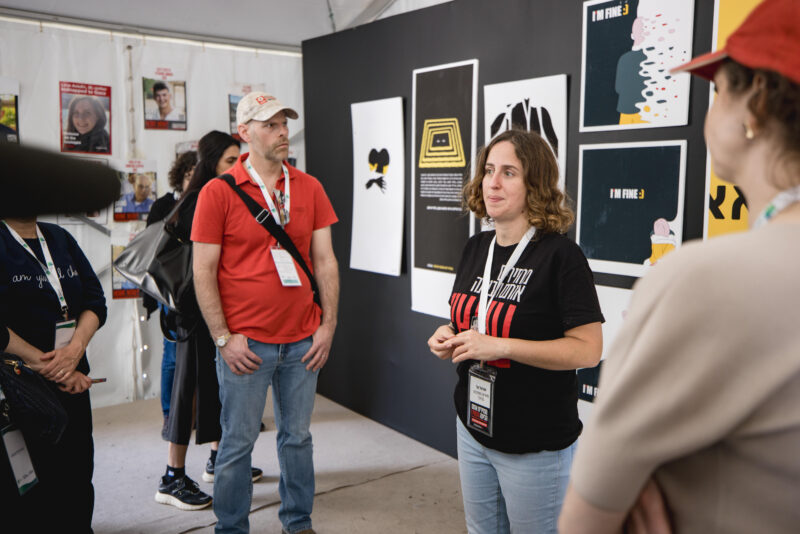
Tomer Foltyn for The Jewish Education Project
The Jewish Education Project staff and trip participants at a tented exhibit in Hostages Square in Tel Aviv in March 2024.
What, then, have we learned through this educational process of encounter and reflection? A final report published by Rosov Consulting indicates that the majority of participating educators have already made changes to their practice of teaching Israel in light of their experiences on this trip; and educators report the impact of the trips growing for them rather than lessening since the interim report in July 2024.
Since the completion of the first round of Israel trips for educators that are the subject of the Rosov reports, The Jewish Education Project and The iCenter continued to bring cohorts of educators to Israel, with the most recent of these taking place in June 2025, and the final trip rescheduled for summer 2026 due to the 12-day Israel-Iran war. The preliminary data collected from these subsequent trips supports the findings of the aforementioned reports.
There are at least three primary ways in which trip alumni are reinventing Israel education in their schools, camps and communities: They are sharing the personal stories of those most directly impacted; incorporating the variety of cultural artifacts created by Israelis in response to current events into their lesson plans; and working to move Israel education beyond isolated lessons or holiday celebrations, integrating it meaningfully into the full scope of their educational practice.
Several groups met with residents displaced from Kibbutz Nir Am, attempting to maintain their community in a Tel Aviv hotel. Itineraries typically included time with survivors of the Nova massacre and family members of hostages held in Gaza. Many also included voices from Israel’s non-Jewish population, including Bedouin and Palestinian citizens of Israel. Participants on these trips had face-to-face interactions with Israelis whose lives were deeply impacted by Oct. 7 and its aftermath. Among these was Itzik Horn, father of now-returned hostages Eitan and Iair, who campaigned tirelessly for their return. Another was Liat Friedman, bereaved mother of IDF soldier Shahar, who speaks of her late son with unbearable warmth and joy. Friedman left behind an “agenda” for living a good life before his own life was taken during a military operation in Gaza.
Educators were profoundly grateful for every opportunity to hear personal stories firsthand and unmediated, and often felt a profound professional calling to amplify these stories upon their return to North America. In follow-up surveys, an overwhelming majority (97%) of participants reported incorporating personal stories they heard on their trips into their teaching.
Another thing that many educators (90%) reported integrating into their teaching was cultural artifacts. Each group of educators participated in cultural experiences, including presentations of visual art, poetry and music. Among these was a provocative piece of graffiti found in a Tel Aviv alleyway, depicting a Hamas terrorist threatening a Jewish child of the Holocaust wearing a yellow ribbon in place of a yellow star, and declaring “Never Again!”
When tour guide Maya Yehezkel asked, “How does this make you feel?” every single person had something to share.
Israelis have created an incredible quantity of cultural artifacts since the Oct. 7 attacks. With the appropriate scaffolding (and, of course, translation), each one can serve not only as a gateway to building Israel literacy and exploring Israeli society from one Israeli perspective at one moment in time, but also as an invitation for learners to bring their lived experiences into the room (What resonates with you? What challenges you?), engage thoughtfully with other viewpoints (Why might the artist have felt compelled to send this message? To whom is the artist speaking? Why might somebody find this message compelling or troubling?) and reflect on their own commitments in response to the experience (What would you choose to convey through your own art about Israel today? Who do you want to share that message with?).
Rosov’s data shows that educators are not only integrating new pedagogical approaches for teaching about Israel, but also rethinking its place within Jewish education in their professional settings. These educators recognize that learning about Israel must begin earlier, continue longer and engage families more than ever before.
When presented with several images portraying the relationship between Jewish education and Israel education, only 3% selected an image of two mutually exclusive circles with no point of contact. Jewish educators increasingly recognize that Israel cannot be shoehorned into a six-week unit in sixth grade, a Yom Ha’Atzmaut celebration or Israel Day at camp. It is no longer an elective.
Instead, Israel must be pervasive in Jewish education: ever-present through the design of our educational spaces; a staple in our conversations about Torah stories, prayer and Jewish values; core to our explorations of Jewish identity in the 21st century. This reflects a change not only of pedagogy or curriculum, though these are surely needed, but a paradigmatic shift.
We have once again seen the incredible impact of bringing Jewish educators to Israel, and we must continue to explore such opportunities — not only during these challenging times, but as a continued investment in their growth and development. In order to teach a changed and changing Israel, Jewish educators would also benefit greatly from updated pedagogies, resources and approaches, as well as training and support in incorporating these into their practice.
One of our priorities as a community of educators, philanthropists and other stakeholders, must be to bring to educators here in North America the personal stories and cultural artifacts of today’s Israel (and tomorrow’s), along with educational guidance for sharing them in developmentally sensitive ways with learners across the age spectrum. We must create and curate this content and give our educators enthusiastic permission to bring it to our learners — not once or twice per year, but as part of a robust vision for teaching Israel at the heart of Jewish education.
Importantly, this moment also highlights the power of collaboration. The success of these trips and lasting shifts in practice stem from the collective work of educators, institutions, funders and partners committed to a shared vision. Looking ahead, our shared challenge is to further advance this transformation — listening, learning and innovating together to reimagine Jewish education with Israel at the center.
Mikhael Kesher is the director of Israel education at The Jewish Education Project.
Dan Tatar is the interim CEO of The iCenter.