WHAT YOU SHOULD KNOW
Diaspora Jewish leaders stress Israel ties — no matter the outcome of tomorrow’s elections

Samuel Corum/Getty Images
A man carries two Israeli flags during a pro-Israel rally outside of Israeli Embassy on Oct. 8, 2023 in Washington, D.C.


 Add EJP on Google
Tomorrow morning, Israelis will head to the polls to vote in the first national elections since the Oct. 7 terror attacks and the resulting three years of war, which have radically reshaped the country both internally and internationally.
The final surveys before the election, which were released on Friday, do not offer a clear expectation for what’s to come. Most polls indicate that neither Israeli Prime Minister Benjamin Netanyahu’s current coalition nor a coalition made up of opposition parties — likely led by presumed front-runner Maj. Gen. (res.) Gadi Eisenkot — can safely expect to clinch a clear majority without partnering with one or both Arab parties, which both sides have said they will not do. But all of the estimates contain margins of error that could radically affect these forecasts, enough to give either side a victory, a deadlock that could require another round of voting or some other, unexpected arrangement.
However the results shake out, the effects for the country — and world Jewry — will be significant. For many Diaspora Jews, the reelection of a Netanyahu-led coalition would be a tough pill to swallow. A survey last month by the Jerusalem-based Jewish People Policy Institute found that while many “connected” American Jews refrain from weighing in on Israeli politics, supporters of opposition parties outnumber supporters of coalition parties 4-to-1. Though not as recent, a 2024 survey shows that British Jews have a similar outlook, with 65% of respondents saying that they “strongly” disapprove of Netanyahu and 15% saying they “somewhat” disapprove of him. (Far-right Ministers Bezalel Smotrich and Itamar Ben-Gvir have even worse approval scores.)
Ahead of the election, Diaspora Jewish leaders — particularly progressive ones — are proactively reiterating their support for Israel, no matter who takes power.
Last week, the Reform, Progressive and Liberal Jewish movements initiated a joint open letter, signed by some 2,000 people, stressing the connection between Israel and Diaspora Jewry.
“In the spirit of our ancestors, this moment calls each of us to say Hineni — here I am,” the letter reads.
For Israelis, the signatories say, this means voting for a government that will advance their movements’ values.
“For Reform and Progressive Jews throughout the Diaspora, Hineni means refusing to retreat from Israel because our conversations are difficult or reducing our relationship to politics alone. It means deepening our engagement, investing in Israel education, strengthening people-to-people partnerships, visiting Israel, and supporting those working to build a more just and inclusive society,” they wrote.
Over the weekend, Phil Rosenberg, president of the Board of Deputies of British Jews, pledged to “double down on British Jewish Zionist values,” regardless of who wins the upcoming Israeli election. In a speech at the group’s plenary, Rosenberg said that this means supporting Israel, but not doing so blindly and being prepared to criticize its government if necessary.
“To switch off our minds in that way is zombie Zionism. Real Zionism is a series of values which we will fight for, even if some of the prominent… faces of the Zionist cause — even if it’s the elected Israeli government of the day — appear to go against them,” he said.
“With love and with determination, we will seek to work with the Israel we love to get it to where we want to see it, to where our values take us. Israel is a Jewish and democratic state, a state that is well capable of defending itself where it needs to, but willing to stretch out the hand of peace,” Rosenberg continued.
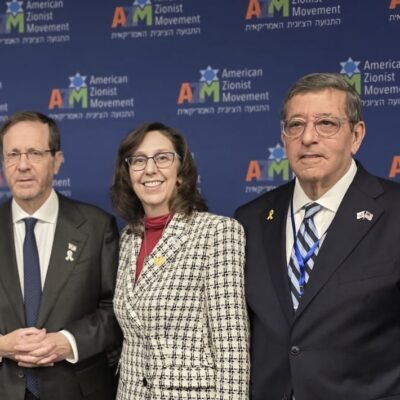
Writing in these pages, Mark Levenson, president of the American Zionist Movement, and Shoshana Dweck, AZM’s national board chair, similarly called for continued engagement, no matter the results.
“Some American Zionists will welcome the election’s outcome. Others will be disappointed or concerned. All of us should stay engaged in this conversation and keep listening to one another. That is what Zionist unity truly looks like in action,” they wrote.
Some of the organizers of the Reform, Progressive and Liberal movements’ letter — who are in Israel for the Jewish Agency’s Board of Governors meeting — told eJewishPhilanthropy that their missive is meant to serve a number of functions, pushing Israelis to take Diaspora Jewry’s concerns seriously, shoring up struggling Diaspora Jewish support for Israel and giving public voice to what many Jews are privately expressing.
“This letter is saying, ‘We’re not losing interest,’” Rabbi Lindsey Danziger, director of campaigns at the Religious Action Center of Reform Judaism, told eJP. “It puts into words what they are feeling and helps them articulate what this moment means.”
On a practical level, she added, this provides the movements with a ready-to-go list of 2,000 people who care deeply about Israel — always a handy thing to have for future political activism.
Asked why the letter was published only in English if it is also aimed at convincing Israelis to consider Diaspora Jewry, Danziger and Weinberg said that it should have been written in Hebrew as well. It still may be translated, they said.
The organizers explained that they felt compelled to write a declaration of mutual responsibility for this this week’s election, when they didn’t before the previous one, because this time both feels more consequential for Diaspora Jewry as antisemitism has skyrocketed around the world and the rift between Diaspora Jews and Israel appears to have gotten significantly worse.
“[Diaspora Jews] feel a lot more implicated by what happens in Israel,” Danziger said.
Harry Levy, the chair of the Association of Reform Zionists of America, said the distancing of Diaspora Jews from Israel and vice versa is a “concern that is raised in every meeting I come to in Israel.”
Levy accused the current Israeli government of creating a self-fulfilling prophecy, taking steps that alienate Diaspora Jewry on the grounds that it is insufficiently loyal to Israel. “And if Diaspora Jews lose interest, [the government] will turn around and say, ‘Aha, we knew it,’” he said.
Rabbi Josh Weinberg, vice president of the Union for Reform Judaism and executive director of ARZA, said that the fear is less about Diaspora Jews losing interest in Israel if the current government is reelected and more about them becoming disillusioned and apathetic.
“I think we [would] see a greater trend of Diaspora Jews just saying, ‘I don’t want anything to do with that place,’” Weinberg said.
The letter, he said, is meant to send a message to the movements’ constituents that their voices are heard and to express “who we are as Zionists.”
Weinberg, who has Israeli citizenship, will be voting in tomorrow’s election, he said — something that came at a certain personal cost for him.
While Weinberg spearheaded the Reform movement’s campaign for the World Zionist Congress, he did not vote in the American WZC elections or appear on the Reform slate, as the WZC bylaws bar people from voting both in the Israeli national election and the WZC elections. “So I’m heading to Jerusalem because that was my last address when I lived here,” he said.