WHAT YOU SHOULD KNOW
Beyond the library: Learning from the one and only Dolly Parton
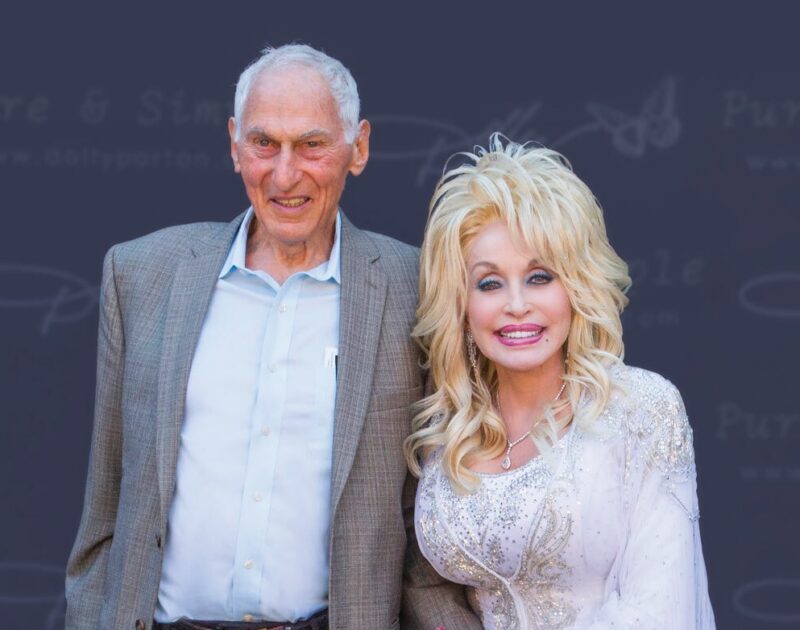
Courtesy/Harold Grinspoon Foundation
Harold Grinspoon and Dolly Parton in an undated photo.




 Add EJP on Google
Tributes and thought pieces have been churning out from 9 to 5 since the announcement that singer, songwriter, actor and philanthropist Dolly Parton died on Tuesday at 80.
The Jewish community’s response in particular has been to spotlight her role in inspiring the creation of PJ Library, a Jewish connection eJewishPhilanthropy has also highlighted over the years. In 1995, Parton launched the Imagination Library, a program that mails a free age-appropriate book every month to children from birth to age 5. The seed for the program was personal — at its inception, the Imagination Library distributed books to children living in Sevier County, Tenn., the Smoky Mountains community where Parton grew up — but its reach has expanded internationally. More than 300 million books have gone out to children in the U.S., Canada, the U.K., Ireland and Australia to date, according to the organization’s website.
Businessman and philanthropist Harold Grinspoon and his eponymous foundation consistently credit Parton and the Imagination Library as Grinspoon’s model in the genesis of PJ Library. Launched in 2005 with the goal of reaching children who might not otherwise have books with accessible Jewish content in their home, PJ Library has sent millions of books with Jewish themes to hundreds of thousands of families around the world. It also grew to include Sifriyat Pijama in Israel and Maktabat al-Fanoos for Arabic-speaking schoolchildren.
Other articles since Parton’s passing have focused on the biblical references in her songs, some of them deep cuts, as well as the Jewish connections involved in her professional trajectory — the talent agent, the producer, the song writers.
In 1994, back in the days before social media and cancel culture, Parton still faced backlash for a comment referencing Jews in Hollywood during an interview for Vogue. The article quoted her as saying that she abandoned a TV series concept about a country singer crossing over to gospel music because “everyone’s afraid to touch anything that’s religious because most of the people out here are Jewish, and it’s a frightening thing for them to promote Christianity.”
After Abe Foxman, then the national director of the Anti-Defamation League, reached out to explain how her comments invoked antisemitic stereotypes about Jewish control of Hollywood, Parton’s apology was reported in the media as well.
“In her letter to Mr. Foxman, written last week, she said, ‘I know from personal experience how stereotypes can hurt, and I regret that my words could have conjured up an impression of Jewish “control” of Hollywood,’” The New York Times reported.
“‘Whatever she said was unfortunate, and she recognizes that,’” Foxman told the Times. “‘I know it’s not easy for celebrities to publicly say they made a mistake. As far as we are concerned, the matter is behind us.’”
Parton was unambiguous over the years about the culture that she came from — unabashedly country, deeply Christian — and it isn’t a stretch to imagine that antisemitism education was not a fixture of the milieu in which she came up. The Vogue episode can be viewed as an example of how warm relationships with Jews don’t completely inoculate people against a faux pas reflecting ignorance of antisemitism’s many expressions. It can also be viewed as an example of what it looks like when a public figure models accountability and openness to learning instead of the excuses or defensiveness we see so often from others.
But there is also something about Parton herself — her unapologetic embrace of her origins, her willingness to stand out in a world that often rewards softening what makes someone different — that offers a lasting lesson for our community about being a changemaker.
Parton faced criticism over the years for her looks and personal style, and was candid about responding by leaning into campiness rather than toning herself down. “I’m proud of my hillbilly, white trash background,” she once said in an interview with Southern Living. “To me that keeps you humble; that keeps you good. And it doesn’t matter how hard you try to outrun it — if that’s who you are, that’s who you are.” In a CBS interview she described being “deeply attached to the customs, the humor and, for sure, the music of her roots.” Parton’s approach to her art and work as well as her philanthropy had a clear “If I am not for me, who will be for me? And when I am for myself alone, what am I?” quality.
The distinctiveness of Parton’s look, her music and the way she gave back as a philanthropist were what endeared her to people and made her a role model for people — funders like Harold Grinspoon, and die-hard fans like the author of one of today’s opinion pieces for eJP.
As the Jewish community continues its discourse around particularism versus universalism, it is worthwhile to keep Parton’s example in mind. There is no one way to look or sound or give that is the “right” way to be a changemaker. Differentness might even add a layer of impact that conventionality never could; it can give you important insight into a problem, or offer a sense of being seen or belonging to people who see themselves reflected in you.
And if you are successful in your efforts — boy will being distinctive get you noticed.