HOLIDAY MEALS
As war drags on and Passover approaches, Israeli food-aid nonprofit sees major jump in requests
'Every year, we give away about 60,000 food baskets for Passover... We already have at least 5,000 more requests than usual — and the phone doesn’t stop ringing'
courtesy
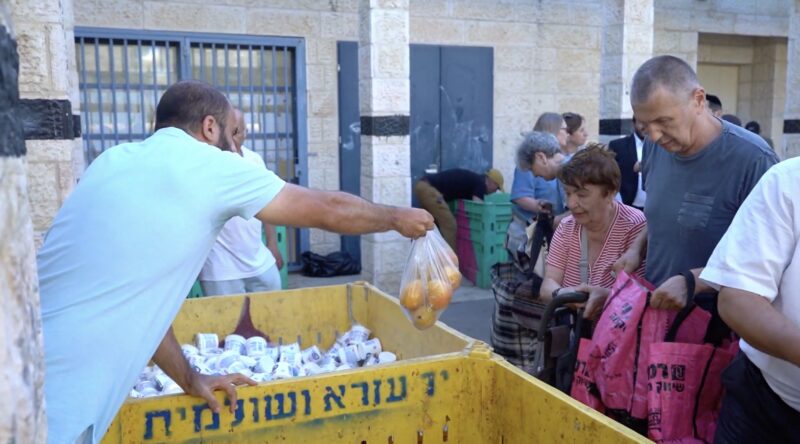
A worker from the Israeli food-aid nonprofit Yad Ezra V’Shulamit hands a bag of oranges to a client.




 Add EJP on Google
Amid the economic fallout from the ongoing conflict with Iran, demand for food assistance in Israel has surged dramatically as the country prepares for the upcoming food-focused Passover holiday, according to Yad Ezra V’Shulamit, one of the country’s largest food-aid organizations.
“Passover is expensive for everybody, and every year, we give away about 60,000 food baskets for Passover,” Tefilla Buxbaum, Yad Ezra V’Shulamit’s director of resource development, told eJewishPhilanthropy. “But this year the requests have skyrocketed. We already have at least 5,000 more requests than usual — and the phone doesn’t stop ringing.”
Calling the situation a crisis, Buxbaum said they began seeing a similar increase in demand for their food packages during the COVID-19 pandemic.
Yad Ezra V’Shulamit distributes 12,000 food packages weekly through a network of 95 distribution centers across the country, she said. During Passover, the number of requests for food packages traditionally increases, and this year especially many of the requests for food baskets are coming from people who have never needed help before, said Buxbaum.
“People who were working and doing OK suddenly have no income,” she said. “Working people like the cleaning lady, the waitress — restaurants are closed or empty, so there are no tips and even if they get their salary it is only half of what they usually receive.”
Many Israeli families are still recovering economically from the aftermath of the Oct.7, 2023, attacks and the ensuing two-year war in Gaza, she said, and businesses such as tourism and the diamond trade have been slow to rebound, leaving some workers without stable employment.
“People don’t realize that the effects of the [Gaza] war have not disappeared,” she said. “Those same people that were out of work [because of the war] are out of work again. The economy has not recovered. There’s so many more requests and more poor people. More people are falling under the poverty line. The war is really giving a knockout punch to the economy.”
According to the most recent Israeli National Insurance Poverty Report, which was published in January, about 2 million Israelis, including 880,000 children and 158,700 elderly, were living in poverty in 2024. With over a quarter of all Israeli children living in poverty in 2024, Israel ranked second in the OECD for child poverty at 28% in 2024, up from 27.6% in 2023. The poverty level among the elderly is also above the average in OECD countries.
Although the report noted a decrease in the percentage of Israelis experiencing food insecurity, from 33.4% in 2023 to 28.1% in 2024, it noted that this includes 1 million children.
Almost 30% of Israeli households were unable to make ends meet and cover all expenses, the report found, with 4.7% of households forgoing a hot meal at least once every two days due to financial difficulties. When broken down by population segments, the situation gets more stark: roughly half of all Arab Israelis cannot cover all their monthly expenses, nor can approximately 30% of Haredim.
“My stomach tightened when I heard the data on the number of citizens and children living without food security. Nearly 1 million hungry children is a severe, difficult, and sad figure we cannot allow to exist here,” said MK Adi Ezuz (Yesh Atid), who was among the MKs initiating a recent discussion of the report’s findings at the Knesset’s Labor and Welfare Committee last month.
Although the National Authority to Combat Poverty was approved last year, it has not yet begun operating, noted Yochi Iluz, director of the Food Security Division at the Ministry of Welfare and Social Affairs, at the Knesset meeting. She said that the 2025–2026 government food security budget of NIS 180 million ($58 million) allowed support for 44,000 families, up from fewer than 30,000 in previous years, but funds are expected to run out by April 2026 pending further budget approval. Her ministry is also waiting for the Finance Ministry to approve additional funding to maintain the program at its current level, she said.
Members of the National Food Security Council, which operates under the Ministry of Welfare, noted that a framework it developed was distributed in May 2025, but none of its recommendations have been implemented.
Professor Roni Strier, former chair of the council, said the state has the money and resources to solve poverty and food insecurity within five years, but “has not taken on the political will to do so.”
“The strategy currently being used reproduces and deepens poverty over the years,” he said. “Advancing the framework will cost money, but what we will get in return is enormous.”
For nonprofits, the situation is complicated by the fact that prices in Israel have risen by 12% this year, while the dollar has depreciated by 20%, said Buxbaum. This means donor contributions from abroad are worth less, and the cost of purchasing food locally has increased. A $100 donation made last year is now effectively worth only $70, she noted.
Altogether, she estimated that providing Passover assistance this year will require approximately $2 million. If each basket costing $250 supports an average of five people, the Passover effort could feed more than 300,000 individuals nationwide, Buxbaum calculated.
“We always say our donors are all of Am Yisrael,” said Buxbaum. “Everybody gives a little, and together it makes a huge difference.”
While the needs have risen because of the war, the conflict is also complicating the organization’s ability to raise money to address them. Fundraisers that are meant to take place in Los Angeles over the next week may have to be altered as flights from Israel have been canceled, and Ezra V’Shulamit organizers are unable to get out, she said. In addition, while they reach out to foundations for funds, their donor base of largely individual Israeli donors is also experiencing financial strain because of the war.
Approximately 94% of all their donated funds goes directly to food distribution, she said. The food baskets contain staples like vegetables and fruits sourced from Leket National Food Bank, chicken or fish, oil, sugar, and canned goods and dairy products obtained from corporate partners like Tnuva and other companies, as well as challah for a normal Shabbat and matzah and grape juice for Passover.
Request applications are reviewed through a regulated process overseen by Israeli nonprofit authorities, and families seeking regular weekly assistance must submit financial documentation, Buxbaum explained. For one-time holiday support, however, the organization tries to approve requests quickly so families can celebrate Passover with dignity.
Related News

ADVANCING A VISION
N.Y. federation donates $1M toward building shared-society center named for peace activist killed on 10/7

PRESIDENTIAL REBUKE
Israel’s Herzog: Mamdani ‘makes no effort’ to hide disdain for Israel, Jews must fight back

MAGICAL EXPERIENCE
Shefa launches psychedelics retreat for Jewish professionals suffering burnout

EXIT INTERVIEW
Elizabeth Sokolsky, longtime EVP of Birthright Israel, to retire next year

EXCLUSIVE
Detroit-based philanthropists Nancy, James Grosfeld donate $8M to renovate JDC’s Israel campus