Opinion
ICYMI
A window for systemic change: Andrés Spokoiny’s address to JFN 2026




 Add EJP on Google
In Short
When certainties collapse, trust evaporates and usual habits fail, these are the moments when change is possible — but the window is short, so we have to make it count.
I’m not proud of it, but I have the habit of leaving things to the last minute. In fact, some of you know that I write my conference speech the day before the conference starts.
But this year, I told myself: This time I’ll do things differently. I’ll be a good boy… I’ll write my speech a month before the conference.
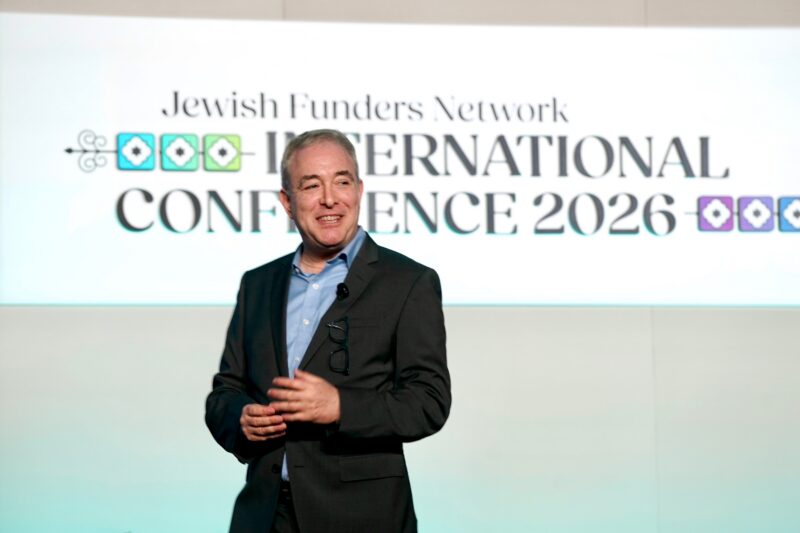
Courtesy/Jewish Funders Network
Andrés Spokoiny, president and CEO of the Jewish Funders Network, at the organization's annual conference mon March 16, 2026.
Well… it turns out I should have procrastinated.
But then, is the context today so different from the one we had two weeks ago? In truth, the essence of what I wanted to share with you hasn’t changed much, because for many years now we have been living in crisis and turmoil. Like in W.H. Auden’s famous poem, “September 1, 1939”:
Uncertain and afraid
As the clever hopes expire
Of a low, dishonest decade.
He also wrote, in the same poem, something else that describes our times so well:
The enlightenment driven away,
The habit-forming pain,
Mismanagement and grief:
We must suffer them all again.
As the sirens blared in Israel, that last stanza kept coming back to me: “We must suffer it all again.”
Indeed, it sometimes feels like we are living through a one-in-a-hundred-years crisis every year. We could ask ourselves why this is happening; but that, at this point, would be merely academic.
I think the more important question is: How do we live in these strange times in which destiny has placed us? And how — without falling into the tired cliché that “every crisis is an opportunity” — can we actually make something meaningful and transformative out of the convulsive times in which we live?
I don’t have the answer, but I thought I would share with you two thinkers who give me the conceptual framework to think about our times. Both were Jewish. Both escaped Nazi Germany. Both knew uncertainty and fear. And both turned their experiences into powerful ideas about change, agency and hope.
The first is Kurt Lewin.
Lewin is one of the founders of modern social psychology. His life of successive crises shaped the way he thought about change. His theory is brilliant for its simplicity.
Change, he said, happens in three stages: Freeze. Unfreeze. Refreeze.
In the freeze, institutions, habits, norms and expectations are stable. Change is hard — sometimes almost impossible — because the range of what feels possible is very narrow. Many options appear out of reach or virtually unthinkable.
Then something happens: a shock, a failure, a crisis. Equilibrium is lost and the system unfreezes. Suddenly, we discover that what looked immutable was simply the way things had been arranged. During an unfreeze, trust erodes, institutions fail, authority weakens and old methods stop working.
Sound familiar? But in those moments, resistance to change drops dramatically — not because we suddenly became wiser, but because the old order has stopped functioning.
And that is when the impossible begins to look possible — because constraints, either institutional or psychological — weaken or disappear.
Finally comes the refreeze: New patterns stabilize. A new normal forms. And the range of possibilities narrows again. Sometimes even narrower than before.
Think of the French Revolution. The old monarchy — freeze. The revolution — unfreeze, a moment when everything seemed possible. And then the Terror — refreeze.
Lewin’s key insight is this: If you want systemic change, the moment is the unfreeze. If you wait too long, reality freezes again and the window closes.
Sometimes you don’t need a brilliant idea. You simply need to leverage a moment when the forces resisting change have weakened.
The second thinker is Albert O. Hirschman.
Hirschman also lived an extraordinary life: fighting in the Spanish Civil War, rescuing Jews in Vichy France and later becoming one of the great thinkers of economic development.
His main idea is called possibilism. Possibilism is the refusal to accept the claim that “nothing can be done.”
Hirschman noticed that whenever change is proposed, resistance tends to appear in three predictable forms: He called them futility (“It won’t change anything.”), perversity (“It will make things worse.”) and jeopardy (“It will risk what we already have.”)
We hear these arguments all the time, but Hirschman believed that they were often simply excuses. The idea that things are impossible generally comes from people who are trying to shut down debate, discourage experimentation and protect their own power.
Because the truth is, you rarely know what is possible until you begin acting. That is the essence of his idea of possibilism. You don’t need a perfect plan: you need one plausible move, then action itself expands the range of possibilities; the more you do, the more becomes possible.
Now, I share this little lecture with you, partly because I am an intellectual snob who enjoys sounding professorial (we know each other — though, believe me, I spared you the mathematical formulas) — but because these two thinkers capture the hidden promise of times like ours.
We have been living inside that Auden poem. For many of us, the last few years have been the most challenging of our lives.
But they are also the very definition of Lewin’s unfrozen times. Times when certainties collapse. Trust evaporates. Usual habits fail. Times in which we feel alone, endangered and disoriented.
And Lewin teaches us something crucial: These are the only moments when systemic change is possible.
But he also teaches us something uncomfortable — that the window is short before change becomes exponentially harder.
Everything has been unfrozen, but we are already beginning to see the refreeze, which means there are things that are possible today that will not be possible a year from now.
Lewin gives us the urgency, and Hirschman gives us the attitude — the courage to try things even when certainty is impossible, and the belief that our actions will open new possibilities and unsuspected opportunities.
And today — because I don’t want to be purely theoretical, I want to make a concrete call to action —I believe there are five things, at least, that our philanthropic community needs to do now, before the refreeze. Not cosmetic improvements but systemic changes, ones that are not only necessary but maybe, for the first time, possible.
Israel
What is more unfrozen right now than Israel?
As we heard from the young people on the previous panel, the war created enormous dislocation — but also extraordinary civic energy. Civil society stepped up. Young Israelis took responsibility.
But we are already seeing the refreeze. The unity of the first months is fading. Old divisions are reemerging. And let me say something clearly: If we only rebuild, we will have failed. We owe it to these young people to emerge from this moment better, not bitter.
Israel needs systemic change — in governance, in its social contract, in its infrastructure and in public diplomacy. I don’t pretend to know exactly what that change looks like. But Hirschman reminds us: You discover possibilities by acting.
And the opportunities are not only internal. Israel, despite the trauma, emerges from this war into a new Middle East in which old dreams of regional cooperation now become possible. Have you ever dreamed of Israel being in the same coalition with six Arab countries?
Have we fully absorbed what that means? What role can philanthropy play in advancing that vision? Whatever you are doing to support the rebuilding, also consider working with your peers in decisive actions for structural reforms.
Jewish day schools
Right now, we have a unique opportunity. Interest in Jewish education is growing. Tax credits are emerging. Funders are increasingly committed.
This is the time to fix what I consider a historic disgrace. In the wealthiest Jewish community in history, Jewish day schools remain unaffordable. It’s incredible that we cannot do what far poorer communities once managed: to provide excellent Jewish education that families can actually afford.
But there is a historic opening to right that wrong. A group of funders is already tackling this challenge, and we are proud to host a peer network for day school funders that will meet right after the closing of this conference. Join us, because this is exactly the kind of change that must happen before the refreeze.
Politics
Another taboo is breaking.
For decades, funders insisted on staying out of politics. Yet many of the issues we care about — antisemitism, democracy, poverty, education — cannot be addressed without political engagement. We wanted to keep our hands clean, but now we realize that you cannot protect the things you love without entering the political mud.
We are in a moment of enormous political upheaval. Old norms are being abandoned, and our political system — in Israel, the US, and around the world — seems to be moving towards dark directions.
We can lament that, or we can get engaged. We must recognize that now, before the political system freezes into something dominated by extremists or antisemites, it’s the time to act. They are trying to use the unfreeze to their advantage, we must do it too, and win.
The Antisemitism ecosystem
I don’t want to rehash the old debate here, just state the obvious: The way our community addresses antisemitism is messy, and it’s not working as well as it should.
Yes, I said many times that antisemitism is not a problem we can “solve,” and it’s also true that there have been successes. But there’s fragmentation and duplication. Too many organizations.Too many overlapping initiatives. Too little research and coordination.
But the opportunity is that the mindset is changing. Funders are beginning to realize that the system must become smarter and more efficient.
In the old freeze, a handful of organizations dominated the field. In the unfreeze, the system exploded. Maybe a change was needed, but the refreeze can’t anchor this fragmented and inefficient reality.
Ask yourself a simple question: Could we achieve the same results with 20% less spending? If the answer is yes, that means $150 million could be redeployed for other urgent needs.
That kind of systemic thinking is exactly what unfrozen times allow.
Jewish meaning
Finally, something deeper is happening. I call it “the ideological unfreezing.”
Millions of Jews are asking existential questions. Many were searching for meaning before Oct. 7, 2023, and that search has since intensified.
Behind the fear and the anger lies a deep question: What is all this for?
We have a historic opportunity to invest seriously in adult Jewish learning, reform rabbinical training, strengthen pluralistic Jewish learning and bring serious Jewish content into our communal life; in other words, to end the model of pediatric Judaism — the idea that Judaism is something you learn only as a child, instead of something that can offer meaning and depth to deal with the challenges of life.
We must enact not just an organizational change, but an ideological and educational revolution in adult Jewish life. But the window is short here too.
People are open now. Will they be a year from now?
Sometimes I use a meditation app called 10% Happier, and I often think like that — I tell myself not to think in terms of big revolutions. Maybe if we just improve things by 10%, it’s good enough.
But in unfrozen times, that logic fails. In unfrozen times, we must think big. Unfrozen times must be used.
My personal regret about the COVID-19 pandemic, as a communal leader, is that it was also an unfrozen moment — and we didn’t take full advantage of it to produce structural change.
This time the upheaval is even greater, and I believe there are traumas so profound that can only be redeemed by big, bold dreams.
At the beginning of the American Civil War, Abraham Lincoln didn’t have big visions; he simply wanted to restore the old Union. But when he saw the carnage of the war, he realized that returning to the old normal would not be enough. All that suffering could only be justified if America emerged from the war transformed. And so he called the nation to a higher vision.
We are in a similar moment. Like Lincoln at Gettysburg, we look at devastation and ask ourselves: How do we honor the sacrifice?
The hostages.
The Nova survivors.
The soldiers.
Families in shelters.
Jews facing antisemitism around the world.
They are asking us the same thing: Earn this. Make all this count.
And the way to make it count is by producing positive, transformative change. Lewin tells us, now is the moment; and Hirschman reminds us of Spanish poet Antonio Machado’s words:
Traveler, there is no path.
The path is made by walking.
History is a long chain of surprises.
And surprises — especially the ugly ones — are better faced together.
So let us return to Auden:
Defenseless under the night
Our world in stupor lies;
Yet, dotted everywhere,
Heroic points of light flash out.
Let each of us be a point of light in the dark stupor of our world.
Beleaguered but heroic.
Rattled but undefeated.
Afraid but determined.
And in the depth of this long winter, let us remember that within us there’s an invincible spring.
Like the lion of Judah, let us roar under the sun, proclaiming to the world: Am Yisrael Chai.