RETURN ON INVESTMENT
As ‘venture capitalists of the tzedakah world,’ Good People Fund looks to invest early
Leading the group’s latest Israel mission, Julie Fisher says the organization is not just funding nonprofits, it’s helping create them
courtesy
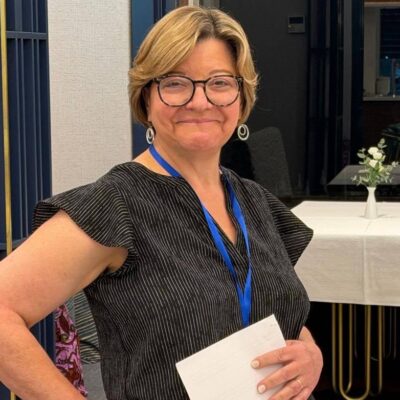
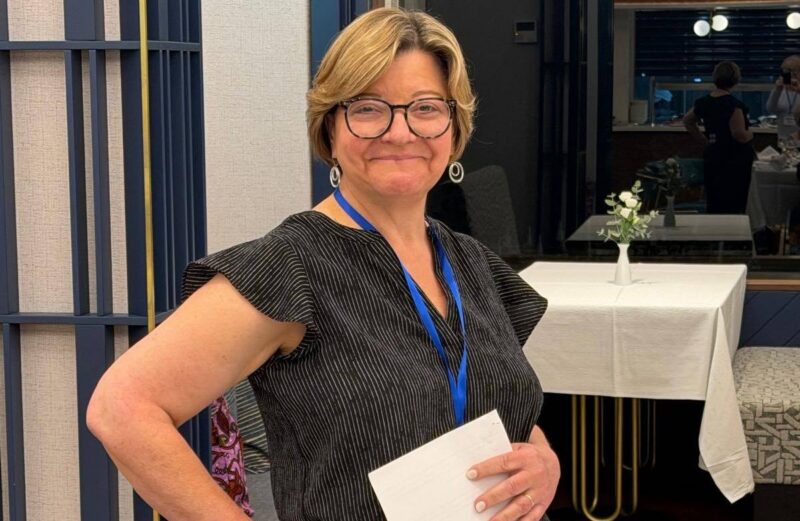
Julie Fisher, executive director of The Good People Fund, in an undated photograph.


 Add EJP on Google
When Julie Fisher first met Naomi Eisenberger, the founder of The Good People Fund, at the organization’s 10th-anniversary celebration in Tel Aviv eight years ago, she doubted philanthropy could work the way Eisenberger described it: Find good people and back them while they do good.
Fisher now leads the organization built on that idea. She took over as executive director on July 1, succeeding Eisenberger at the New Jersey-based grantmaker, which launched in 2008.
A Minnesota native, Fisher lived in Israel with her family while her husband, Daniel Shapiro, served as U.S. ambassador from 2011-2017 and then stayed on for several years after. In Israel, Fisher worked closely with the African migrant community, founding the Consortium for Israel and the Asylum Seekers. After meeting Eisenberger in 2018, Fisher became increasingly involved with The Good People Fund, becoming its first director of engagement in 2023 after her family moved back to the U.S.
Fisher credits the fund’s board chair, Beth Gansky, who took the role as the organizations began planning Eisenberger’s succession, with helping steer the handoff. “I am lucky to have partners like Beth and our board members who take their roles seriously and roll up their sleeves to help further our mission,” Fisher said.
The fund has supported 260 grantees and currently backs 62, including 27 in Israel, with annual grants of $10,000 to $20,000. For some Israeli nonprofits, that check is the first money they receive from abroad. The fund bets on founders before they have data to show. Fisher cites Kaima, a farm outside Jerusalem for teens who have dropped out of school, which received its first grant from Eisenberger and helped win legal recognition for social farming as a therapeutic tool; there are now dozens of them across the country.
The Good People Fund backs changemakers of any faith, which Fisher argues gives donors a way to support Israel without wading into the politics that divide many Jewish families and foundations.
In her characteristic calm tone, Fisher spoke with eJewishPhilanthropy during her organization’s mission to Israel earlier this month, discussing the fund’s early-stage model, its response to the Oct. 7 terror attacks and whether small grants can draw a new generation of American donors closer to Israel.
This interview has been lightly edited for length and clarity.
Justin Hayet: For people who don’t know, what is the approach of The Good People Fund, and why do you believe it is the right approach?
Julie Fisher: The approach is unique in the ecosystem of Jewish philanthropy. Our mission is to identify visionary changemakers at the beginning of their journey, when they are organizations that are emerging, and we support and nurture them. For example, in Israel, we may be the first outside-of-Israel donation that an organization receives. We are very focused on the person who is doing the good — the social visionary. A person who has decided to address some kind of need in society or in their own community, usually from a place of personal knowledge, passion and intense desire to make a difference.
When we say we support and nurture our social visionaries, we offer them wraparound support. We keep our grantees on for many years. We are not a three-years-and-out funder. A typical number would be somewhere between three and 10 years.
JH: A lot of funders write checks to smaller organizations. Why is this different?
JF: Where we are unique is that we are in the messy work of emerging nonprofits, where they may not have impact reporting yet. In the U.S., they may not already have 501(c)(3) status. We may be giving them a pro bono lawyer to help them with their paperwork. We may be teaching them what’s a 990 Form and how do you file it. We have an amazing volunteer who teaches about QuickBooks. It’s very lonely work to be a social visionary. We’ve created a community where they know each other, learn from each other and network.
JH: Would you describe The Good People Fund as a consulting firm, as a giving circle, as a scout? How would you explain it?
JF: We are the venture capitalists of the tzedakah world. We started very much as a circle, and we are transitioning to a team that does some incubation. We do not call ourselves an incubator, but a lot of what we do looks like incubation and wraparound support. We invest in early-stage tzedakah startups, often when they are little more than a powerful idea and a passionate social visionary determined to make a difference. We recognize potential where others may be frightened by risk, providing not only critical seed funding but also mentoring, guidance and connections that help these emerging organizations grow and thrive.
JH: What do you think funders should know about the nonprofit sector in Israel, specifically the smaller nonprofits and the lesser-known social innovators?
JF: [There’s] incredible innovation happening that is under the radar. I have the absolute privilege to meet people who have not yet been identified by other funders. They’re not household names yet, and they may not be for many years, but the work they’re doing is incredibly impactful — really life-sustaining and lifesaving in many cases. And they are people representing their communities themselves, which is part of why I think some funders aren’t meeting them yet. If English is their second language or their third language, they may not be meeting the federation group. There are very few of us in the field right now, especially with ROI closing. That was a pipeline. We had a lot of overlap with ROI here in Israel.
JH: How has your giving evolved or changed in Israel in the past three years?
JF: There isn’t a person, individually or professionally, who was not impacted by what happened on Oct. 7 and what happened in the days after. We immediately began to see how every one of our grantees in Israel was suffering, personally and professionally. We’re only working with emerging organizations, so these organizations may not have funds for a rainy day. They are meeting people who are already on the fringes of society and who are already vulnerable. So when Oct. 7 happened, they were hit in ways that were expected and ways that were not expected. They had to take care of their staff members, who were traumatized or lost family members or were displaced from their homes and try to keep their organizations intact and to keep the well-being of their staff intact. And then they personally, as leaders, were hit. So we immediately began to give some small grants to take care of immediate needs.
JH: What’s your vision for the organization 10 years from now?
JF: My hope is that we will retain the beauty of the trust-based relationship that we have with our grantees, that we’ve had the whole time. That we will keep our special sauce of person-to-person tzedakah that’s based on relationships and trust and that will not change, but that our resources will change because we’ve developed a model that is now time-tested.
JH: What’s one thing from traditional philanthropy that you really incorporate into your work, and what’s one that you flip on its head?
JF: We are an organization historically thought of as sort of the reaction to [conventional giving]. That was how we started with the idea that instead of giving your check once a year and not knowing where it’s going, if you share your generosity with The Good People Fund, you will know exactly where it’s going.
And we’ve moved into some of the more conventional philanthropic approaches. We used to say we were the best-kept secret. Well, we don’t want to be the best-kept secret anymore. That doesn’t help us support our changemakers. Now we want to go out and find social visionaries who maybe don’t know us because they don’t look like us and they’re not friends with our cousins. We actually want to scout.
JH: Why should a small family foundation or a midsize one give money to The Good People Fund, as opposed to just writing a check to that organization themselves?
JF: For many of our organizations, especially in Israel, you can’t write a check to them yet. We are actually their fiscal sponsor because they’re brand new, so the only way that you can support them would be to give through us.
We have a multiplier effect. When someone gives us a dollar, we use that to support all of our grantees — not just in the annual grants that we give them, but in the mentoring phone calls, in helping them with their messaging, in the workshops. So [if] we’re presenting a one-hour workshop to 30 grantees and the funding for that comes from one donor, that donor’s generosity has helped grow 30 organizations, not just one. That’s part of where we have our impact.
One of the reasons why some small family foundations in the United States give to us is because they don’t have a real person here, and here we are, in regular contact. So we can steward their money very carefully, very responsibly, without them having to have someone on the ground.
JH: For the skeptic: Tell me why $20,000 on the ground to one founder can make an impact. Why give $20,000 to five nonprofits versus $100,000 to one nonprofit?
JF: Our grants, which are not enormous, are indeed enormous to our grantees because we’re in the emerging space. When we give a $15,000 grant to someone who is just beginning an organization to address food in the community, that is a huge percentage of their yearly budget.
We don’t stop our mentoring or our relationship with our grantees after we graduate them. We like to say we keep them for life. They can still call us up and ask for advice. They can come to any workshop that we do. We want our active grants to go to our emerging organizations. But that move from being 20% of the budget to 3% of the budget is exactly what we’re striving for.
JH: Some philanthropists say there are too many nonprofits in Israel, many of which are inactive. How are you making sure the ecosystem doesn’t duplicate, but also establishes new nonprofits as needed to address certain social causes?
JF: It’s true, there are many nonprofits here. I had the pleasure of getting to know many of them when I lived here. When someone approaches us, [we ask]: Is someone already doing that? We are not looking to just support the creation of more nonprofits. We are looking very carefully at what problem this person is aiming to solve and in what community.
We like to say we have a finger on the pulse. Trust-based philanthropy is thrown around as this term that sometimes no one knows what it really means. Well, for us, what it means is when someone hits a bump, these amazing changemakers call us. They talk about what happened, and we are able to come in and connect them with someone who can help, or work with them on how to repair or fix it. We help them strengthen their organization, get the right policies in place and do the work that needs to be done. We’re in there to make sure that they can get past that bump.
JH: Since you lived in Israel as the spouse of the U.S. ambassador 10 years ago, so much has changed in Israel and so much has also stayed the same. How do you carry those two things with you in this role?
JF: I love that this new role keeps me involved in Israel and in the experiences I had in Israel that I found most powerful, which is in the relationships that I developed with Israelis, who are so amazing in their desire to confront challenges head-on. I did a lot of bridge building in my role as spouse of the ambassador of the United States. People would say I’m the explainer: Explain Israel to Americans, explain America to Israelis. There are so many cultural experiences and differences. I became a different leader after my time here. I became more able to be a little bit more blunt in how we describe things and less diplomatic, which is funny, because I was [in a] diplomatic family.
JH: Do you think The Good People Fund can be that bridge between the Israeli social sector and younger Jewish philanthropists in America who are struggling with Israel?
JF: I hope so. We’ve been asking ourselves that question, because we believe that what we do fills people with hope. And this isn’t about some of the harder existential issues that we struggle with in our two communities.
One thing that I found is that every time I sit down to talk to someone about what we do at The Good People Fund, what we believe, people across generations of Jewish life get excited. Their eyes light up. They want to hear about Yoni from Kaima Farm helping youth who fall out of the school system to find a better path. They want to hear about Ronnie-Lee going out into the streets of Tel Aviv and administering to people on the street. They want to hear about all of our amazing changemakers doing the work that they’re doing.
JH: So, you’re hopeful?
JF: I’m hopeful.
Related News
ADVANCING A VISION
N.Y. federation donates $1M toward building shared-society center named for peace activist killed on 10/7
EXIT INTERVIEW
Elizabeth Sokolsky, longtime EVP of Birthright Israel, to retire next year

MAGICAL EXPERIENCE
Shefa launches psychedelics retreat for Jewish professionals suffering burnout
PRESIDENTIAL REBUKE
Israel’s Herzog: Mamdani ‘makes no effort’ to hide disdain for Israel, Jews must fight back
CLOSING WORDS
In AZM address, Cosgrove links communal ‘orthodoxy’ on Israel to rising anti-Zionism among young Jews