WHAT YOU SHOULD KNOW
A tumultuous 2025 comes to a close
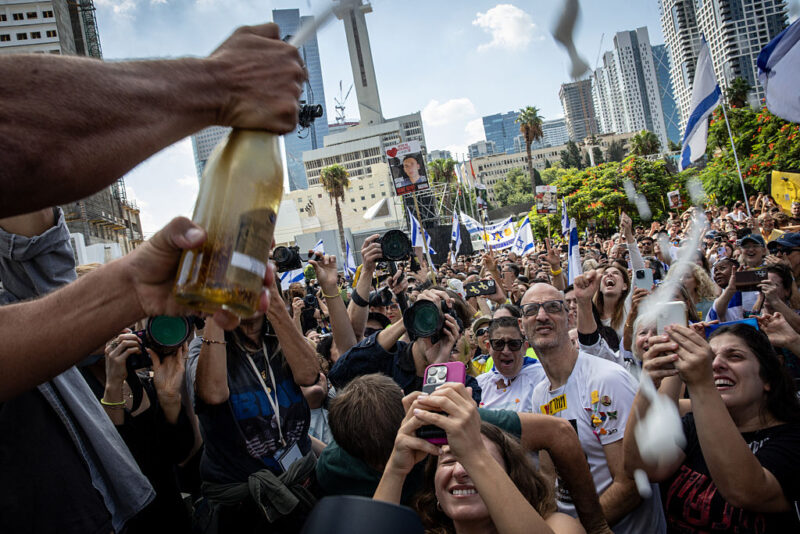
Chris McGrath/Getty Images
A man sprays sparkling wine over the crowd after 20 hostages were released from captivity in Gaza, at Hostages Square in Tel Aviv, on Oct. 13, 2025.




 Add EJP on Google
The past year has been a tumultuous one for the Jewish communal and philanthropic world, kicking off with the inauguration of President Donald Trump, whose Israel-related policies have largely been hailed by the Jewish community, while his domestic activities and his political allies have been a major source of division. Alongside the joy that accompanied the release of all the remaining living hostages in Gaza and all but one of the slain captives, the Diaspora Jewish community also experienced the pain of multiple deadly attacks in 2025, culminating with last week’s terror attack in Sydney, Australia, in which 15 people were shot dead and scores were injured.
This summer saw a punishing 12-day war between Israel and Iran, following a major strike on Iran’s nuclear project and ballistic missile program, though the success of the American-Israeli operation is up for debate, as Israeli Prime Minister Benjamin Netanyahu is expected to discuss plans for a follow-up strike during his upcoming visit to the United States.
The past year has also seen several major philanthropic donations, including one of the largest ever earlier this month, with Michael and Susan Dell’s $6.25 billion pledge to provide $250 investment accounts to 25 million American children. This year also saw the largest-ever single philanthropic donation by Israeli donors, with Shmuel and Anat Harlap’s $180 million gift to central Israel’s Rabin Medical Center, which was also the largest-ever gift to an Israeli hospital.
Other notable donations that were made this year include: Jon and Mindy Gray’s $125 million gift to Tel Aviv University in May; the Jack, Joseph and Morton Mandel Supporting Foundation’s $90 million matching grant for Cleveland’s Jewish day schools; and Sylvan Adams’ $100 million donation to Soroka Medical Center in October, after it was struck by an Iranian missile this summer. More on this below.
The Jewish communal world has also lost several leaders over the past year, most recently H. Glenn Rosenkrantz, a longtime communications specialist, who died suddenly last week. In March, Theodore “Ted” Comet, who worked for decades with a variety of Jewish groups, died at 100. In July, Wesley LePatner, a Blackstone executive and emerging Jewish leader, was killed in a shooting at her firm’s headquarters; she was 43. And in October, Rabbi Moshe Hauer, the executive vice president of the Orthodox Union, died of a heart attack at 60.
Though it has slowed, the so-called “Surge” in Jewish engagement continued in 2025. This year saw a highly contentious World Zionist Congress election, which was marred by widespread fraud, and a plenary session in Jerusalem that was rocked by political fighting and allegations of corruption. The past year has also seen multiple Jewish groups shut down and merge as they grapple with funding shortfalls and retirements.
This summer also saw major allegations of mismanagement levied against one of the Jewish world’s biggest fundraisers, Friends of the Israel Defense Forces, resulting in the CEO and board chair stepping down three weeks later.
Last month also saw a highly contentious New York City mayoral election, in which rabbis and other Jewish leaders vocally condemned the Democratic candidate — and eventual victor — Zohran Mamdani, who will be sworn in as mayor next week.
As the Jewish world brings in the secular new year, it will be accompanied by many of these common threads, perhaps most significantly mounting concerns about Jewish security in the wake of last week’s deadly terror attack.