PULPIT POLITICS
After Rabbi Elliot Cosgrove endorses Cuomo, leaders debate if he opened Pandora’s box or if circumstances demanded it
The Park Avenue Synagogue rabbi says that while he normally abstains from politics, he 'felt compelled to enter new territory' given the threat posed by Democratic mayoral candidate Zohran Mamdani
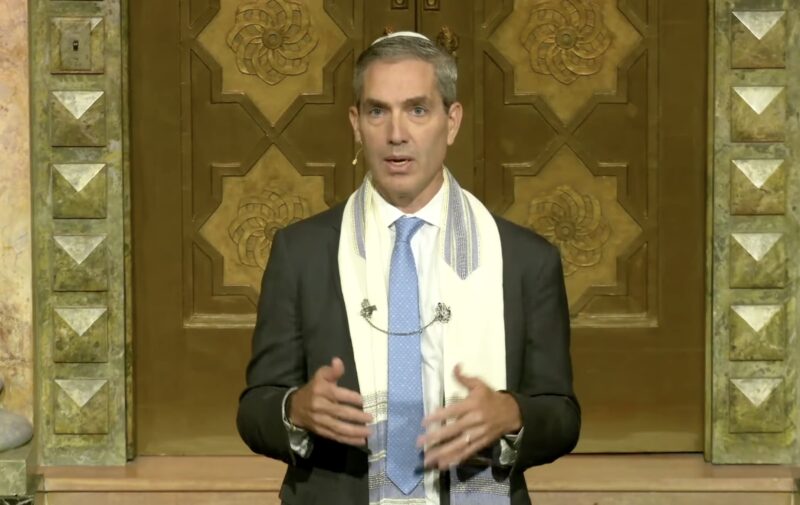
Screenshot
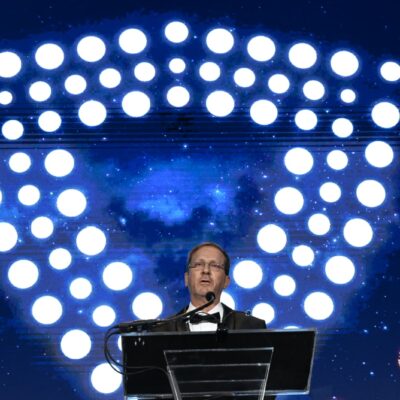
Rabbi Elliot Cosgrove delivers a sermon against New York City Democratic mayoral candidate Zohran Mamdani at Park Avenue Synagogue in Manhattan on Oct. 18, 2025.




 Add EJP on Google
Even after the IRS ruled this summer that spiritual leaders could endorse candidates from the pulpit, few major rabbinic figures opted to do so. But this past Shabbat, Rabbi Elliot Cosgrove of the Park Avenue Synagogue on Manhattan’s Upper East Side and one of the leading rabbis in the country, pleaded with congregants not to vote for Democratic candidate Zohran Mamdani in the New York City mayoral race. He urged them to call undecided friends and family members and spread the message. And, perhaps most significantly, he endorsed former New York Gov. Andrew Cuomo, the independent candidate, in the election, early voting for which opens on Saturday.
“To be clear, unequivocal and on the record,” Cosgrove began his sermon last Saturday, before offering a litany of reasons why he was speaking out against Mamdani including: “Mamdani’s refusal to condemn insightful slogans like ‘Globalize the intifada,’ his denial of Israel’s legitimacy as a Jewish state, his call to arrest Israel’s prime minister should he enter New York and his thrice repeated accusation of genocide in Thursday’s debate.”
Preaching politics into the pews has always been a fine line. Prior to July’s IRS decision, the Johnson Amendment, a 1954 tax code, caused congregations to lose tax-exempt status if leaders endorsed candidates (not policies), but it was rarely enforced. The line blurred more as Mamdani stoked fears among New York’s Jewish population, with prominent rabbis like Rabbi Ammiel Hirsch, the leader of Manhattan’s Reform Stephen Wise Free Synagogue, taking aim at the front-runner on his podcast and in sermons, and more than 900 rabbis signing a petition condemning Mamdani earlier this week.
But Cosgrove crossed a Rubicon by outwardly endorsing Cuomo from the pulpit. Some in the Jewish community told eJewishPhilanthropy that given the risk posed by a Mamdani mayoralty, this is something that should have occurred far more often and far earlier. Others expressed concerns that — regardless of one’s opinions of a specific candidate — this kind of politicization of religion ultimately puts Jews and democracy in danger.
“As a rabbi, the safety of the Jewish people is my preeminent concern,” Cosgrove told eJP. In the past, he has never been so forthrightly political. The rules dictated by the IRS had nothing to do with his decision to condemn Mamdani or endorse Cuomo, he said. “Just because you can doesn’t mean you should. This was an exceptional circumstance.”
What made this an extenuating circumstances? Cosgrove said he gave the sermon “because I’m deeply concerned about what happens when chants of ‘Death to the IDF,’ as has happened in other countries and cities and music festivals, are chanted at a concert in Central Park. I’m deeply concerned about when tens of thousands of Jewish New Yorkers show up at the Celebrate Israel Parade as an expression of their Jewishness and love of Israel, what will happen in those moments if, as has happened in Colorado and Washington, D.C., antisemitic violence perpetrated in the name of anti-Zionism [occurs]? Where will the Mamdani administration be? These are not imagined concerns, these are concerns born of the fear of an avowed antizionist operatizing his vision in his mayoral administration.”
Rabbi Jack Moline, who spent seven years as executive director of the Interfaith Alliance, is far from a Mamdani supporter, describing Cosgrove’s speech against him as “terrific.” Yet Moline said that ultimately the reasons for endorsing a politician from the pulpit are not relevant, and the Johnson Amendment should be kept intact.
“On a personal level, I found very little to disagree with it. My problem is where he said it and when he said it. If he’d stepped to the sidewalk outside of Park Avenue Synagogue and given that speech to CNN or ABC or to Vox, I would have had no problem with it,” Moline said.
Moline also finds it problematic when a formal endorsement doesn’t occur, just a call to not vote for someone, as Hirsch has been doing. And, he stressed, it’s not a function of whether a politician is liberal or conservative.
Moline said that he knows that many of his colleagues see the New York City mayoral election as “an Esther moment,” referring to the biblical story of Purim, in which the eponymous well-positioned Jewess uses her status to prevent a genocide of the Jews.
“[Such people say,] ‘If we don’t speak up now on this particular issue, we’re going to be in trouble.’ My response to that is, everybody has these deeply held convictions that convinces them that they’re exempt from what is best for the body politic. You think that a Roman Catholic bishop doesn’t think that abortion is as essential an issue as we think Zionism is? And yet, if a diocese were to organize for or against a particular candidate on that issue, we would scream bloody murder about it,” Moline said.
The separation of church and state is a foundational value that has protected the United States and Jews, he said, and these lines cannot be blurred because once the genie is out of the bottle, they will not be able to be put back in.
“If there are influential congregations, Jewish or non-Jewish, that can now create, essentially, campaign rallies and worship services for their candidates, it’s going to open the door to campaign money coming into those institutions, which means it’s going to create political influence in those institutions, which means it’s going to create Democratic synagogues and Republican synagogues, Democratic churches and Republican churches,” he said. “That’s not what the United States is all about. I simply do not accept the argument that this is a special case.”
These issues concern Cosgrove, too, he said. “I am concerned about opening a Pandora’s box of electioneering in religious institutions… I also believe this is an exceptional circumstance where the security of the New York Jewish community is on the ballot.”
For rabbinic student Steven Goldstein, who left the Reconstructionist movement because he felt its rabbinic school was “a training ground for anti-Zionist rabbis,” Cosgrove’s speech should have happened three months ago, before Mamdani became mayoral front-runner.
Instead, he told eJP, Jewish leaders didn’t take Mamdani or his rhetoric seriously or believe others would back him. Mamdani is now consistently leading in polls.
“It may well be too late for this election, but it’s not too late to create a new model of Jewish activism in this country,” said Goldstein, who previously served as a civil rights lawyer, as a press secretary for Congress and as a counsel to the House Judiciary Committee.
Politics only upsets people if they disagree with them, he said. “People say they don’t want politics from the pulpit. Oh, they do. They want their own politics. They don’t view politics from the pulpit as being politics if it’s their politics.”
Churches have regularly hosted candidates, whom the pastor would then endorse outside the church, he said. “An excellent model are African American churches, which for years have been involved in issues to a great and commendable impact… It’s time for synagogues to do the same, and it’s time for rabbis to do the same. This isn’t just a matter of politics, it’s a matter of life and death.”
Seeing a rabbi endorsing a candidate was “refreshingly honest and open,” he said, adding that he wants to know a rabbi’s politics so it can inform his decision to attend their congregation.
For instance, “could I belong to a synagogue that welcomed Zohran Mamdani over the high holidays?” he asked, referencing the politician’s recent visit to Brooklyn’s Reform Congregation Beth Elohim. “There is no way in hell that I could belong to such a synagogue.”
When asked to comment on Cosgrove’s speech, Rabbi Jacob Blumenthal, the CEO of United Synagogue of Conservative Judaism, said it’s ultimately up to rabbis to decide how they should engage with politics from the pulpit.
“USCJ values each rabbi as mara d’atra, the spiritual authority, who best knows their community and does not weigh in on individual use of that role,” Blumenthal wrote in a statement. “Weighing in on political matters is always complex, and we trust rabbis and their communities to carefully consider the implications of any public political endorsement and act thoughtfully on behalf of their own community. We recognize that the rise of anti-Zionism in political discourse has brought these questions to the forefront in many communities.”
The reaction to his speech in his congregation, Cosgrove said, “has been largely, but not uniformly, positive.” Leadership has been supportive of his decision to speak out.
“The pulpit should be a place for learning, for inspiration, for comfort, for reminding people not of who they are but who they should be, to teach from the riches of traditions,” he said. “That’s my comfort zone as a rabbi. In this instance, I felt compelled to enter new territory.”
Related News
EXIT INTERVIEW
Elizabeth Sokolsky, longtime EVP of Birthright Israel, to retire next year

MAGICAL EXPERIENCE
Shefa launches psychedelics retreat for Jewish professionals suffering burnout

MAJOR GIFTS
Center for Jewish History celebrates 25 years with a $25M matching grant
EXCLUSIVE
Detroit-based philanthropists Nancy, James Grosfeld donate $8M to renovate JDC’s Israel campus
CLOSING WORDS
In AZM address, Cosgrove links communal ‘orthodoxy’ on Israel to rising anti-Zionism among young Jews