BREAKING
Israel’s Yesh Atid Party drops out of World Zionist Organization, calling it ‘corrupt’
Yair Lapid, Israel's opposition leader, calls for nationalization of Keren Kayemeth LeIsrael-Jewish National Fund; announcement throws coalition talks into turmoil
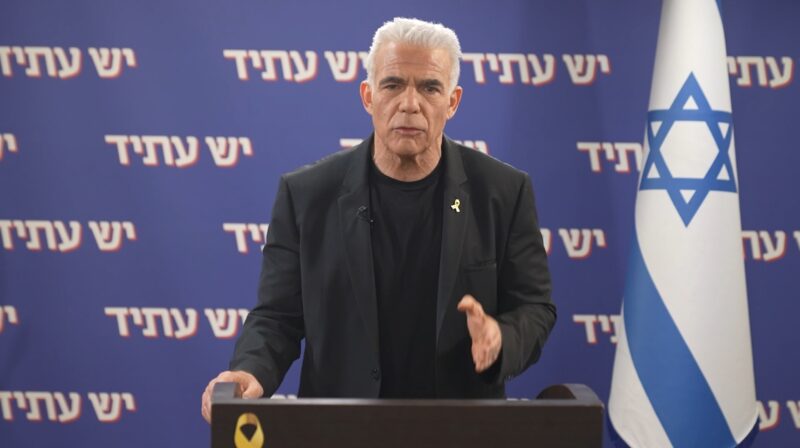
SCREENSHOT
Yesh Atid leader Yair Lapid announces that his party was dropping out of the 'National Institutions' on Nov. 5, 2025.




 Add EJP on Google
In a bombshell announcement, Yair Lapid, Israel’s opposition leader, said on Wednesday that he was pulling his centrist Yesh Atid party out of the World Zionist Organization and called for the “immediate nationalization” of the Keren Kayemeth Le’Israel-Jewish National Fund, which controls more than 10% of the land of Israel, describing the so-called “National Institutions” as hopelessly corrupt.
The announcement comes as the World Zionist Congress was nearing a power-sharing agreement that would have seen Yesh Atid split control of the WZO and KKL-JNF over the next five-year term. An initial arrangement was tentatively approved last week, but it fell apart after Culture Minister Miki Zohar of the Likud party, who negotiated on behalf of the center-right bloc, announced that he planned to name Israeli Prime Minister Benjamin Netanyahu’s divisive son, Yair, to a senior position within the WZO. A new deal was approaching completion, but Lapid’s decision to abandon the organization throws the negotiation process back into turmoil, with no clear path forward.
A spokesperson for Yesh Atid told eJewishPhilanthropy that the party views the National Institutions as irrevocably corrupt and rife with excessive budgets and positions. “Every stone you pick up and look under, there’s more budgets, more jobs, more things that you can’t explain. The whole thing is just rotten to the core,” the spokesperson said.
In a video statement, Lapid said that the party had hoped to reform the WZO and KKL-JNF but reached the conclusion that this was not possible. “We wanted to clean the National Institutions of the culture of corruption and political appointments — but it’s not possible. There’s no way to do it, and no one to do it with,” Lapid said, calling for other Israeli political parties to follow suit.
A spokesperson for MK Rabbi Gilad Kariv of the Israeli emocrats party, which was created through the merger of the liberal Zionist parties, told eJP that his Labor party was not planning on dropping out of the WZO at this point. “It’s not being considered. These are important institutions,” the spokesperson said.
Yesh Atid has long viewed the National Institutions warily. Indeed, the party has in the past called for the nationalization of KKL-JNF, an organization that has often been accused of corruption, waste and politicization. The organization has also faced criticism for only allocating land for Jewish projects — a requirement of its mandate — despite some 20% of Israel being non-Jewish.
According to Lapid, the tipping point was the latest power-sharing agreement, which would have included the creation of several new departments within the WZO. This would have created new department heads, who would have been given offices, staff and other benefits.
“The only reason they’re being set up is to hand out more and more jobs and budgets to political cronies — at the expense of the Jewish people, and at the expense of Israeli taxpayers. It’s an entire culture of corruption. We will fight it, not join it,” Lapid said. “We won’t lie to ourselves that we can ‘influence from within.’ I don’t usually walk away from a fight, and we very much wanted to enter the institutions, to clean them up, to return them to serving the interests of the state and the people. But after seeing all the details, I’ve reached the conclusion that they can’t be fixed — they need to be shut down.”
Lapid added that his party was submitting a bill in the Knesset to nationalize KKL-JNF, its significant land holdings and its accordingly large budget.
He stressed that while he saw the WZO and other Zionist institutions as corrupt, this was not a reflection of his views of the Diaspora Jewish communities that are part of them. “They are not cynical, but they’re not naïve either — they understand exactly what’s going on in these institutions. It pushes them even further away from the State of Israel and from Zionism,” Lapid said.
The creation of the new departments allegedly stemmed from negotiations regarding the position of Rabbi Doron Perez, the chair of the religious Zionist World Mizrachi movement. Under an initial power-sharing agreement, Perez was meant to serve as chair of the WZO for the first half of a five-year term, followed by a representative from Yesh Atid.
Under the proposal that was announced on Tuesday, WZO would instead be split between World Likud — with current WZO Chair Yaakov Hagoel serving in the role for the first half of the five-year term — followed by an as-yet-undecided Yesh Atid representative.
Perez would have been appointed to another position within the so-called National Institutions, either as president of the WZO, which is a largely ceremonial role, or as chair of the international Keren Hayesod fundraising operation, a WZO official from the center-left bloc told eJP on Tuesday.
The center-left bloc had been pushing for Perez to lead Keren Hayesod. If Perez demanded the presidency of the WZO, which would have effectively given Perez’s Mizrachi movement an additional department to control, other parties would have also demanded another department — and budget — to control as well.
According to the Yesh Atid spokesperson, this is what happened, though he stressed that the issue is not the specific circumstance, but the general culture of waste and excess in the WZO. “There is always an excuse,” the spokesperson said. “It’s all ridiculous.”
Unlike most political bodies, the World Zionist Congress is not designed as a “winner-take-all” organization, with a ruling coalition and an opposition. Instead, the congress allocates positions within the so-called National Institutions, largely based on the shares of seats that different factions have earned in the elections held every five years. In general, the leadership of the organizations goes to the larger faction, with lower-ranking positions going to the smaller one. Such was the case in 2020, when the Likud gained control of both the WZO and KKL-JNF.
Without an agreement on how to appoint the leaders of the National Institutions, the congress voted last Wednesday to extend itself by two weeks to leave more time for negotiations.
Related News

EXIT INTERVIEW
Elizabeth Sokolsky, longtime EVP of Birthright Israel, to retire next year

HIGHER EDUCATION
As Jewish donors reconsider academia, Jan Koum doubles down, endowing Israel studies at Stanford

MAJOR GIFTS
Center for Jewish History celebrates 25 years with a $25M matching grant
ADVANCING A VISION
N.Y. federation donates $1M toward building shared-society center named for peace activist killed on 10/7

MAGICAL EXPERIENCE
Shefa launches psychedelics retreat for Jewish professionals suffering burnout