RECONSTRUCTION EFFORTS
Inside Soroka hospital’s push to raise $475M after an Iranian missile struck its main buildings
Almost immediately after the attack, the Koum Family Foundation committed $50 million and convened a meeting with other leading Jewish philanthropies; and then Sylvan Adams pledged $100 million
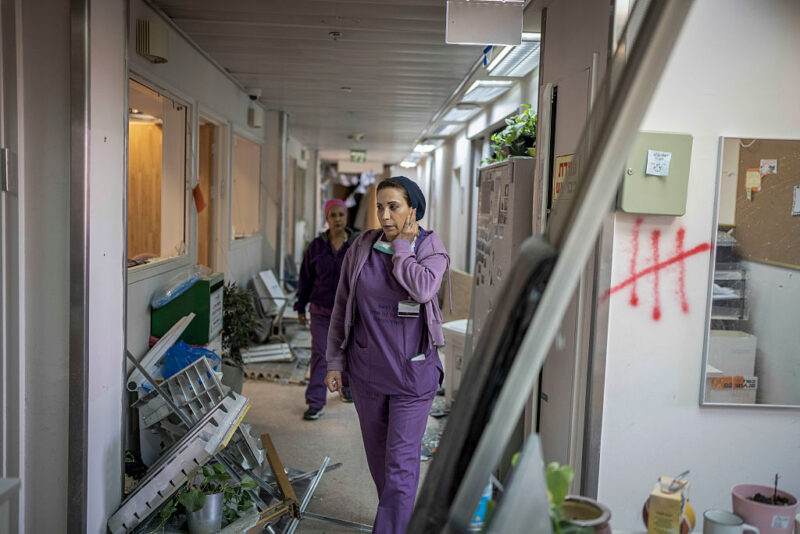
Ilia Yefimovich/picture alliance via Getty Images
Israeli health workers walk through a damaged hallways at Soroka Medical Center in Beersheva after it was hit by an Iranian missile in June 2025.




 Add EJP on Google
BEERSHEVA — When the Iranian Sejjil ballistic missile struck the Soroka Medical Center’s Northern Surgical Building on June 19 at 7:13:48, the hospital’s director, Dr. Shlomi Codish, was taking cover in a bomb shelter in one of the nearby buildings.
“There was the blast, and then two thoughts go through your head: One, ‘How many people were killed?’ Because when the blast is that strong and everything shakes, it’s clear that this was a strike and not an interception or anything else, and you know that at that hour, on average, you have about 2,000 people in the hospital. And two, ‘Are buildings going to collapse?’” Codish said.
Relatively quickly, however, Codish learned that somehow no one had been killed in the strike, though there were a number of injuries, and that while the Northern Surgical Building sustained heavy damage, as did the buildings immediately surrounding it, there was no risk of collapse.
“I am slowly getting used to the word ‘miracle.’ I don’t love the word ‘miracle’ because it’s a lazy word. But we evacuated the floor that was hit 16 hours earlier, despite the fact that it had fortifications. I don’t have a logical explanation for it. So let’s go with ‘miracle,’” Codish told eJewishPhilanthropy recently. “One of the things that keeps me up is: If we hadn’t evacuated the wards 16 hours prior, or if the missile had struck a day earlier, there would have been 50 people killed. And I’m not sure that the war with Iran would have ended. Because if you had a war where a hospital was hit, and 50 civilians were killed on the Israeli side… I don’t know, I’m not a politician, but I’m very happy with my little and my staff’s contribution to the fact that it didn’t happen.”
Codish made his remarks in his office in the hospital’s administration building, with windows looking out toward the Northern Surgical Building, which stands empty, with a hole in the roof and its top windows blown out, as the hospital negotiates with the Tax Authority over whether it is more cost-effective to repair the structure or to demolish it and rebuild. But Codish does not need to look out of his office to be reminded of the Iranian missile strike. There is a massive crack next to his door where his window frame slammed into the wall after being hit by the shockwave from the 750-kilogram warhead.
It was the same shockwave that hit the buildings next to the Northern Surgical Building, collectively containing some 60% of the beds in the hospital, which serves roughly 1 million people in the Negev. According to Codish, there’s no doubt that the Iranian strike was deliberate. “If you want to plan maximum damage, that’s how you do it,” he said.
The missile strike destroyed not only the top floors of the building but also the elevator shafts in the surrounding buildings, making it practically impossible to remove most of the equipment from them. Indeed, as we walked through the Northern Surgical Building some four months later, glass crunching under our feet, the stench of rotting milk permeated the halls as the massive insulated carts used to bring meals to the wards could not be removed, so they were left in place, full of their dairy breakfast contents. The three buildings that were most damaged by the strike had to be evacuated using hand-held stretchers.
Almost immediately after the attack, Codish said that a number of philanthropic foundations reached out to him, offering assistance. He singled out three main funders: the Koum Family Foundation, The Leona M. and Harry B. Helmsley Charitable Trust and Canadian-Israeli real estate mogul and philanthropist Sylvan Adams.
Adams is, perhaps, the most obvious recipient of appreciation from Codish and Soroka, having pledged $100 million to the hospital in October and helping convince the Israeli government and the Clalit healthcare provider, which owns Soroka, to contribute similar amounts.
And while Codish heaped praise on Adams, he also highlighted the contributions of the Helmsey Charitable Trust, one of the most consistent supporters of Israeli hospitals, and the Koum Foundation. Despite making major donations to Jewish organizations in the United States, Israel and around the world, the Koum Foundation — started by WhatsApp co-founder Jan Koum — strives to fly under the radar, and thus did not receive the same amount of public acknowledgment as Adams.
“Koum, who already knew us, reached out on their own very quickly and pledged $50 million. At the time, I didn’t even know what the needs were,” Codish said.
“What Koum also did, which to me is phenomenal, is that they opened doors for us with places that we didn’t already know. They organized a Zoom meeting for me to discuss our needs, and they invited dozens of people from the Jewish philanthropy world and made connections. They created a community of philanthropists gathering around Soroka,” he said.
“Unfortunately, some of the foundations don’t want to be named, which is a shame because I’m dying to give them credit,” Codish said, noting that this was both to acknowledge their contributions and to demonstrate to his employees that people care about them.
Quickly, Codish determined that three things had to happen: one, the damaged wards had to be repaired; two, a new fortified building — dubbed “Tekuma,” meaning rebirth or revival — would have to be built; and three, the hospital had to deepen its commitment to innovation and research.
In total, he said, these plans will cost nearly half a billion dollars. His first focus was on the fortified building.
“I started with the building because that is the most expensive thing. Of the $475 million, it will cost $343 million, and that is the thing that, over time, people will understand the need for it less and less,” he said.
And Codish said that a fortified building is critical for his ability to attract and maintain his staff.
Of the big hospitals in Israel, he said, “we are the least fortified hospital in Israel, which is insanity… and that’s after 12 years of rockets from Gaza.” Two days before the Iranian missile strike, Codish said that he brought together the hospitals’ department heads for a “Zionism conversation,” as more and more staff members expressed concern about working in an unprotected hospital. “I told them that 1 million people were counting on us, and that I too was coming to work in an un-fortified office,” he said.
After an Iranian missile indeed struck the hospital, that kind of pep talk would likely not work on its own, Codish said.
“People think that we are on Khamenei’s ‘speed dial.’ If I were Khamenei, I wouldn’t attack Soroka again because we already showed that we are more resilient than he thinks,” Codish said. “But my 5,700 employees need to see a future. They need to see that it may take six years, but they’ll have fortifications. In the next war, I need to be able to tell them, ‘We need to come into work, unprotected, while they are building our fortified building.’ Unfortunately, there will probably be another war before the building is ready. But they need to see that it’s happening.”
Once this “community of philanthropists” came together, Codish said, the donors were able to exert pressure on the Israeli government, getting the state to make commitments to help Soroka rebuild.
Codish stressed his appreciation for his staff, who saw their hospital hit by a missile after “two years of total chaos,” following the Oct. 7 terror attacks. He noted that 674 injured people were brought to Soroka on Oct. 7, 2023, and that as the closest major hospital to Gaza, helicopters bringing rescued hostages and wounded soldiers regularly arrived to Soroka without advanced notice. Codish also added a “hat tip” of appreciation to the American Friends of Soroka Medical Center and the Israel Healthcare Foundation — the American fundraising arm of Clalit — particularly the husband-and-wife team of Perry Davis and Margy-Ruth Davis, who have been working with IHF.
“And then Sylvan came,” Codish said. “We’d already spoken with him. I don’t know how he makes his decisions, but it was amazing. It was so fast. He pledged $50 million for the building, and $50 million for the hospital’s strategic development, and that’s extremely important too. Ultimately, brick-and-mortar is not everything. The missile hit bricks and mortar. Thank God it didn’t hit people. But if you don’t have a way to attract people, to encourage innovation and research, you’re going to wind up with bricks and mortar, with a beautiful building that doesn’t fulfill its vision. And that’s where Sylvan came in, with a wider vision for the Negev.”
Indeed, Adams’ $100 million commitment to Soroka was his second donation of that size to the region, having pledged $100 million to the adjacent Ben-Gurion University in late 2023.
While Codish lauded Adams for his donation and his vision for the Negev, he noted that a downside of receiving such a major commitment is that suddenly other donors believe that Soroka no longer needs assistance.
“We’re almost done, but we’re not done yet,” Codish said. “We still need to raise $50.4 million.”
Codish said that he is now more concerned about recruiting talented physicians, from within Israel and from the Diaspora, than he is about raising money.
“In terms of the future of the hospital, 30 new-immigrant doctors are worth millions of dollars in donations,” he said. “There’s a line in [Through the Looking-Glass], ‘It takes all the running you can do, to keep in the same place. If you want to get somewhere else, you must run at least twice as fast as that!’ So we’re running as fast as we can, and we’re staying in place.”
Related News
ADVANCING A VISION
N.Y. federation donates $1M toward building shared-society center named for peace activist killed on 10/7
HIGHER EDUCATION
As Jewish donors reconsider academia, Jan Koum doubles down, endowing Israel studies at Stanford
PRESIDENTIAL REBUKE
Israel’s Herzog: Mamdani ‘makes no effort’ to hide disdain for Israel, Jews must fight back
EXCLUSIVE
Detroit-based philanthropists Nancy, James Grosfeld donate $8M to renovate JDC’s Israel campus

MAGICAL EXPERIENCE
Shefa launches psychedelics retreat for Jewish professionals suffering burnout