EXCLUSIVE
Teach Coalition study finds state-funded scholarships go mostly to families, not raising tuition
The 32% of funding that stays within the schools strengthens academic programming
Teach Coalition
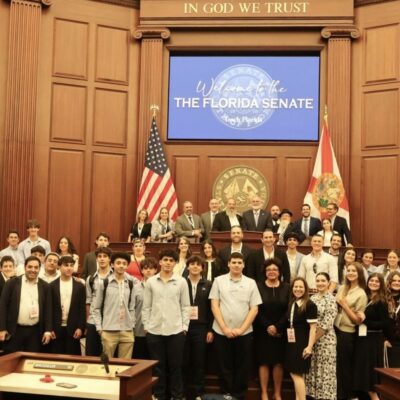
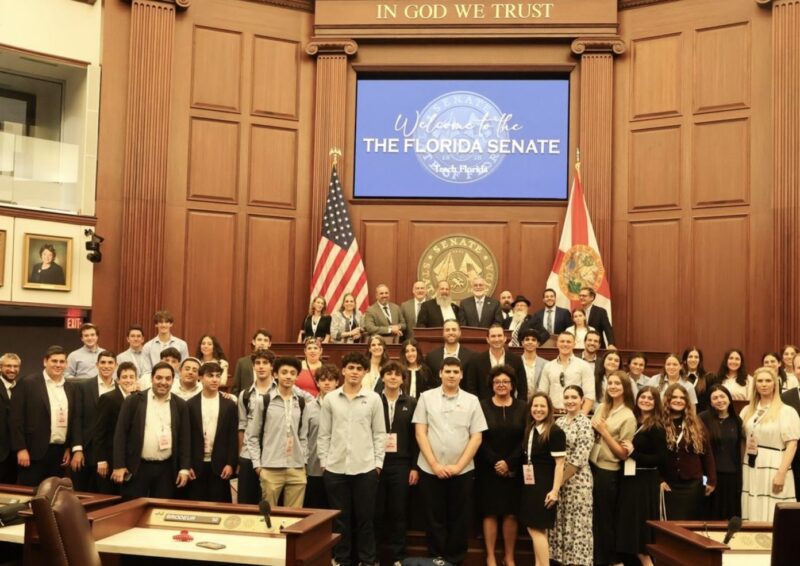
Teach Coalition representatives at The Florida State Senate in Tallahassee for Teach Florida’s Advocacy Day in February 2026.




 Add EJP on Google
Three reasons are typically offered to explain the United States’ comparatively low enrollment in Jewish day schools, particularly among non-Orthodox families: chiefly high tuition costs, followed by logistical issues and perceived lack of excellence compared to other education options.
To address the costs, a number of philanthropic initiatives have been rolled out over the years to provide scholarships and tuition assistance. But in recent years, there has also been a growing push — initially led by Orthodox groups, but increasingly by federations and other mainstream groups — to secure government funding for Jewish day schools. But even with these rebates and tax breaks, day school tuition remains out of reach for many in the Jewish community, leaving some to question whether they are as effective as they seem — is that money actually bringing down tuition for families, or are schools just raising their rates to match the new incentives?
With a new federal scholarship tax credit initiative set to launch in 2027, this question has taken on newfound urgency, as many states still weigh whether or not to opt in.
To answer it, Teach Coalition, the Orthodox Union’s division that advocates for government funding for Jewish day schools, conducted a study surveying the states where there are already tax incentives for private schools, finding that while a portion of the funds do benefit the schools, the majority does indeed bring down costs for families.
“There’s a narrative that scholarship programs, when they exist, just cause schools to raise tuition,” Gabriel Aaronson, director of policy and research at Teach Coalition and the study’s lead author, told eJewishPhilanthropy.
While enrollment at Jewish private schools has been ticking up for the past five years, many families remain priced out, and the federal scholarship tax credit, part of President Donald Trump’s One Big Beautiful Bill Act, is meant to offer some new hope for a large swath of the community.
Teach Coalition’s study, titled “The Effect of State Scholarships on Affordability in Jewish Schools from 2012 to 2022,” which was shared exclusively with eJewishPhilanthropy ahead of its publication today, sought to answer the question: When scholarship money comes in, do schools simply raise tuitions, or does the money go to the families who need it?
For much of America, private school vouchers are nothing new. Many states have offered them for decades, starting in the 1990s and becoming popular around the turn of the century, especially in red states. The study looked at IRS forms and available enrollment and scholarship data from 74 Jewish schools serving more than 30,000 students across six states, some of which offer government scholarship initiatives and others that don’t.
According to the study, in the states that offer vouchers or scholarships — Florida, Pennsylvania, Georgia and Ohio — tuition increased 47% over the decade in question. In the states that don’t offer vouchers or scholarships — New York and New Jersey — tuition increased 35%. But, at the same time, scholarships drastically offset the cost to families in scholarship states.
In scholarship states, tuition increased by a weighted average of $7,433. If it were raised by the same percentage as schools in non-scholarship states, tuition would have increased by an average of $6,345.
That means tuition at schools in scholarship states averaged an increase of $1,088 over tuition in non-scholarship states, yet the average scholarship offered in scholarship states increased by $3,431 over the decade, meaning families captured $2,343 — or 68% of the funding.
The 32% that stays within the schools is believed to go toward hiring better teachers, increasing teacher pay, adding staff, creating resource groups, improving extracurricular activities, purchasing supplies and strengthening academic programming. This is at a time when schools are competing with each other — and with public schools and non-Jewish private schools — for students and teachers.
“Schools are not trying to get rich when they keep money,” Danny Aqua, director of special projects at Teach Coalition, told eJP. “It doesn’t mean they’re perfect. It doesn’t mean they don’t make mistakes and have inefficient spending sometimes, but the primary goal is to pay teachers and educate students.”
When Aqua moved to Florida in 2016, he recalled getting “calls from families literally crying that they couldn’t afford a Jewish education.” At that time, vouchers were offered only to low-income households. “I remember getting calls [from] people saying, ‘I got a new promotion at work. I’m making $5,000 more, but I will lose $28,000 in scholarships for my four kids,’” he said.
In 2023, Florida passed a bill removing income-eligibility requirements for educational savings accounts, offering students over $8,000 for anything related to education, including tutoring, textbooks and private school tuition. Enrollment in Jewish day schools skyrocketed across the state.
A good school board will maximize funds for everyone, Aqua said. “School boards are very important… Because all our schools are nonprofits being run by boards, [they] have to determine [a school’s] value, [the] order and priority [of where to use funds]. Sometimes it’s going to be [that] we have to pay teachers more, and we’re willing to sacrifice a little bit on affordability to pay teachers more. But being very intentional about those decisions is critical.”
When Aaronson studied at the Talmudical Academy of Baltimore during the early 2000s, “sports were a joke,” he said, adding that he had a great time there, yet “didn’t touch a single chemical during chemistry, and it’s like, ‘They could use a little more funding.’”
Because there has been so little research on how much government scholarship programs reduce tuition, Aaronson “didn’t know what to expect” from the study. What did surprise him, he said, was how inexpensive it is to attend day school in the predominantly Orthodox community of Lakewood, N.J. The study showed that tuition in Lakewood averaged $4,834 for the 2022-23 school year, compared to $20,000-plus in most other places. Aaronson guesses that the reason for the low cost in that case was fundraising.
Governors of 31 states have either opted in or indicated that they plan to opt into the federal scholarship tax credit initiative that launches on Jan. 1. The initiative offers up to a $1,700 income tax break to individuals who donate to Scholarship Granting Organizations supporting K-12 students. The Joint Committee on Taxation estimates the program will lead to $500 million donated to SGOs.
Most of the states that have joined the initiative are red states, but in New York and Colorado, states that plan to opt in, this will be one of the first opportunities for families to attain support. Even if a state opts into the initiative, communities need to plan ahead to take advantage of the program by setting up new 501(c)(3) organizations dedicated to offering scholarships, which are then provided to students in schools. (To facilitate this, local and national Jewish organizations have been establishing these SGOs across the country.)
“Every community should be working as hard as possible to get as many community members to donate to the fund as possible, so that they can maximize affordability for funding for parents,” Aaronson said.
Related News

MAJOR GIFTS
Center for Jewish History celebrates 25 years with a $25M matching grant
PRESIDENTIAL REBUKE
Israel’s Herzog: Mamdani ‘makes no effort’ to hide disdain for Israel, Jews must fight back
CLOSING WORDS
In AZM address, Cosgrove links communal ‘orthodoxy’ on Israel to rising anti-Zionism among young Jews
ADVANCING A VISION
N.Y. federation donates $1M toward building shared-society center named for peace activist killed on 10/7
HIGHER EDUCATION
As Jewish donors reconsider academia, Jan Koum doubles down, endowing Israel studies at Stanford