BETWEEN TWO WORLDS
Alma, Tel Aviv’s home for secular Jewish study, finds a lifeline
Led by celebrated educator Ruth Calderon, the institute has found new life in a deal with the municipality — though its financial future remains uncertain.
Hadar Dolan
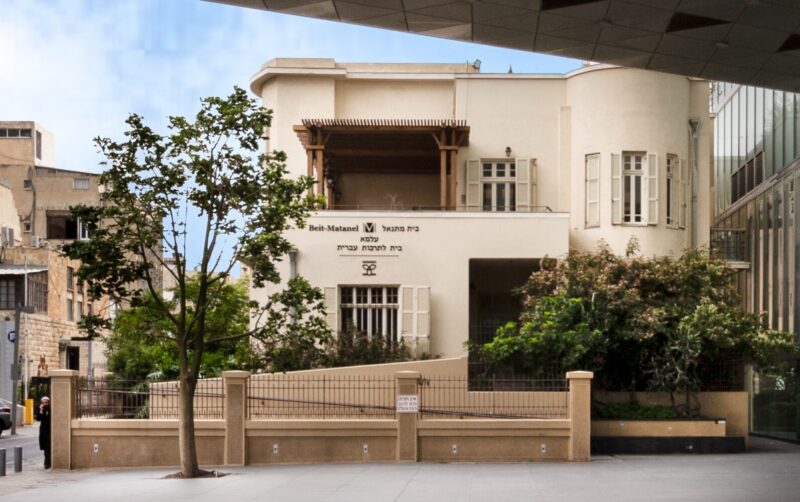
Alma, the Home for Hebrew Culture, in central Tel Aviv.




 Add EJP on Google
One of Israel’s few secular institutions of Jewish study nearly collapsed earlier this year — but has been saved, for now at least, by an unlikely alliance of alumni, artists and Tel Aviv City Hall.
Alma, the Home for Hebrew Culture, founded in Tel Aviv by former Knesset member Ruth Calderon, couldn’t make payroll this spring; one Tel Aviv city council member said the organization owed a “huge” debt to the city in municipal property tax. Without paid staff, Alma relied on 25 volunteer teachers just to keep its programs running.
Planted smack in one of Tel Aviv’s toniest neighborhoods, Alma is surrounded by the contrasts of Tel Aviv: the iconic Rothschild Boulevard with its high-end businesses, the historic Levin House, which sits alongside the posh R48 hotel, trendy non-kosher restaurants and the Great Sephardic Synagogue.
To Calderon, her organization’s dire straits were the result of discriminatory government policy: Israeli law fully exempts houses of worship, including synagogues, mosques and churches, from paying municipal property tax, known in Hebrew as arnona. Houses of worship can also receive state funding from the local religious council or Israel’s Religious Services Ministry. As a cultural nonprofit, Alma had to pay municipal property tax in full and was not eligible for that religious state funding. (The institution is eligible for other forms of funding as a cultural institution, Calderon acknowledged, but has not received any state grants in several years. She said she hopes that will change under a new Israeli government.)
In an effort to stay afloat, earlier this year Calderon launched a crowdfunding campaign asking friends, alumni and secular Israelis to join her in the fight to keep Alma alive. She was moved by the response, which raised NIS 265,679 ($89,134) from nearly 1,000 Israeli supporters — evidence, she argued, of the hunger Israelis have for a secular Judaism.
“People are not against knowing or owning their Judaism, but they want to get to know it in a way that respects their way of life. Before we complain about the unattachment of unaffiliated Jews, we should try the Alma method,” Calderon said.
Last week, Calderon announced to Alma supporters, alumni and friends that Tel Aviv Mayor Ron Huldai has decided to incorporate Alma into the city’s Bialik Houses, a network of historic cultural buildings. This means Alma will now operate as one of the city’s own cultural institutions rather than as an independent tenant. The city will not be directly funding Alma.
The decision allows the organization to finish the school year and its annual Tikkun Leil Shavuot study session in full. An accompanying art fair, where alumni — some now prominent figures in Israel’s cultural world — donated work to be sold in support of the organization, drew coverage across Israeli print, television and radio. It was that momentum, Calderon said, led to a meeting with the mayor and his staff, and what she described as a historic decision to bring Alma into the Bialik Houses network — a cluster of city-owned cultural buildings, among them the former home of Israeli national poet Hayim Nahman Bialik, that the municipality’s culture department already runs as heritage sites.
Under the arrangement, which Calderon told eJP is not yet finalized, Alma would be exempt from arnona going forward and pay a significantly reduced rent instead of the current market rate. The outstanding debt Alma already owes the city, however, remains unresolved. “It’s not signed yet, so I don’t want to break it before it’s completely final,” Calderon said.
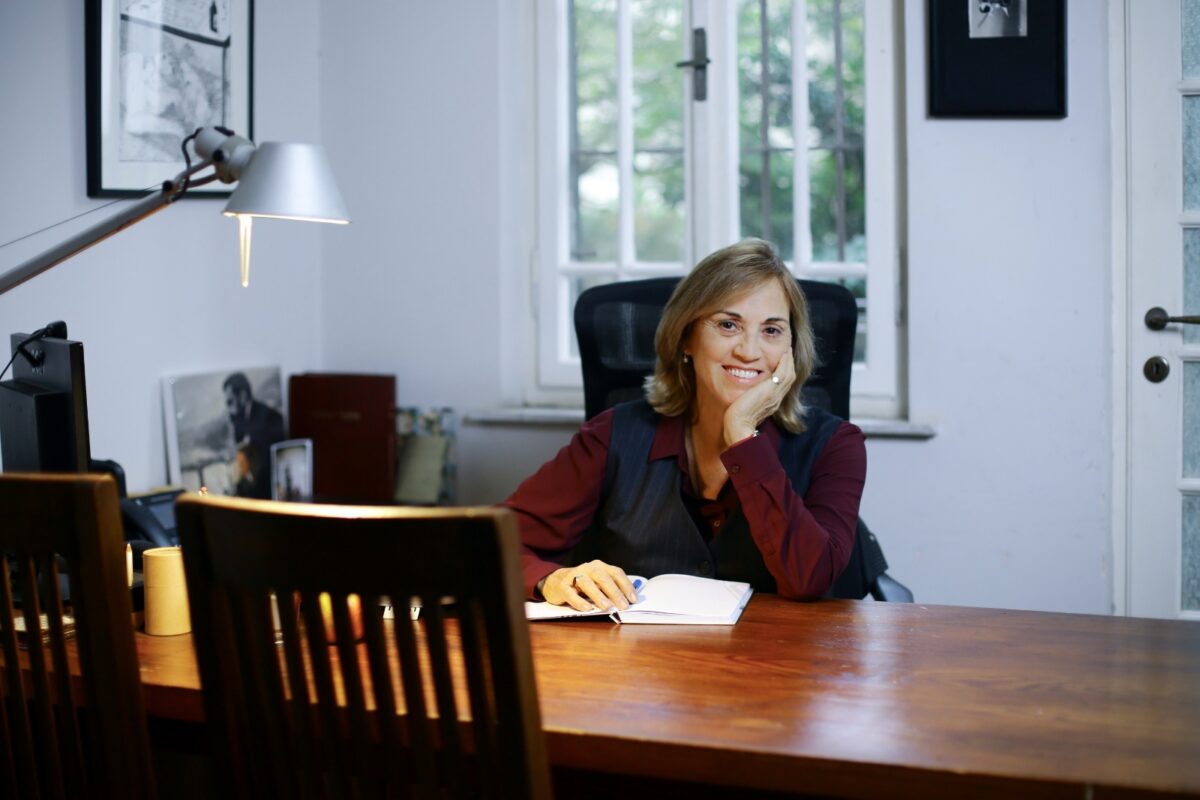
Still, Calderon called the achievement a milestone regardless of the paperwork. After three decades, Calderon said, the city has come to recognize Alma as essential to Tel Aviv’s identity and culture — and that Judaism, for the secular Hebrew public, is culture, and thus deserving of resources in the form of a permanent space alongside Rothschild Boulevard. “That’s a very big deal after 30 years of being very lonely and not understood in the secular mainstream Israel,” she told eJP. “It’s a little revolution that’s worth the pain.”
In a separate win, Calderon said the mayor has also asked Alma to bring its approach into Tel Aviv’s public schools.
Calderon is careful not to call the arrangement a comprehensive solution to Alma’s challenges. “It’s not a solution yet, but I hope it’s on the way,” she said. The city is providing space, though not funding, and Alma’s core problem — its exclusion from state and religious council funding — remains a structural one it will keep fighting.
On the funder front, Alma’s challenges had been exacerbated by the departure of major funders due to evolving priorities, including The Jack, Joseph and Morton Mandel Foundation and the Margolis Foundation. That left just the Matanel Foundation and the Posen Foundation as Alma’s primary supporters, with 70% of its funding coming from abroad.
Since the Oct. 7 terror attacks, Jewish giving had concentrated on rebuilding Israel’s North and South, trauma recovery, combating antisemitism and improving security for Jewish institutions in the Diaspora — leaving pluralistic cultural institutions in Israel like Alma, already a niche priority, squeezed even harder.
But to Calderon, Alma was never supposed to be a rarefied institution. She founded it in 1996, born from a boiling frustration: The unaffiliated majority of Israeli Jews had nowhere to study Torah that didn’t demand they become someone they weren’t, and no place that honored secular, Hebrew, Zionist life.
So she built one — and over three decades it has drawn a particular kind of Israeli: artists, musicians, filmmakers, mental health professionals who worked in the Gaza envelope, young writers crafting a vision for Israel. Among its alumni are composer Yoni Rechter, singer Rona Keinan, musician Shem-Tov Levi and former Israeli Education Minister Yuli Tamir.
Some, however, question if there is indeed broad interest in a primarily intellectual, academic engagement with Judaism.
Shlomo Fischer, a sociologist at Hebrew University and a senior fellow at the Jewish People Policy Institute, noted that in the wake of the Oct. 7 terror attacks and the past nearly three years of war, there has been growing interest in Judaism among Israelis, including those who previously considered themselves secular or traditional but nonobservant.
“There has been a revival of religion in Israel,” he said, “but not in the sense of what Alma is offering.”
What is taking place in Israel today, according to Fischer, is primarily an emotional, spiritual awakening: Traditional Jewish practices have suddenly come into vogue, even among those who do not observe halacha. For a long period at the start of the war, tzitzit — the biblically mandated fringed undershirts — were in short supply as soldiers of all backgrounds opted to wear them. At home, women started gathering to perform hafrashat challah, a traditional practice of saying blessings while sacrificing a piece of dough from a large batch.
This revival is taking place mainly among Israel’s masorti, or traditional, population (not to be confused with the Conservative Masorti movement), which Fischer estimated makes up roughly a third of Israeli society — a population that American liberal movements have largely failed to reach in 50 years.
“In Israeli culture, Alma is an elitist institution — sophistication, poetry, cinema, Talmud,” he said. “The revival that is taking place is not taking place in the pluralist institutions.”
Calderon sees it differently. “Something is happening since the Oct. 7 war,” she said. “The unaffiliated Jewish majority of Israel is standing on its feet and saying, ‘Don’t patronize us. We are Jews in our own way, we want to educate our children to choose their own way, and we need government support like anyone else.’”
Today, Alma engages 5,000 students a year. Nathalie Rashevsky found it by accident. Living in Jaffa, going through a painful period in her marriage, with young kids at home and no way back to university, she went online, found Alma, applied for a study program and showed up knowing almost nothing about Jewish text.
“I knew the Bible,” she told eJP outside her weekly evening class at Alma, “but I didn’t know what the Mishnah was.”
She found herself studying Talmud alongside artists, in a room full of people who saw the world as an open playground — not in agreement on everything, but sharing a quality of openness that she had not known she was looking for.
“This place held me through such a dark time,” she said. “I was so miserable, so alone, so confused — and here I felt seen and hugged. It saved my life.”
“If you want to keep the spirit of Judaism alive in Israel, you need to support Alma,” she said. “The Jewish spirit is dying here, and this is one of the last frontiers.”
Calderon is asking Diaspora Jews not just to send money, but to pay attention. “Tel Aviv is a theater for a culture war,” she said. “To fight against extremist and messianic forces, we need you.”
Just over a month ago, before the city intervened and with Alma’s path forward unclear, Calderon stood on the organization’s balcony overlooking Rothschild as the city hummed below. To her left, Tel Avivians were walking home from work. To her right stood the dome of the neighboring Orthodox synagogue. Her institution, caught between those two worlds, is trying to create a new one. “Alma is like Noah’s ark in the cultural war in Tel Aviv between extreme secular and extreme religion — a place that just loves Judaism and does not let Orthodoxy look down on us,” she said.
Related News
CLOSING WORDS
In AZM address, Cosgrove links communal ‘orthodoxy’ on Israel to rising anti-Zionism among young Jews
EXCLUSIVE
Detroit-based philanthropists Nancy, James Grosfeld donate $8M to renovate JDC’s Israel campus

EXIT INTERVIEW
Elizabeth Sokolsky, longtime EVP of Birthright Israel, to retire next year

MAGICAL EXPERIENCE
Shefa launches psychedelics retreat for Jewish professionals suffering burnout

MAJOR GIFTS
Center for Jewish History celebrates 25 years with a $25M matching grant