Your Daily Phil: Same old engagement won’t cut it with next-gen donors, fundraising consultant says




 Add EJP on Google
Good Thursday morning.
In today’s edition of Your Daily Phil, we interview fundraising consultant and Giving Institute board member Avrum Lapin about the latest Giving USA report. We report on the expansion of the Orthodox social justice group Uri L’Tzedek to Washington and examine the anti-Israel Jewish Voice for Peace‘s pivot to electoral politics. We feature an opinion piece by Avi S. Olitzky about what happens when an organization’s charismatic founder leaves the scene. Also in this issue: David Callahan, Esther Manheimer and Tali Cohen.
What We’re Watching
Keren Kayemeth LeIsrael–Jewish National Fund kicked off its summer seminar in Israel this week for 180 Jewish educators from 22 countries.
What You Should Know
The annual Giving USA report that was released last month described a thriving philanthropic field, which saw a rise in inflation-adjusted giving for the first time since the COVID-19 pandemic.
The survey found that 2024 continued many of the existing trends in charitable giving, such as fewer donors providing more of the donations. The increase in giving was also not uniform, with some areas, like public-society benefit and international affairs seeing significant growth, while giving to religious causes — still the largest recipient — shrank by 1% when adjusted for inflation.
To understand what the Jewish community can learn from the report, eJewishPhilanthropy’s Judah Ari Gross sat down yesterday with Avrum Lapin, the president of the Lapin Group, a fundraising and management consulting firm for nonprofits, who also serves as a board member of the Giving Institute, the organization behind Giving USA and its annual report.
Judah Ari Gross: One of the underdiscussed but likely profound issues in the Jewish communal world is the generational shift in philanthropic giving. How do we see that in this year’s Giving USA report?
Avrum Lapin: There are a couple of things going on. One is that Jewish giving was really counted in giving to religion. And giving to religion, if you look back 20 years, was at you know, 50%, 55%, 60% [of total charitable giving]. And now it’s 23%. And that’s against the backdrop of less affiliation — not just in the Jewish community, all over. And so I’m not surprised that the number has gone down, and it’s gotten picked up mostly by education and human services…
In the realm of philanthropy, we have to find ways to find ways to engage those millennials.
In their parents’ generation, and it’s the same going back, they gave to Israel, gave to the Jewish community first, and only then gave to everyplace else. From Gen X, that went away. Giving to the Jewish community, giving to Israel, giving to Jewish causes was one item on their philanthropic menu. And they are a very generous generation. Obviously, you see the giving continues to grow. So the case needs to be made. We need to find a way to create paths of affiliation, paths of connection of engagement for young families.
In September 2024, the Generosity Commission, which was commissioned by the Giving Institute in 2021, dealt with this issue of the next generation. And interestingly enough, the rising generation of millennials, in particular, was motivated by social justice. They want to see impact from their giving. They want to see the results of the giving. And so that the notion of belonging to a community and being an individual donor in a community is different. And I think that the attention that needs to be paid to the emerging generation is different than it was for the generations before.
I think that the aftermath of Oct. 7 has shined a light on some of the fissures in the Jewish community and the need for the community to bring new solutions to the table rather than just the old prescriptions.
LEAN IN
Orthodox social justice group Uri L’Tzedek expands to D.C., spurred by polarization
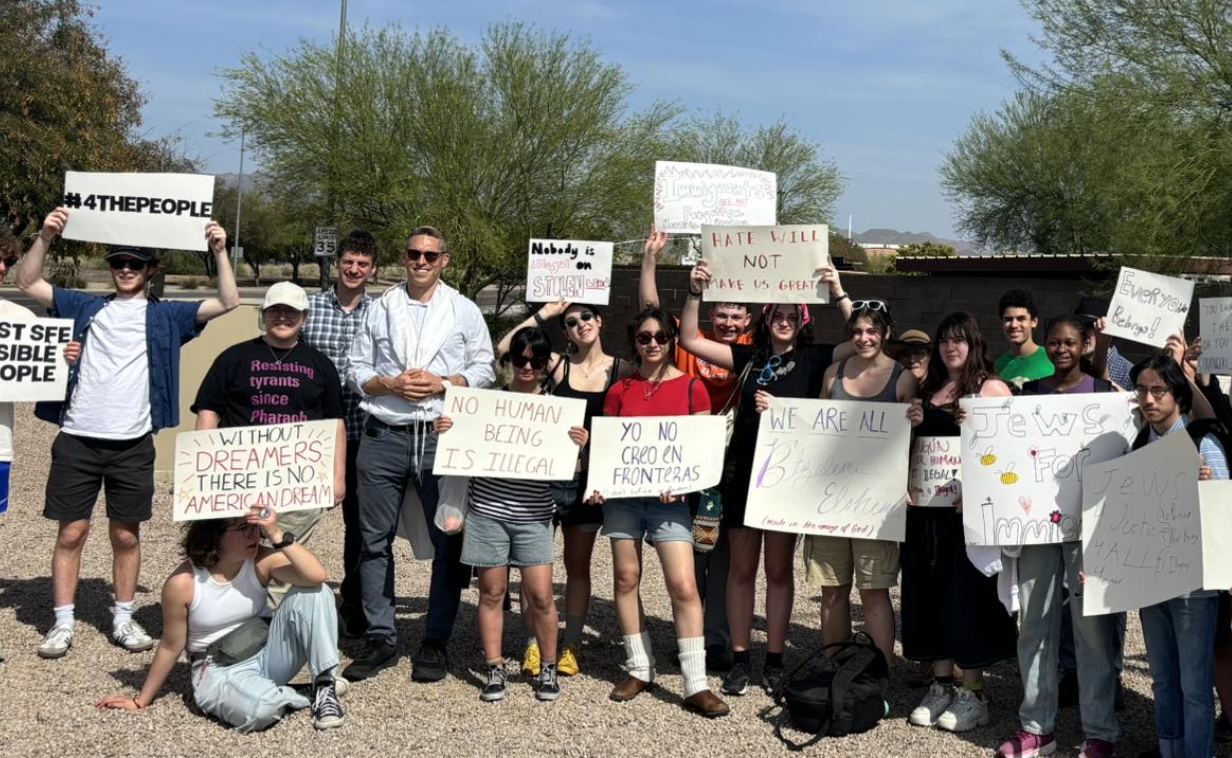
The Modern Orthodox organization Uri L’Zedek, which has brought lessons from the Torah into the social justice ecosystem for nearly 20 years, is expanding into advocacy work in Washington, hoping to “lower the temperature” of the country’s partisan politics. “One of the big dreams was to expand nationally. We always knew that we wanted to have a seat at the table in the D.C. coalitions,” Rabbi Shmuly Yanklowitz, the organization’s founder and president, told eJewishPhilanthropy’s Nira Dayanim. “Given all of the turmoil of the last year, it became clear that this was the right time.”
Not backing away: Two $50,000 grants from different undisclosed donors over the last few months made the expansion possible, Yanklowitz said. But with much of Jewish philanthropy’s funding redirected toward Israel advocacy and combating antisemitism, Uri L’Tzedek has been struggling to secure money in the aftermath of the Israel-Hamas war, he added. “There’s two ways to combat antisemitism. One is directly, and we need to do that, but the second is to continue to live Jewish values on the global stage when there is hate towards our community. The hate against the Jews wins when all we’re doing is playing defense for our community and we’re not actually living our core values as well,” he said.



SWITCHING GEARS
Jewish Voice for Peace restructures, sets its sights on the ballot box
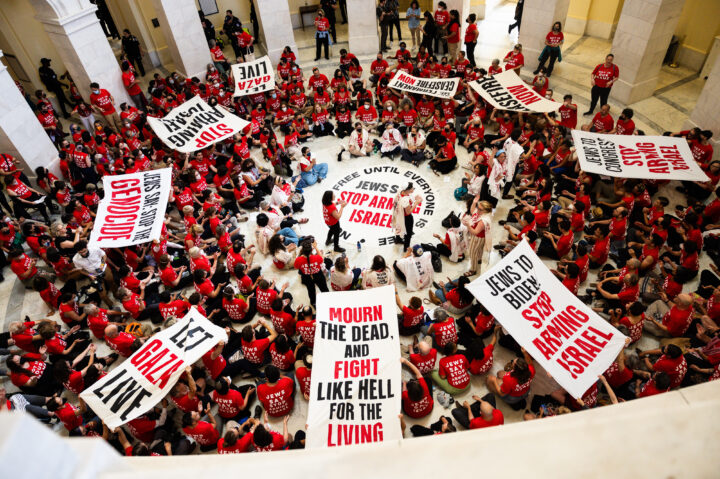
Jewish Voice for Peace, a far-left anti-Israel advocacy group that has built a growing profile in the wake of Hamas’ Oct. 7, 2023, terror attacks, is pivoting to a new organizational structure that will soon allow it to engage more forcefully in electoral politics. The group recently began the process of consolidating its membership and organizing in an affiliated but lesser-known political nonprofit called Jewish Voice for Peace Action, devoting the bulk of its resources to lobbying and political activities, such as supporting and opposing candidates that had not traditionally been a part of its core focus. As a nonpartisan tax-exempt group, JVP, which has been at the forefront of campus anti-Israel protests and promotes efforts to divest from Israel, has been legally prohibited from taking sides in campaigns — a limitation the new structural change is designed to address, reports Matthew Kassel for eJewishPhilanthropy’s sister publication Jewish Insider.
Behind the decision: The shift comes as the activist left has felt newly emboldened by Zohran Mamdani’s shocking victory in New York City’s Democratic mayoral primary in June, fueling debates over the ideological direction of the party as it gears up for next year’s midterms. JVP Action, which recently changed its public name to Jewish Voice for Peace to match its sister organization, was an early supporter of Mamdani and has cited his outspoken opposition to Israel as a sign of evolving voter attitudes about the Israeli-Palestinian conflict. “There is unprecedented, mass support for Palestinians. Our movement has already grown larger, and more quickly, than many of us thought possible. But it’s clear we have not begun to tap our full potential,” JVP writes in a detailed new page on its website about the decision-making behind its shift.
Read the full story here. and sign up for Jewish Insider’s Daily Kickoff here.
SET UP FOR SUCCESS
‘Foundling syndrome’: the organizational orphaning no one talks about

“You’ve heard of ‘founder syndrome’ — the outsized influence of a charismatic, driven leader who built something meaningful but can’t let go of it. But I’ve also come across something different. Let’s call it foundling syndrome: it’s not about the individual leader, but rather the organization they leave behind,” writes Avi S. Olitzsky, president and principal consultant of Olitzky Consulting Group, in an opinion piece for eJewishPhilanthropy.
Feeling exposed: “Foundling syndrome describes what happens when a founder exits and the structure that appeared solid under their leadership turns out to be a collection of habits, workarounds and personal relationships — not a sustainable system. What’s revealed is not succession gone wrong, but that there was never any true succession plan at all. The result? The organization becomes a kind of foundling — abandoned, vulnerable and unprepared for independent life. It was never nurtured to function without the founder’s presence and instincts… Foundling syndrome is painful for staff, for board members and certainly for the incoming leader. But it’s also a necessary awakening.”
Worthy Reads
Faith Persists: In Nonprofit Quarterly, Ted Siefer shares some of the takeaways from “Trust in Nonprofits and Philanthropy,” a report released by Independent Sector. “The nonprofit sector remains among the most trusted institutions in American society. However, there are signs this trust may be fraying amid concerns about the role of the federal government and the influence of wealthy donors. More specifically, Americans are increasingly skeptical of the motivations of the ultra-wealthy when it comes to their participation in the nonprofit and philanthropic sectors… One of the more striking findings of the report is the degree to which broad-based support for the nonprofit sector has persisted amid partisan attacks from Washington, DC. A large majority of Democrats (65%) trust nonprofits to ‘do what is right,’ as do 57% of Republicans — and in both cases, trust has grown modestly since 2024.’ [Nonprofit Quarterly]
Down From Here: In an Inside Philanthropy opinion piece, Editor-in-Chief David Callahan anticipates tough times ahead for the nonprofit sector. “One way to stay hopeful in the face of federal spending cuts is to keep two facts in mind — first, there’s strong public support for nearly everything the government spends money on, and second, politics tends to be cyclical. Given this, there would seem to be a good chance that a lot of lost funding is restored over time. … Dampening such hopes, though, is a hard reality: Crushing public debt is likely to sharply constrain government in the coming years, no matter what voters want or who’s in power. … The future we’re probably looking at, then, is one in which there is steadily less funding available for a whole range of services that Americans have come to rely on or expect. The sizeable slice of the nonprofit sector that provides these services using public funds has likely peaked and now faces decline.” [InsidePhilanthropy]
Effective Altruism Strikes Back: In the Stanford Social Innovation Review, Peter Singer and T. Alexander Puutio argue that funding cuts and an unsure future for the development sector demand using the money that is available to do “the most good” going forward. “We need to be honest about what works, brutally transparent about what doesn’t, and obsessed with delivering the greatest possible consequences instead of good intentions wrapped in bureaucratic comfort. The era of vague narrative wins must give way to the discipline of consequence… Our best shot at securing long-term legitimacy, across political divides and cultural lines, is to become a force for good so clear and compelling that the work speaks for itself.” [SSIR]
Food for Thought: In Devex, Tania Karas reports on experts rethinking the present paradigm for international food aid. “Much of the argument for keeping U.S.-grown in-kind food aid going is that it benefits American farmers and U.S. shippers, my colleague Ayenat Mersie writes. … [But sourcing] food in the U.S. and shipping it overseas typically costs up to 34% more than buying it locally or regionally, according to the U.S. Government Accountability Office. It can also undermine local markets and food systems — which doesn’t exactly encourage self-sufficiency or help countries reduce their dependence on foreign aid. Cash aid is overall cheaper and often easier to administer.” [Devex]
Word on the Street
Jewish Journal interviews Esther Manheimer, the mayor of Asheville, N.C., about her Jewish upbringing and her response to the deadly hurricane that hit Western North Carolina last fall…
Les Wexner purchased Norman Foster’s Martha’s Vineyard estate for $37 million…
The New York Times spotlights For the People, a criminal justice nonprofit supported in part by the Schusterman Family Philanthropies, which is helping female prisoners take advantage of new resentencing laws…
A former director of Jewish Care Scotland was sentenced to 18 months in prison for embezzling more than $72,000 from the charity…
Dr. Miriam Adelson broke ground on a new “$8 billion ultra-luxurious resort and entertainment destination in Singapore” that is being built by her Las Vegas Sands…
Major Gifts
The American Jewish Committee donated $30,000 to the Community Foundation of the Texas Hill Country for flood relief efforts, a spokesperson for the organization told eJewishPhilanthropy; the funding came from AJC’s Harriet and Robert Heilbrunn Humanitarian Relief Fund…
Transitions
Tali Cohen is joining the Anti-Defamation League as the director of the group’s Washington office, following more than two decades at FEMA and the Department of Homeland Security…
Pic of the Day

Hundreds of Druze residents of the Golan Heights demonstrate yesterday on Israel’s border with Syria against attacks on the Druze community in the Syrian Golan city of Sweida, with unconfirmed reports indicating that Syrian government forces killed more than 250 Druze fighters and civilians.
Hundreds of people crossed the border into Syria yesterday, and dozens of Syrian nationals tried to enter Israel, as the Israeli military struck many Syrian regime targets throughout the day in retaliation for the attacks on Syria’s Druze population, which it has sworn to protect; those targets included the country’s general staff command building and an unspecified “military target” near the Syrian Presidential Palace in Damascus.
Birthdays

German-British cellist and Holocaust survivor who was awarded the Member of the Order of the British Empire in 2016, she is the last remaining survivor of the Women’s Orchestra at Auschwitz, Anita Lasker-Wallfisch turns 100…
Chef and two-time James Beard Foundation Award winner, Joyce Goldstein… Professor emeritus at Tel Aviv University and former Israeli foreign minister, Shlomo Ben-Ami… Emmy Award-winning play-by-play announcer on radio and TV, currently with the Los Angeles Dodgers, Charley Steiner… Co-editor of The Big Book of Jewish Humor, Moshe Waldoks… Civil rights and criminal defense attorney, co-founder of the Innocence Project, Peter J. Neufeld… Former chairman of the Board of the Jewish Federation of Greater Hartford, he is now a lecturer at UConn law school, Robert K. Yass… Rabbi emeritus at Reform Congregation Keneseth Israel in Elkins Park, Pa., Lance J. Sussman… Managing GP and co-founder of Pitango Venture Capital, Nechemia (Chemi) Peres… Chair of Samson Energy Company, co-founder of Granite Properties and chair of the Charles and Lynn Schusterman Family Philanthropies, Stacy Helen Schusterman… Business development team lead at Quorum, Steven Lebowitz… Television and film director, Joshua Seftel… Actress best known for playing Sharona on the television series “Monk,” Elizabeth Natalie “Bitty” Schram… Rabbi of the Young Israel of Woodmere, N.Y., Shalom Axelrod… Founder and CEO of Zeta Global, David A. Steinberg… Stand-up comedian, Gary Gulman… Blogger, journalist and science fiction author, Cory Doctorow… Treasurer of Australia until 2022, now chairman of the Australian arm of Goldman Sachs, Josh Frydenberg… President and CEO of Mashber Strategies, developing campaigns to fight antisemitism and respond to different types of hate, Matthew E. Berger… Public television host, Shannan Butler Adler… Member of the Knesset for the Yesh Atid party, Boaz Toporovsky… Emmy Award-winning actor and comedian, Brett Goldstein… Healthcare reporter for Barron’s since 2019, following 9 years at the Forward, Josh Nathan-Kazis… Senior account manager at Red Banyan, Jared Sorhaindo… Branch expansion strategy lead and executive director at JPMorgan Chase, Melanie Ettleson… Para table tennis player and Paralympic gold medalist, Ian Seidenfeld… Daughter of Jared and Ivanka, Arabella Rose Kushner…