Your Daily Phil: As Passover approaches, war-affected Israelis turn to nonprofits for food aid




 Add EJP on Google
Good Tuesday morning!
In today’s edition of Your Daily Phil, we cover the second day of the Jewish Funders Network conference. We report on the rise in requests for food assistance in Israel as the war against Iran and Hezbollah drags on, and on the Jewish Federations of North America’s fresh push for greater government funding for Jewish institutions’ growing security costs. We feature Andrés Spokoiny’s full address from this week’s Jewish Funders Network conference in San Diego and an opinion piece by David Picone, a former San Diego Fire Department battalion chief, highlighting the need for better infrastructure in Israel to support first responders and soldiers dealing with trauma. Also in this issue: Yehuda Kurtzer, Adi Shankman and Natalie Zadok.
What We’re Watching
The Israeli military is expanding its ground operations in southern Lebanon.
The Jewish Funders Network International Conference wraps up today in San Diego. More on this below. If you’re there, say hi to eJP’s Jay Deitcher!
In the wake of last week’s attack on Temple Israel in West Bloomfield Township, Mich., a delegation of Jewish officials from the Detroit area, including Jewish Federations of North America Chair (and Detroit native) Gary Torgow, Jewish Federation of Detroit CEO Steve Ingber, Temple Israel Rabbi Jennifer Lader and Gary Sikorski, the Detroit federation’s security director, will be meeting with legislators.
The Anti-Defamation League’s Never is Now conference also concludes today. At this morning’s plenary, New England Patriots owner Bob Kraft will be awarded with the group’s Changemaker Award. The Carlyle Group’s David Rubenstein and author and former NFL player Emmanuel Acho are also slated to speak. At this afternoon’s closing session, Scott Galloway, Dan Senor, Pamela Nadell and Nancy and Bob Milgrim, the parents of slain Israeli Embassy staffer Sarah Milgrim, will address the gathering.
What You Should Know
It is customary for winners of the annual Genesis Prize, often referred to as the “Jewish Nobel,” to donate the $1 million award to causes they are passionate about. Past recipients have given their funds to combating antisemitism, assisting refugees, women’s rights and preserving the memory of Greek Holocaust victims. When Israeli actress Gal Gadot was announced as the 2026 Genesis Prize laureate in November, she promised to “dedicate this award to the organizations who will help Israel heal,” and now she will be able to double her impact.
Andrés Spokoiny, president and CEO of the Jewish Funders Network, told the attendees yesterday at the JFN International Conference morning plenary, that the Genesis Prize Foundation had partnered with JFN “to turn that gift into a catalyst for greater action” through a gift-matching program. By getting JFN members to invest an additional $1 million, Gadot’s initiative will invest “in the therapists, educators, social workers and community leaders helping Israeli society heal” in the wake of both the Oct. 7 terror attacks and the following two-plus years of war, including the current conflict with Iran and its Lebanese proxy, Hezbollah, reports eJewishPhilanthropy’s Jay Deitcher from the gathering in San Diego.
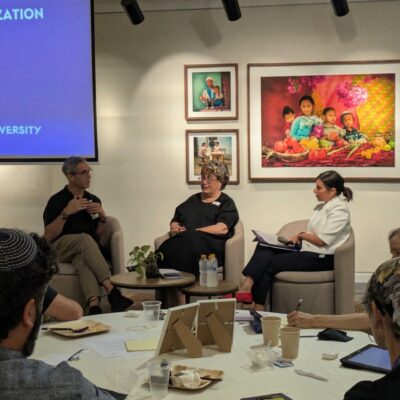
It’s one of many topics, some fraught with emotion, that attendees were discussing on the second day of the California gathering, which was attended by over 600 funders and representatives from philanthropic foundations.
The opening plenary also featured Sigal Yaniv Feller, executive director of the Jewish Funders Network Israel, who trekked 31 hours from Israel — on three flights — to make it to the conference, discussing the results of a recent Edmond de Rothschild Foundation study of “the Young Pioneers” of Israel, which found that young Israeli adults were both severely affected by the past two-plus years of war and nevertheless determined to rebuild their country. “While they feel abandoned by the state, they believe in themselves,” Yaniv Feller said. “Maybe most importantly, 84% still see their personal and professional future being built within Israel” — a potential positive sign for a country increasingly concerned about emigration and a so-called “brain drain.”
The plenary then showcased three young leaders via Zoom who were spurred to action after the Oct. 7 attacks: Miriam Amedi, CEO of Forum for Reservists’ Wives; Maor Tsabari, a poet and the head of mental health rehabilitation at Brothers for Life; and Yonatan Shamriz, a social activist and founder of the “Kumu” (Awaken) movement that aims to develop leaders bottom-up. (The three were supposed to attend the conference in person but were unable to make the trip.)
The morning plenary ended with Spokoiny’s annual address, where he called on the Jewish community to make brave moves, and he gave the audience a list of five action items to focus on: reforming Israel, making affordable Jewish day schools, politicizing philanthropy, uniting antisemitism initiatives and finding meaning through adult learning. More on this below.
Over the past year, she said, funders have increasingly looked at what they were investing in and questioned if initiatives were repetitive. They are learning what wasn’t working and working together to find solutions. “There are no sacred cows,” Emily Kane Miller, founder and CEO of Ethos Giving, told eJP. “What we are seeing here are funders asking hard questions,” she said.
Live from JFN: This year, eJewishPhilanthropy is serving as the conference’s official media partner, creating a bespoke daily newsletter for attendees, alongside our normal coverage. (Sign up for it here.)
HOLIDAY MEALS
As war drags on and Passover approaches, Israeli food-aid nonprofit sees major jump in requests

Amid the economic fallout from the ongoing conflict with Iran, demand for food assistance in Israel has surged dramatically as the country prepares for the upcoming food-focused Passover holiday, according to Yad Ezra V’Shulamit, one of the country’s largest food-aid organizations. “Passover is expensive for everybody, and every year, we give away about 60,000 food baskets for Passover,” Tefilla Buxbaum, Yad Ezra V’Shulamit’s director of resource development, told Judith Sudilovsky for eJewishPhilanthropy. “But this year the requests have skyrocketed. We already have at least 5,000 more requests than usual — and the phone doesn’t stop ringing.”
War weary: Yad Ezra V’Shulamit distributes 12,000 food packages weekly through a network of 95 distribution centers across the country, she said. During Passover, the number of requests for food packages traditionally increases, and this year especially many of the requests for food baskets are coming from people who have never needed help before, said Buxbaum. “People who were working and doing OK suddenly have no income,” she said. “Working people like the cleaning lady, the waitress — restaurants are closed or empty, so there are no tips and even if they get their salary it is only half of what they usually receive.”



COMMUNAL PRIORITY
JFNA renews push for increased security funding following Michigan attack

Following an attack last Thursday on Temple Israel and its early learning facility in West Bloomfield Township, Mich., the Jewish Federations of North America is making a renewed push for expanded security funding and resources to protect the Jewish community, reports Marc Rod for eJewishPhilanthropy’s sister publication Jewish Insider.
Pollak’s position: Pollak’s argument was a wonky one, suggesting that changes to IRS rules regulating nonprofits could increase transparency — and require the organizations fomenting antisemitism at U.S. universities to reveal much more information about their operations and staff. Pollak called for the federal government to create limits on fiscal sponsorship, a tool by which an existing nonprofit incubates a new one. This allows a new nonprofit organization to launch quickly, with donations passing through a larger, more established organization. The idea is that once the new nonprofit has a steadier foundation, it will eventually incorporate as a 501(c)(3) nonprofit with the IRS, after which point it must meet certain federal requirements and make information about its finances and activities publicly available.
Read the full report here and sign up for Jewish Insider’s Daily Kickoff here.
ICYMI
A window for systemic change: Andrés Spokoiny’s address to JFN 2026
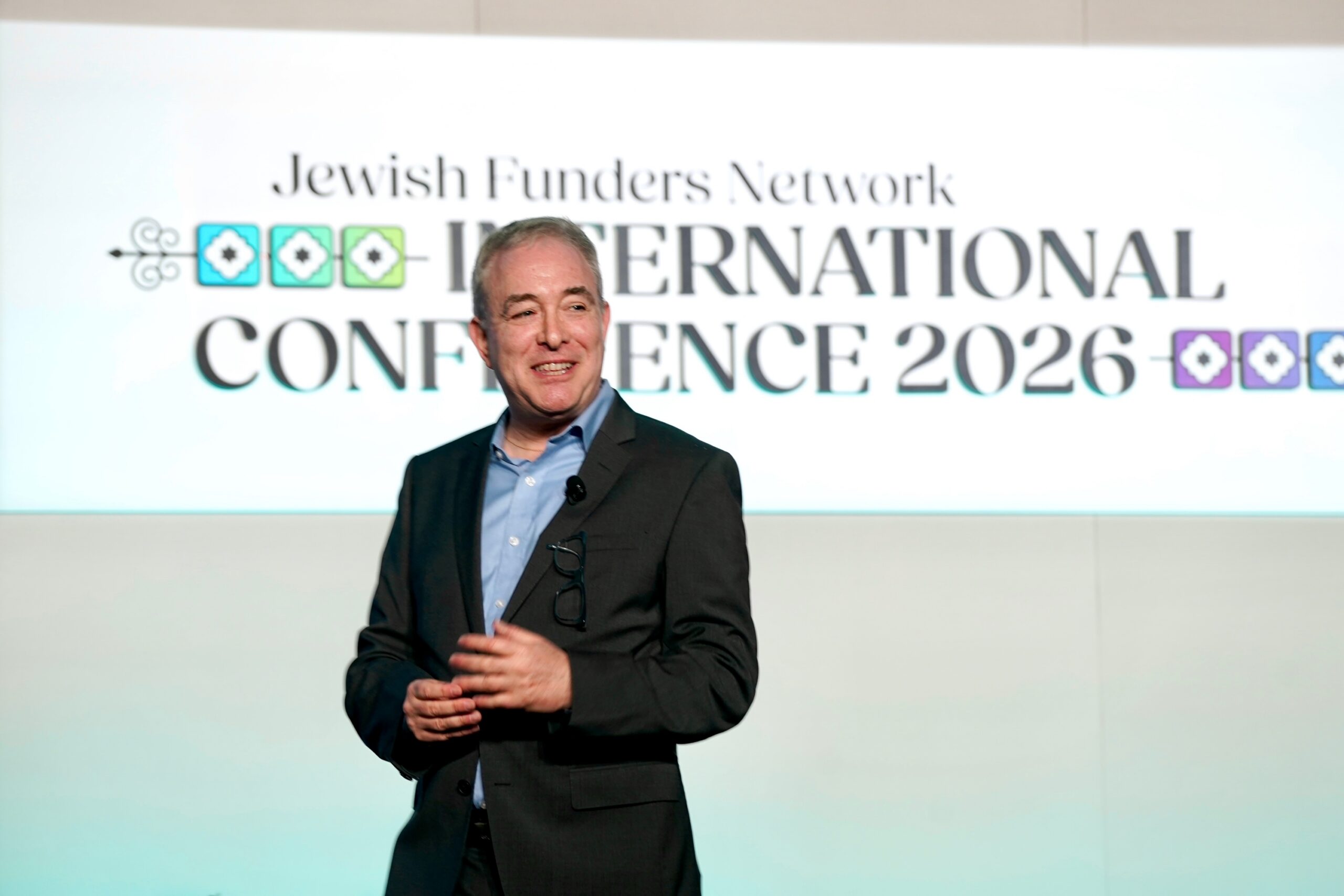
“How do we live in these strange times in which destiny has placed us? And how — without falling into the tired cliché that ‘every crisis is an opportunity’ — can we actually make something meaningful and transformative out of the convulsive times in which we live?” said Jewish Funders Network president and CEO Andrés Spokoiny in his address to the 2026 JFN International Conference yesterday in San Diego, shared with eJewishPhilanthropy.
Two frameworks: “I thought I would share with you two thinkers who give me the conceptual framework to think about our times. … The first is Kurt Lewin. … Change, he said, happens in three stages: Freeze. Unfreeze. Refreeze. … Lewin’s key insight is this: If you want systemic change, the moment is the unfreeze. If you wait too long, reality freezes again and the window closes. … The second thinker is Albert O. Hirschman. … His main idea is called possibilism. Possibilism is the refusal to accept the claim that ‘nothing can be done.’”
LIFE SUPPORT
As philanthropists gather in San Diego, Israel’s first responders face a growing trauma epidemic

“As the former battalion chief responsible for firefighter health and safety for the City of San Diego, I spent much of my career confronting a reality that every firefighter, paramedic, police officer and soldier eventually learns: The most serious injuries in these professions are often not the ones sustained during the emergency itself. They are the injuries that remain afterward, long after the smoke clears and the sirens fall silent,” writes David Picone in an opinion piece for eJewishPhilanthropy.
Critical infrastructure needed: “Israel is widely recognized as a world leader in trauma medicine and emergency response. Yet researchers, first responders, soldiers and members of the military themselves acknowledge that Israel does not yet have specialized campuses and clinics built around the kind of transdisciplinary biopsychosocial ecosystems that are now changing outcomes throughout California. For a country whose first responders, soldiers and reservists carry such an extraordinary burden of trauma exposure, building that infrastructure could make a profound difference. What San Diego and the Institutes of Health have demonstrated together is that these trauma trajectories are not inevitable. With the right systems of care in place, these epidemics among first responders can be prevented, treated and reversed.”
Worthy Reads
Sitting With Our Differences: In his Substack “Identity/Crisis,” Yehuda Kurtzer argues that while disagreement between American and Israeli Jews over the war with Iran might be inevitable, Jewish Peoplehood shouldn’t depend on political alignment. “Peoplehood can remain a countercultural commitment, as we decide that our bonds matter even when we can no longer take for granted that our interests as Jews in different countries do not fully align. Even amidst a war, the real demands of peoplehood are mutual commitments to curiosity in how each of us is confronting the challenges of citizenship and survival under radically different conditions; mutual commitments to empathy for one another; and the simple decision that the Jewish people do not walk away from one another.” [Identity/Crisis]
Sanctions Relief: In the Financial Times, Paul Caruana Galizia examines the curious case of Eugene Shvidler, a Russian-born oil magnate who was sanctioned by the British government in 2022 and can’t figure out how to get out of it. “Sanctions such as these raise the cost of an even indirect association with the Kremlin. The idea is to force a choice that could counter Russian aggression: remain loyal to the old system and lose your global life or cut ties and regain your assets. But Shvidler’s case illustrates not only how politics can interfere with what is meant to be a tool of foreign policy but also the opacity of the process. Experts say the Foreign Office offers little specificity on what individuals under sanctions need to do to regain their assets and has delisted fewer than 10 individuals since the invasion. ‘The government doesn’t seem to be indicating a path off the list,’ says Tom Keatinge, director of think-tank Rusi’s Centre for Finance and Security. ‘And there should be one: that’s the point.’” [FT]
Not Impressed: In an opinion piece for the Jewish Telegraphic Agency, Menachem Rosensaft explains how a recently-filed U.S. brief meant to support Israel’s case at the International Criminal Court falls short. “I do not mean to be snide. But as someone who once clerked for a federal trial judge and then spent more than 30 years as a securities and international litigator, I can say without fear of contradiction that a third-party submission in a litigation, which is what these interventions are, that does not educate a court and merely reiterates the obvious will not be taken seriously and may well end up backfiring. No judge or law clerk appreciates being fed pablum. Simply put, if one of my students were to submit a term paper of the quality of the U.S. intervention in one of my classes, they would not be happy with their grade.” [JTA]
Old Familiar Story: In The Spectator, Anglican clergyman and former journalist Rev. Michael Coren recounts interviewing Roald Dahl and observes that the children’s book author’s no-apologies brand of antisemitism is back in vogue. “Dahl wrote of ‘a race of people’ who had ‘switched so rapidly from victims to barbarous murderers,’ and that Washington was ‘so utterly dominated by the great Jewish financial institutions’ that the Americans ‘dare not defy’ Israel. Dahl was willing, even eager, to speak to me and in the interview went even further. … I told him that my father was Jewish, spoke of the impressive war record of my Jewish grandfather, of the number of Jewish men in all of the allied armies, but he was indifferent. Did he, I asked, want to clarify or rethink? ‘No thank you, I think I’ve made myself clear. Goodbye.’” [TheSpectator]
Word on the Street
Jonathan Greenblatt, CEO of the Anti-Defamation League, called out two Democratic lawmakers from the main stage of the organization’s Never is Now conference in Manhattan on Monday — Sen. Chris Van Hollen (D-MD) and Rep. Ro Khanna (D-CA) — accusing them of perpetuating antisemitism, Jewish Insider’s Haley Cohen reports.
The Australian Jewish News examines the Australian Jewish Communal Appeal’s recent overhaul, adopting a corporate, board-led structure instead of being run by its member organizations…
The Knesset’s House Committee voted yesterday to advance a bill that would effectively ban egalitarian and female-led prayer at the Western Wall, including in the section where it is currently permitted today; the legislation now heads to the parliament’s Constitution, Law and Justice Committee, where it will be discussed and potentially amended before heading back to the plenary for the first of three votes…
Philadelphia Jewish Film and Media has been formally absorbed by the city’s Weitzman National Museum of American Jewish History, where it has already been based and run its events for several years…
A Maryland man has been sentenced to three years in federal prison for sending threatening messages to Philadelphia Jewish institutions…
The Associated Press looks into Ad Kan, an Israeli far-right organization that discreetly arranged flights to remove Palestinians from the Gaza Strip…
The Washington Jewish Week profiles Adi Shankman, the local teenager who was elected international president of BBYO last month…
British Jews are fuming over a column in The Guardian that appeared to rationalize vandals targeting Gali’s, an Israeli-founded bakery…
The Times of Israel examines the growing calls for answers after Israeli Border Police officers shot and killed four members of a Palestinian family who were driving home from a shopping trip, leaving behind two orphans; the police said they believed that the father had accelerated his car toward them — a claim doubted by relatives…
The House of Representatives unanimously passed the Holocaust Expropriated Art Recovery (HEAR) Act of 2025, which is meant to help Holocaust survivors and their families reclaim artwork stolen by the Nazis; the legislation now heads to the president for signing into law…
The New York Times examines disgraced financier Jeffrey Epstein’s extensive ties to elite private schools…
Transitions
Jaime Fox has been named the next West Coast regional director for World ORT…
Pic of the Day
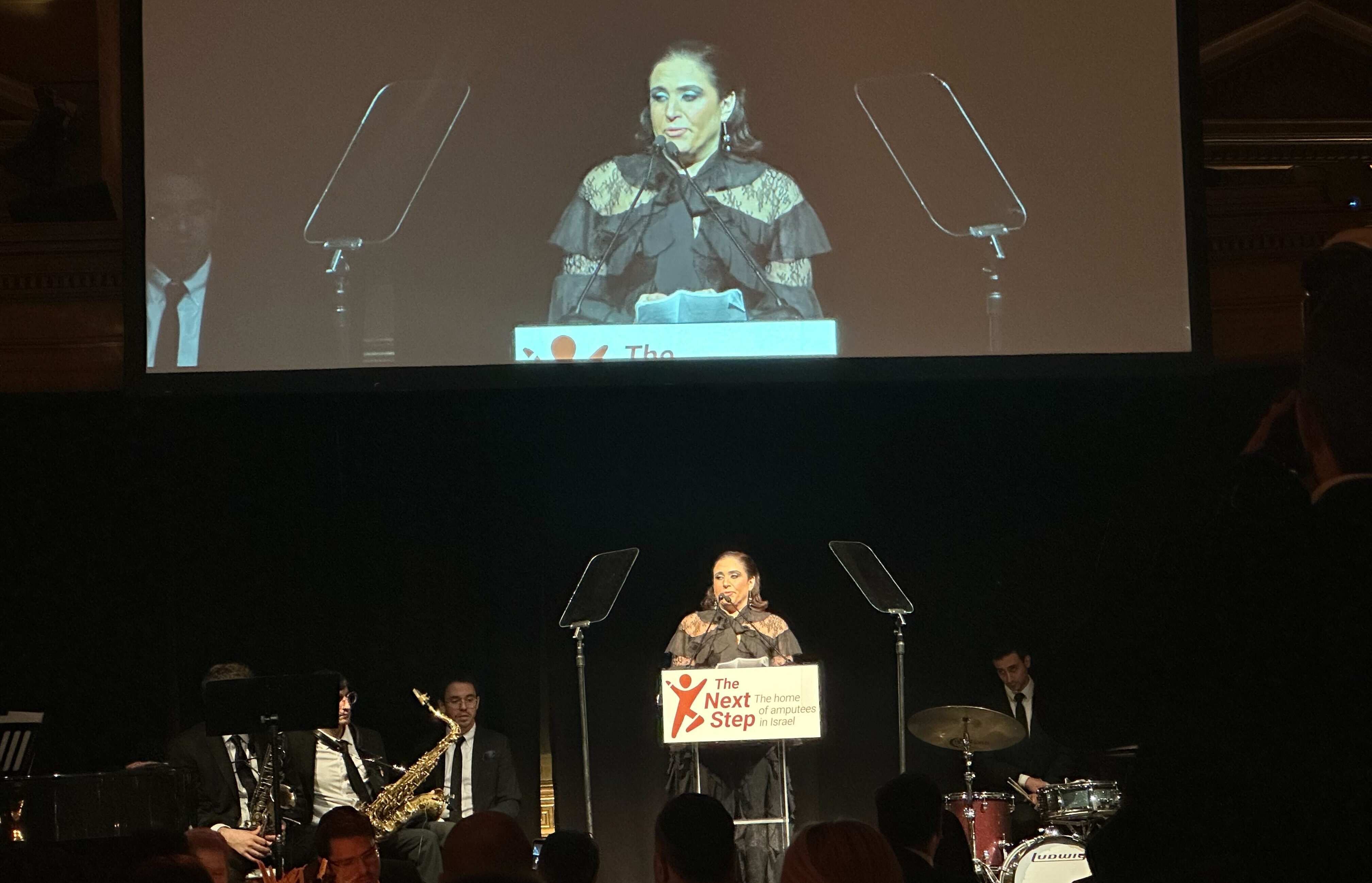
Natalie Zadok, an Israeli mother of three whose leg was amputated in 2024 because of sarcoma, a cancer affecting bone and soft tissue, speaks last night at the inaugural gala of The Next Step, a nonprofit that helps Israelis who have lost limbs, at Capitale in New York City.
Zadok said that the organization’s leaders provided physical and emotional services that “gave me hope I can have a normal life again,” including connecting her with a running coach. Zadok told the attendees that because of the confidence Next Step has instilled in her, she plans to run the Brooklyn Half Marathon next month with a prosthetic leg.
Birthdays

Actor, music producer and stand-up comedian, best known as Gustavo Rocque on the Nickelodeon television series “Big Time Rush,” Stephen Kramer Glickman turns 48…
Washington columnist for The Dallas Morning News, Carl Philipp Leubsdorf turns 88… Retail and real estate executive, CEO of Wilherst Developers and trustee of publicly traded Ramco-Gershenson Properties Trust, Mark K. Rosenfeld… Oral and maxillofacial surgeon in Fort Wayne, Ind., Michael Iczkovitz… Susan Schwartz Sklarin… DOJ official for 20 years, he has also served as a defense attorney, author of a NYT bestseller about his time working on the Mueller Investigation, Andrew Weissmann turns 68… Founder, president and CEO of Laurel Strategies, Alan H. H. Fleischmann turns 61… Director of legislative affairs at B’nai B’rith International since 2003, Rabbi Eric A. Fusfield… Member of the San Francisco Board of Supervisors, she served on the board of the San Francisco JCRC, Myrna Elizabeth Melgar turns 58… Lead field/floor/sideline reporter for CBS Sports football and basketball broadcasts, Tracy Wolfson turns 51… CEO and president at Las Vegas-based Gold Coast Promotions, assisting nonprofits in fundraising, Richard Metzler… Hasidic singer, entertainer and composer, Lipa Schmeltzer turns 48… Television writer and producer, he co-created the Netflix animated series “Big Mouth,” Andrew Goldberg turns 48… Musician and digital strategy executive, Rick Sorkin turns 47… Judge on the U.S. Court of Appeals for the Eleventh Circuit since 2019, Judge Robert Joshua Luck turns 47… Digital reporter and producer for ABC News including “World News Tonight With David Muir,” Emily Claire Friedman Cohen… Associate professor at GW University in the School of Media and Public Affairs, Ethan Porter turns 41… Senior grants officer at the Open Society Foundations, Jackie Fishman… Senior director and general manager at Uber Eats, Annaliese Rosenthal… Los Angeles-based tech journalist and founder of the TechSesh blog, Jessica Elizabeth Naziri… Associate VP of business development at ContinuServe, Zachary Silver… Director of e-commerce strategy at TAGeX Brands, Zach Sherman…