WHAT YOU SHOULD KNOW
What a car-ramming in Brooklyn shows about the messiness of this moment
X/Chabad
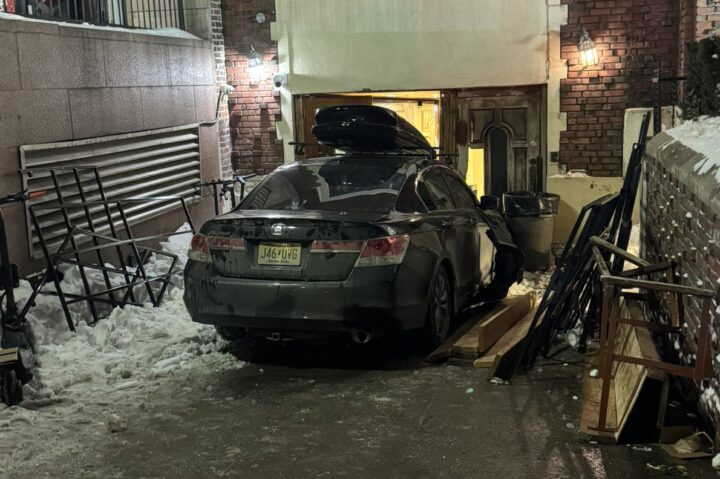
A car that was driven into Chabad's headquarters in Brooklyn on Jan. 28, 2026.




 Add EJP on Google
The reports came in quickly last night, just before 9 p.m.: A driver repeatedly rammed his car into the international headquarters of the Chabad-Lubavitch movement at 770 Eastern Parkway in Brooklyn. No injuries were reported.
With the reports came the commentary, tying the event to rising antisemitism generally and, more specifically, to New York City Mayor Zohran Mamdani’s anti-Israel rhetoric and fraught relationship with the Jewish community. Harmeet Dhillon, the assistant attorney general for civil rights, tweeted that she was instructing prosecutors to open a civil rights investigation into the ramming. The satirical Twitter account “Rabbi Linda Goldstein,” which lampoons progressive antisemitism with sarcasm, wrote in a tongue-in-cheek post that “there is no evidence the car ramming attack at 770 Chabad HQ was an anti-Semitic attack. Jumping to conclusions only stokes Islamophobia.”
As additional information emerged about the attack, however, Chabad officials began saying that, in fact, the attack on the synagogue-headquarters was not motivated by antisemitism. “Antisemitism does not appear to be a factor in this,” Rabbi Mordechai Lightstone, who runs social media for Chabad, wrote in a tweet. A spokesperson for Chabad, Motti Seligson, also noted that the motivations behind the ramming were “unclear.” This was not a perfunctory comment.
The snap commentary alleging antisemitism and assigning blame appears to have been misplaced. (Curiously, hours after Chabad officials began saying that the ramming was not motivated by antisemitism, U.S. Ambassador to Israel Mike Huckabee released a statement decrying the “cancerous bigotry towards Jewish people” that he said would soon be leveled against Christians. Huckabee’s office did not respond to eJP’s request for an explanation.)
It appears that the driver, whose name has not yet been released, had been attempting to convert to Judaism and had been rebuffed. Sources familiar with the incident told eJewishPhilanthropy that he also appeared to be struggling with mental health issues. As he was taken into custody, the man could be seen wearing shorts in single-digit weather.
According to eyewitness accounts and video footage, the driver told people standing outside the building to move out of the way before ramming into the building. The sources said that this indicated that not only did he not intend to hurt people, but also took active steps to avoid hurting people — even if ramming a car into a building repeatedly is an inherently dangerous and violent act that could have still resulted in injuries or death.
Of course, there was ample reason to assume that this ramming was indeed an antisemitic attack. The day before, a rabbi was assaulted in Queens by a 32-year-old man who screamed at him, “Fuck the Jews.” Earlier this month, a synagogue was severely damaged in an arson attack in Jackson, Miss. And last month, Chabad’s Hanukkah candlelighting event in Sydney, Australia, was attacked by terrorist gunmen, who killed 15 people and injured scores more.
The Jewish community is on edge, and for clear reasons. But particularly when that’s the case, an event like last night’s car-ramming not only demonstrates the wisdom of refraining from making assumptions until more information is available but also shows that reality can be messy and individual events do not always fit neatly into the broader narratives playing out around us.
The fact that this ramming does not appear to have been motivated by hatred of Jews, but by some combination of mental health issues and misdirected anger from rejection, also does not diminish the communal demands for additional protection. Jews and Judaism being topics of discussion in the public discourse also makes it more likely for Jewish people and institutions to be targeted, even if not for explicitly antisemitic reasons.