Turning mourning into action to address a modern tragedy, Jewish Earth Alliance holds pre-Tisha B’Av environmental lobbying day




 Add EJP on Google
Jews have survived many tragedies. Temples destroyed; revolts quelled; expulsion, expulsion, Holocaust. This Saturday night, on Tisha B’Av, the ninth of Av, Jews around the world fast in recognition of these horrors.
Now, environmental activists want to add global warming to the list.
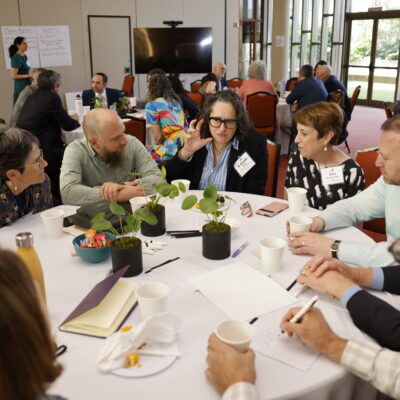
Last Wednesday, in a pre-Tisha B’Av virtual lobbying day, the volunteer-run Jewish Earth Alliance partnered with 57 Jewish synagogues and nonprofits to commend lawmakers for positive moves for the environment while calling on them to do more. Across 26 states, 395 volunteers met with 51 lawmakers or their representatives, turning the holiday of mourning into a day of action.
Founded in 2019, the Jewish Earth Alliance is a Washington-based environmental advocacy group. In its early years, the group held monthly education and advocacy meetings with experts, but in 2022, Jewish Earth Alliance’s co-founder, Rabbi Deborah Lynn, “bemoaned” to her friend, Rabbi Melanie Aron, that “because of COVID, they could no longer go into congressional offices,” Aron told eJewishPhilanthropy.
“Previously, they had collected letters from all around the country and hand-delivered them. I said, ‘Well, you know, you could do virtual meetings,’” Aron, a former California-based Reform rabbi who moved to Washington in 2022, said.
Since 2023, the Jewish Earth Alliance has held two annual virtual lobby days, on Tu BiShvat, which fell this year in early February, and on Tisha B’Av. After the current Trump administration slashed funding and programs protecting the environment, volunteers attended this year’s events in droves, leading to a record turnout for the Tisha B’Av lobbying. The efforts are co-sponsored by Adamah, Aleph: Alliance for Jewish Renewal, Dayenu: A Jewish Call to Climate Action, Reconstructionist Rabbinical Association, T’ruah: The Rabbinic Call for Human Rights, United Synagogue of Conservative Judaism, Women of Reform Judaism and others.
“If the Earth Alliance asks me to do something, I try to say ‘yes,’” Rondi Brower, the co-lead of Michigan’s contingent, told eJP. As co-chair of Metro Detroit Reform Temple Kol Ami’s “Green Team” and social action committee, she says, “It’s not enough to just change what I do [to halt climate change]. It’s not enough to just change what the congregation does. We’ve got to work more broadly.”
The lobby days are “the easiest sort of high-level lobbying that you can imagine,” Brower said.
Attendees work off a script created by the Jewish Earth Alliance steering committee, which includes a former EPA employee, a geologist, an Orthodox rabbi, a Renewal rabbi, and a communications expert. In states with smaller Jewish demographics, meetings were supplemented by leaders in the movement from other states.
Because “in Washington, evangelical Christianity has been assumed to be the moral voice,” Brower said, it’s essential that Jewish values are heard.
“It was easier locating legislation that we could support in the Biden administration,” Aron said. “Right now, we’re asking people to protect the EPA [Environmental Protection Agency], which has suffered tremendous cutbacks, FEMA [Federal Emergency Management Agency], which is being disabled from being able to help people, and NOAA [National Oceanic and Atmospheric Administration] on which we depend to understand [and predict climate, weather and ocean changes].”
Just this week, in fact, the EPA Administrator, Lee Zeldin, announced that the agency was revoking the so-called “endangerment finding,” the scientific determination that greenhouse gases threaten public health, which Rabbi Jennie Rosenn, the founder and CEO of Dayenu, likened to “tossing out the Ten Commandments.”
Even if group members didn’t vote for the sitting legislators, they can find common ground, Ellen Siegel, a representative from Gainesville, Fla., told eJP. “It’s valuable to talk to our legislators and their staff who don’t see the world the way we do. We might learn something about how they see the world that we could then help them understand that if they moved towards the way we see the world, all of us would benefit.”
She gave the example of some people wanting to plant trees in a community to improve aesthetics, while others aim to increase carbon sequestration. It doesn’t matter why someone does something, just that they do it, Siegel suggested
“One must posit no enemies in these conversations,” Siegel said. “You’ve got to go in knowing that we all want the best for our family, our loved ones, our cities, our communities, our state. So how do we find where we intersect on that? That’s the only way anything’s going to get done. Either that or we’re going to have an armed coup, which I would rather not have to deal with.”
While Tisha B’Av is a holiday mourning the past, the Jewish community keeps its eye trained on the future, Aron said. “We’re part of a chain of generations, so we don’t just worry about what happens today, we also look to what’s going to happen to our children or our grandchildren, and I think that motivates a lot of the people who volunteer with us.”
The movement has grown significantly since its first lobby days in 2023. Early on, Brower knew everyone participating in the meetings and attendees introduced themselves to lawmakers one by one. Today, so many people attend that introductions need to be made in the chat. Senators know who the group is and set meetings well in advance. Average people are finding their voice.
“Have we changed anything about what our senators are doing specifically?” Brower said. “I don’t know. But it never hurts to say thank you to the people who are supporting you.”
Related News
ADVANCING A VISION
N.Y. federation donates $1M toward building shared-society center named for peace activist killed on 10/7
HIGHER EDUCATION
As Jewish donors reconsider academia, Jan Koum doubles down, endowing Israel studies at Stanford
PRESIDENTIAL REBUKE
Israel’s Herzog: Mamdani ‘makes no effort’ to hide disdain for Israel, Jews must fight back

MAJOR GIFTS
Center for Jewish History celebrates 25 years with a $25M matching grant
CLOSING WORDS
In AZM address, Cosgrove links communal ‘orthodoxy’ on Israel to rising anti-Zionism among young Jews