WHAT YOU SHOULD KNOW
The Israeli tradition of (not) disqualifying Arab parties and the fight over judicial authority
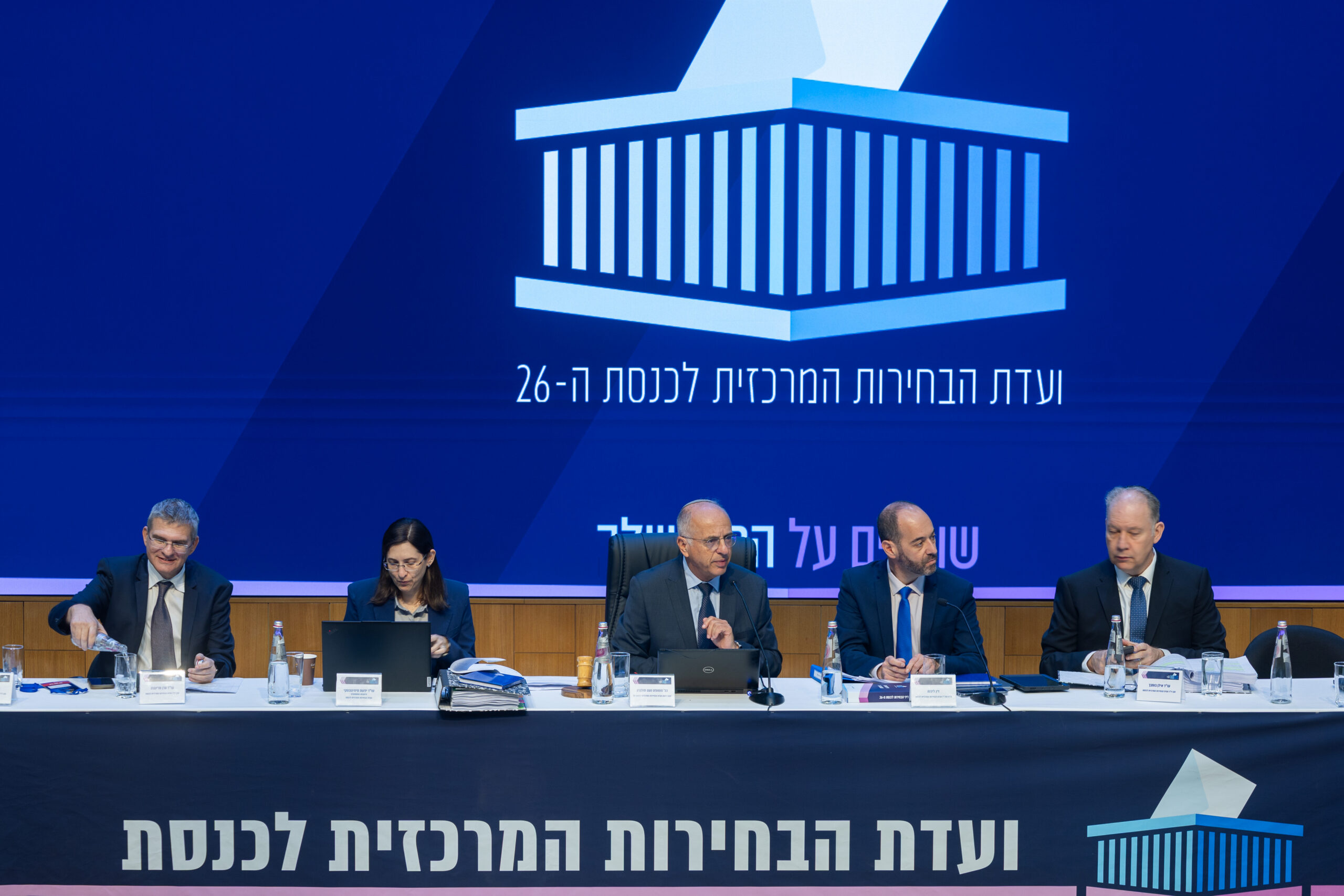
Yonatan Sindel/Flash90
Central Elections Committee Chair and Supreme Court Justice Noam Sohlberg, leads a hearing on a request to disqualify Balad Chairman Sami Abu Shehadeh at the Central Elections Committee at the Knesset in Jerusalem, on Sept. 23, 2026.




 Add EJP on Google
A piece of political theater — mostly but probably not entirely pointless — played out in Israel this week, as it does ahead of every national election: the disqualification of political parties. In this case, the parties in question were the four Arab ones, Hadash, Ta’al, Balad and Ra’am, as well as specific candidates.
For liberal and progressive supporters of Israel, this is a disheartening and worrying tradition, one that calls into question the country’s standing as a true democracy that ensures free speech and the full enfranchisement of its minority citizens.
“The partisan decision… is a direct attack on the fundamental and inalienable rights of political organization and representation by and for Israel’s Arab Palestinian citizens,” Sir Mick Davis and Mike Prashker, the founders of The London Initiative, an international group focused on shoring up Israeli democracy and advancing secure peace, wrote in a statement responding to the disqualification of the Arab parties. (Disclosure: This reporter is a member of The London Initiative.)
For supporters of these disqualifications, however, they are a reasonable enforcement of basic requirements to entry into the Israeli body politic — namely recognizing the validity of the state.
But with one notable exception, these disqualifications are a meaningless rhetorical gesture as they will almost all be overturned by the Supreme Court — as they nearly always are — before the Oct. 27 national election. The one exception to this being the barring of Sami Abu Shehadeh, the leader of the secular Arab Balad party, over a piece he wrote in the immediate aftermath of the Oct. 7 terror attacks that appeared to indicate approval and admiration for the attacks.
“The important thing here is that Israel and its intelligence services are human beings like us. They do not know everything. They can be prevented from penetrating our countries, our parties and our political movements – if the will exists and if we organize properly,” Abu Shehadeh wrote on Oct. 8, 2023. “Furthermore, if small, besieged Gaza managed to do this at this level, then others can do it even more effectively and simply.”
Though the disqualification still needs to be reviewed by the Supreme Court, it is considered far more likely to be upheld than the others as it is based on clearer evidence and is backed not only by most political parties, including left-wing ones, but also — in an unusual move — by Israel’s attorney general. (In its statement, the TLI founders explicitly did not comment on Abu Shehadeh’s disqualification in light of the complexities, focusing only on the political parties.)
But according to Tani Frank, the director of the Judaism and State Policy Center at the Shalom Hartman Institute in Jerusalem, these disqualifications and the process through which they happen are also part of a larger war within Israel about the balance of power between the judiciary and elected officials. This internal dispute is the one that was raging in Israel in the year preceding the Oct. 7 terror attacks and has come roaring back as the conflicts in Gaza, Lebanon and Iran have begun subsiding.
Though he recognized the complexity of the issue, Frank argued that a Supreme Court disqualification of Abu Shehadeh could — perhaps counterintuitively — strengthen Israeli democracy, even if it makes liberals and progressives uncomfortable.
The disqualification process begins in a political body known as the Central Election Committee, which has 23 members from the parties in the Knesset, proportionate to the number of seats they control in the parliament. In the weeks before Israelis head to the polls, the CEC hears petitions to disqualify candidates and parties based on section 7A of Israel’s Basic Law: The Knesset.
That law dictates that candidates and parties may not participate if they (A) negate the existence of the State of Israel as a Jewish and democratic state; (B) incite to racism; or (C) express support for armed struggle against the State of Israel.
It is primarily on clauses A and C that the Arab parties were disqualified, while a failed attempt to disqualify the far-right Otzma Yehudi and Religious Zionism parties hinged on clause B.
The votes in the CEC are generally based on ideology, not defensible legal judgment. In this way, Frank said, they are “part of the circus of the elections,” a piece of political theater.
“People like to see good theater. They pay for it. You are giving a good show to your voters,” Frank said. (Indeed, even before the disqualifications have been reviewed, Otzma Yehudit, which proposed barring Abu Shehadeh, put up massive billboards along Israeli highways claiming credit for the move.)
These disqualification votes also serve as indicators about political partnerships down the line — which parties are legitimate to cooperate with and which are beyond the pale. This time, pertinently the right-wing parties voted to disqualify the Islamist Ra’am party — which served in the previous government and whose No. 2 is a Jewish former top police officer — something they did not do ahead of the previous election.
But there is an additional element to this process that makes it significant not only for the issue of elections but the broader workings of Israeli democracy — the automatic review by the Supreme Court.
For supporters of the government and its plans to overhaul the judiciary and make it subordinate to the executive and legislative branches, this judicial review makes the disqualifications a win-win, according to Frank.
“If the judges disqualify, they win. If the court overturns it, it’s the court’s fault,” he said. This provides additional ammunition to the argument that the courts are too powerful.
Frank said that he believed that while Abu Shehadeh’s comments were problematic, it would be undemocratic — even if legal — to disqualify him; he added that he felt the same regarding far-right politicians who have made racist and anti-democratic statements as well.
Yet if the courts were to uphold Abu Shehadeh’s disqualification, while overturning the others, it would strengthen the judiciary’s legitimacy and objectivity.
“There is a macro fight over democracy in Israel, and this could strengthen the judiciary,” Frank said, adding, “You don’t need to love it.”