Opinion
SURVEY SAYS
The changing field of synagogue Hebrew education comes into focus




 Add EJP on Google
At the start of 2025, educational leaders responsible for Hebrew learning in synagogue and other part-time settings were invited to participate in the “2025 Hebrew Snapshot Survey.” The study was commissioned by #OnwardHebrew, an grassroots initiative spearheaded by Jewish education directors motivated to address the challenges of Hebrew learning in their part-time and congregational programs.
The survey, which drew responses from 129 synagogue education programs — two-thirds of which are not affiliated with #OnwardHebrew — sheds light on how synagogues are teaching Hebrew, the impacts education directors are seeing and the successes and challenges they are encountering. There is much to celebrate in the snapshot survey’s findings, including dramatic improvements in the student experience as reported by education directors.
Courtesy
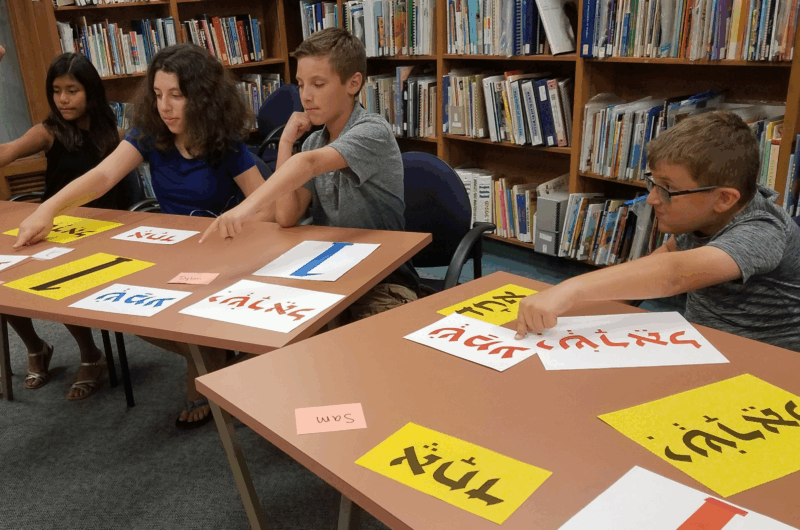
Illustrative. Children in a synagogue Hebrew school.
While negative feelings about Hebrew learning once dominated synagogue education, survey participants indicated that today’s students enjoy learning Hebrew, feel confident in their language skills and have developed a deeper sense of belonging to the Jewish People through learning Hebrew. A noteworthy 95% reported that most of their Hebrew teachers employ learning approaches that create a low-stress learning environment.
The findings also reveal an evolution in Hebrew education in these settings from a singular goal — fluent and accurate prayer decoding — to multiple areas of focus that honor the way children learn their native language: first hearing, then speaking, and, finally, learning to read print.
In synagogues, infusion of Hebrew heritage words into English sentences is a practice that has been adopted by 76% of all surveyed programs and 95% of the subset affiliated with #OnwardHebrew (which calls these words Jewish Life Vocabulary). More than half of the survey participants noted that the intentional infusion of Hebrew heritage vocabulary ignites student interest.
Additionally, 52% of all surveyed programs and 95% of responding #OnwardHebrew sites have adopted Hebrew Through Movement, a language acquisition learning approach that was given high marks by respondents for injecting joy and energy into Hebrew learning for both students and teachers.
It is also noteworthy that nearly all surveyed programs (92%) hold regular prayer services for fourth, fifth, and/or sixth graders, with 85% doing so at least once a week. Almost every #OnwardHebrew site (98%) has tefillah at least weekly; and around three-quarters of educational leaders who hold regular tefillah shared that it sparks energy and active participation.
While some surveyed programs teach Hebrew decoding as early as first grade, a new practice is gaining traction: the introduction of decoding in fifth or sixth grade, or roughly 12 months prior to b’nai mitzvah. A majority of survey participants who take this approach asserted that older students with a foundation in the “sounds” of Hebrew learn to decode relatively quickly. They also appreciated that starting decoding later frees up earlier years for more Judaic learning. This practice is now the norm at 30 #OnwardHebrew sites as well as five additional programs identified through the snapshot survey.
Expectations for students’ Hebrew readiness before b’nai mitzvah tutoring are beginning to shift, too. While 80% of surveyed educational leaders noted their programs still expect fluent and accurate decoding before students embark on tutoring, the remaining 20% either adjust expectations to accommodate each learner’s starting point or rely on tutors to guide students from their first steps in decoding through to full readiness for the b’nai mitzvah ceremony. While many directors’ comments underscore the gap between aspirations and actual decoding competence, 73% of survey participants remarked that their clergy are “satisfied” or “very satisfied” with students’ Hebrew preparedness for b’nai mitzvah tutoring.
The study uncovered the following strategic opportunities that warrant the attention of synagogue professionals and the broader community that supports them:
1.) Expand the pool of individuals who are qualified and willing to teach Hebrew in part-time settings.
The data illustrate both strengths and challenges related to staffing. On a positive note, three-quarters of educational leaders reported that their current Hebrew teachers entered the school year with at least three years of experience. When asked if their teachers were “qualified enough to teach Hebrew,” an even higher number (87%) answered in the affirmative.
Yet, other survey results reflect frustration with the inability to secure staff who possess Hebrew proficiency, classroom experience, and are more than just “qualified enough.” Indeed, 44% of respondents stated they have faced staffing struggles in the last two years. While the cause is not clear, the difference is striking between the 31% of #OnwardHebrew sites that lamented a teacher shortage, compared to the 52% of programs that have not adopted the approach. Several directors commented on the unique hurdle of recruiting Hebrew Through Movement staff, explaining that these teachers must know Hebrew-as-language and be willing to learn specific teaching principles (available via an online seminar).
2.) Create and promote existing Hebrew-specific professional development offerings that incentivize teacher participation and are easy to access.
Only 28% of survey participants shared that most of their teachers engage in at least an hour of Hebrew-specific training annually, while nearly half flagged the lack of such opportunities as a barrier to reaching their goals. Some respondents described the added challenge of getting busy part-time staff to commit time outside of the classroom to furthering their own Hebrew language and teaching skills. Jewish educational publishers could help address this need organically by creating new, evidence-based decoding and prayer materials that better embed teacher education within their pages.
3.) Provide Jewish professionals — those currently in the field and those training to enter it — with opportunities to learn about research-based, best practices in part-time Hebrew education.
A large majority of directors indicated they were “very comfortable” in their ability to supervise and develop Hebrew teachers based on their own personal Hebrew background (81%) or knowledge of language learning (68%). Notably, those in programs affiliated with #OnwardHebrew reported significantly greater confidence: 95% were “very comfortable” based on their Hebrew background, and 81% were “very comfortable” based on their knowledge of language learning principles—a testament, perhaps, to the initiative’s professional development offerings and resource support. Nevertheless, synagogue Hebrew education has the potential to become a more sophisticated and research-based enterprise. Synagogue professionals would benefit from entering the field with stronger preparation.
4.) Equip education directors with change management tools and support to drive progress and build alignment with clergy, lay committees, teachers, parents and students.
Though many educational leaders expressed alignment with clergy (62%) and parents (52%) and viewed their institutions as open to change (66%), other findings tell a different story. In their comments, many directors emphasized the disconnect between their programs’ expectations for students’ Hebrew readiness at the start of b’nai mitzvah tutoring and learners’ actual decoding skills. Others noted staff resistance to adopting new teaching strategies, such as sound-to-print decoding. Additional data point to the need for more robust parental buy-in around the relevance and value of learning Hebrew beyond preparation for b’nai mitzvah. One-third of respondents felt families do not prioritize Hebrew education, half identified inconsistent attendance as a barrier, and one in five cited their own lack of communication about Hebrew learning successes as an obstacle.
Cultivating a shared vision of Hebrew learning goals and outcomes among all stakeholders could bridge these gaps. Without change management skills and adequate support, however, education directors may struggle to balance competing needs while moving their programs forward.
The “2025 Hebrew Snapshot Survey” brings into focus the new approaches to synagogue Hebrew education that are taking root, even as it recognizes that a tipping point has yet to be reached. While the study’s positive results give the Jewish community cause to celebrate, the challenges it identifies call for further communal investment in educators, evidence-based strategies and the development of new resources. Educational change is never easy, but research is affirming that shifts underway in Hebrew learning are generating success and paving the way for continued progress.
Shelley Fishbach, an independent program evaluation and strategy consultant for the nonprofit sector, and Nachama Skolnik Moskowitz, director of #OnwardHebrew, are the co-authors of the “2025 Hebrew Snapshot Survey.”