Opinion
ROOTED IN PURPOSE
How bridge-building through service can heal divides — and curb antisemitism




 Add EJP on Google
In Short
Transformation experienced by the participants in these service projects is not just personal, but communal.
Remarkable things happen when members of diverse communities come together as one to serve their neighborhood with the common goal of making their corner of the world a better place for all. On the cusp of Martin Luther King Jr. Day, when we kick off an entire weekend of service across the United States, there is no more poignant moment to bring his vision of “Beloved Communities,” where everyone thrives through empathy and shared goals, to life.
At Benny’s Pantry in Harlem, which provides healthy and free food for CUNY students, Jewish and non-Jewish community members working side by side as part of Repair the World’s Bridge-Building Service Corps illustrate this vision beautifully.
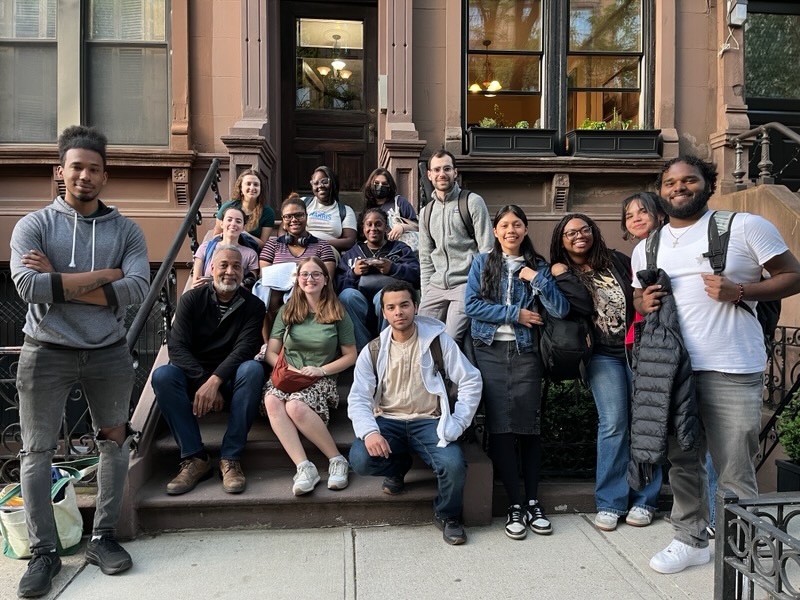
Courtesy/Repair the World
Participants in Repair the World's Bridge-Building Service Corps in Harlem
One volunteer used to visit Benny’s Pantry as a child with her family, but now stood on the other side as the one serving her community by distributing resources with dignity and empathy. She volunteered alongside Jewish peers and neighbors with whom she had never really spoken to, much less engaged with. In the course of 60 hours of shared service, the members of the corps moved beyond the polite acknowledgement that had characterized their interactions. They heard each other’s stories, asked each other questions, challenged assumptions and began building genuine friendships rooted in purpose and hope rather than obligation.
“I’m Black and Jamaican, and I grew up in Crown Heights,” another participant shared. “I’ve seen Hasidic Jews my whole life, but I don’t know anything about them. Why is that the case? Why do I feel like I can’t go talk to them?”
At Repair the World, bridge-building is one of our guideposts, supporting one of our core values — the preciousness of each human — a belief that everyone deserves equal rights, dignity and to be met with generosity.
The transformation experienced by the participants was not just personal, it was communal. As these young adults worked together, preparing meals and serving their neighbors, they bridged distances that had seemed insurmountable. One volunteer has already completed nearly 100 hours of service, drawn back again and again by the meaningful connections she has formed. Now having become the beginning of a true community, they have also become friends united by common values and mutual care, perhaps the best and strongest foundation needed to combat antisemitism today — through authentic relationships.
Another illustration of the incredible bridge-building mobilized by service in action took place In Miami. Raised in the Little Haiti neighborhood, Ruth Blanc, who is not Jewish, was looking for meaningful service opportunities in her region, eager to make an impact in the communities she called home. When she first discovered Repair the World and became a 2022 Corps Member, Ruth volunteered with a service partner that offered education and communication skills to incarcerated women. Initially hesitant about participating in a Jewish program, by the end, she found close Jewish friends and felt deeply inspired by the Jewish learnings around service and community that they had shared. Today, Ruth is one of our 225 Jewish Service Ambassadors leading service and teaching Jewish texts to Jewish and non-Jewish peers — another testament to the power of service as a bridge between Jews and non-Jews.
When non-Jews engage meaningfully with Jews who are living their values — who show up fully, proudly and compassionately — it shifts and can even transform how they see us. And it strengthens how we see ourselves.
As we continue to confront an alarming spike in anti-Jewish hatred, Jewish leaders are rightly focused on securing our safety and confronting violent extremism. We desperately need and welcome these efforts, but chipping away at and ultimately eliminating this hatred requires a continued focus on the broader communities we are a part of, through the incredibly positive impact of building bridges.
We need to build the world we long for today and every day — one in which young Jews feel strong and proud in their Jewish identities; a world in which Jews and non-Jews affirm each other’s dignity and make their communities better, side by side.
At Repair the World, we’ve long believed, as do others, in the transformative power of service as a tool for Jewish connection, social impact and bridge-building. Service is also an increasingly important way to engage more young people in Jewish life. In fact, participation in Repair the World’s programs has doubled since the atrocities of Oct. 7, 2023, and is continuing to grow.
As chasms between Jewish and non-Jewish communities widen, service is not only an expression of our Jewish values but a crucial strategy for finding common ground and combating anti-Jewish hatred. Through our Bridge-Building Service Corps, we bring together cohorts of Jewish and non-Jewish young adults — Ukrainian refugees and Russian-speaking Jews, Black non-Jews and Jewish young adults — to actively engage together in meaningful service and Jewish learning.
Some may be skeptical of bridge-building efforts, especially given the disappointment that more of our neighbors have still not spoken out about the horror of the Oct. 7 attacks or addressed the rise in antisemitism. Research suggests that proximity and dialogue alone are not enough to shift attitudes, mitigate biases, or cultivate empathy for “the other.” That’s why our model goes beyond dialogue or “contact theory.” It integrates immersive service, facilitated dialogue, self-reflection and ongoing collaboration. People do not change their views through education and theory alone, but by putting it into practice working together toward goals that matter to all.
Every year, Repair the World works with more than 300 non-Jewish service partners nationwide to make a tangible positive impact in their communities. We have had longstanding relationships with these groups. The depth of those relationships has paid off. After Oct. 7, 2023, even as relationships between some Jewish and non-Jewish groups began to unravel, every single non-Jewish service partner continued to work with us.
In our recent evaluation, 88% of participants in our bridge-building service cohorts reported they were more likely to speak out against antisemitism because of their experiences. This phenomenal percentage is promising and points to something deeper. When people serve together, they do more than complete a project; they see each other’s humanity. They build friendships, focus on similarities instead of differences and create muscle memory for empathy.
In a time when Jews feel isolated, misunderstood and unsafe, we must expand and champion opportunities for Jews and non-Jews to use their hands, heads and hearts together in service. We also must find ways to strengthen Jewish identity and pride among young people. When young Jews volunteer at food banks or urban farms, or tutor students at schools while simultaneously engaging in Jewish learning, they don’t just help their neighbors — they strengthen themselves by discovering what it means to live Jewish values proudly. Through service, they make a seamless connection from contemporary action to ancient wisdom.
This approach creates a virtuous cycle: Jews serving openly and proudly, living our values in partnership with our neighbors, simultaneously strengthening our own community and challenging antisemitic beliefs through authentic relationships. We transform from strangers to partners; from “the other” to valued members of a shared community.
Amidst all of the brokenness and fear, every time I volunteer as part of the Jewish service movement, I’m flooded with hope about the Jewish future. We cannot hide. We cannot retreat. We must stay engaged in service in relationship with others focused on building a better world for all.
That is our response to antisemitism: not just education, but encounter; not just proximity, but partnership; not just surviving, but serving. Because every act of service is an act of hope and one step closer to repairing the world.
Learn more about the Jewish service movement’s upcoming MLK Weekend of Service opportunities.
Cindy Greenberg is the president and CEO of Repair the World.