Shomer Collective launch Shiva Circle initiative to offer ‘life jacket for grievers’




 Add EJP on Google
In August 2011, Rose Capin celebrated her bat mitzvah with her beloved grandmother Esther, then 76, beaming from the pews. Less than two years later, her grandmother would be diagnosed with ovarian cancer. Then — it seemed almost in an instant — she was gone.
“I was maybe in middle school,” Capin told eJewishPhilanthropy. “I didn’t even know what was happening.” At her grandmother’s shiva, “I remember there being a real sense of, ‘Don’t you dare ask a question. This is just what we do.’”
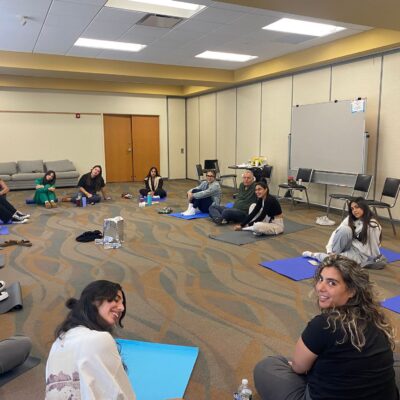
Capin is one of 40 volunteer shiva guides trained by the Shomer Collective, a Jewish, end-of-life support organization, that launched its Shiva Circle initiative this past spring in Atlanta. The initiative makes shiva practices accessible for Jews who lack the knowledge or connections traditionally provided by local synagogues.
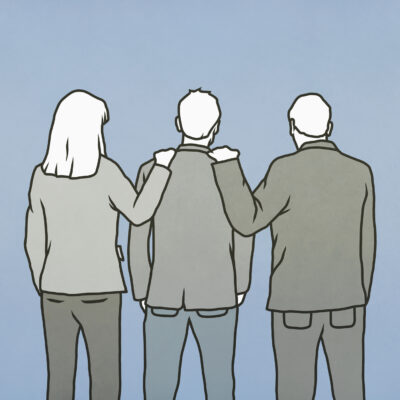
The training taught Capin the tools to “be able to show up for my community and listen and be a project manager for the grief and funeral process.” It allows her to offer the support she wished she had. “The shiva practice provides a really beautiful framework of meaning-making. It sounds kind of dark, but it’s like a life jacket for grievers.”
Shiva guides are one aspect of Shiva Circle’s three-pronged approach to support mourners.
The second aspect of support is providing resources, not just for mourners but also for friends and family, such as informational sheets detailing the ins and outs of the ritual. The third aspect is offering tools, such as spreadsheets, PDFs and a digital organizer powered by OneTable that eases the planning of the shiva, coordinating everything from who will set up chairs, cover mirrors, organize parking, care for kids, take out the trash and, even, walk the dog.
“All of the logistics that happen during shiva can overwhelm a mourner and prevent them from wanting to sit shiva,” Rabbi Melanie Levav, executive director of Shomer Collective, told eJP. “One of the innovations of Shiva Circle is to remove that burden of feeling like ‘I have to host a cocktail party.’”
According to a 2021 Pew study, only 35% of American Jews are synagogue members. “We no longer have a circle of people who come and make shiva for us in the way that we might have [had] a generation or two ago,” Levav said. When a patriarch or matriarch passes away, that’s exactly when people are asking, “Who am I Jewishly?” she said.
Today’s mourners “may not know what shiva is or how to make it happen,” Levav said. “And if their social circle is multifaith, they may not have people who know how to make shiva happen for them. We also see people not showing up for shiva in the way that it was once an expectation and understanding that you show up.”
Shiva Circle is not simply targeting the assimilated though, Levav said. Many members of synagogues have negative experiences with the ritual because they feel that their synagogues are not supporting them the way they want.
“Shiva belongs to everyone,” Levav said. Not everyone wants to hold a traditional evening prayer service, she said, so the tools and guides allow mourners to plan a shiva that is meaningful to them, such as a gathering to share memories of a loved one.
“For those who are intrigued, interested, curious or pretty certain that they want Jewish ritual as part of their mourning, Shiva Circle brings the shul sisterhood of Bubbe’s generation to today’s mourners,” Lindsay Bressman, advisory board chair of Shomer Collective and a member of the advisory committee for Shiva Circle, told eJP.
To do this, Shiva Circle activates the community that the mourner already has. “What about your buddies from bowling or pickleball or your fantasy football league?” Levav said. “Who are the people who could come and host you in your own home?”
Although the half-day training for shiva guides has only been held in Atlanta so far, this winter it will be launched in Boston in-person and online, so guides can serve their communities irrespective of where they live. Volunteer guides range in age from being in their 20s to 90s. Some are Jews of color, LGBTQ and Jews by choice. Many are unaffiliated and others are members of synagogues.
Shiva Circle is already partnered with 30 local Atlanta organizations, including synagogues, Jewish Family and Career Services, the Marcus JCC, Jewish Home Life Communities and Dressler’s Jewish Funeral Care.
The initiative is funded by the Steinhardt Foundation for Jewish Life and several anonymous donors. Michael Steinhardt, whose foundation is in his name, came up with the idea for the initiative and wrote about it in his 2022 book, Jewish Pride. He reached out to Shomer Collective to pilot it. Shomer Collective was founded in 2020 through Natan, an organization his son co-founded.
“We want more American Jews to see the power of shiva,” Rabbi David Gedzelman, president and CEO of The Steinhardt Foundation, told eJP. “Stay at home for a week after you’ve lost a close relative. Let us host you in your own home. We’ll arrange it. We’ll bring everybody in… We think that if people have this experience, they’ll realize, ‘Wow, my people are really wise,’ and maybe they’ll do other Jewish things… We want to do for shiva what OneTable does for Friday night Shabbat dinner.”
OneTable was an easy choice for a partner as they already had a customizable platform available to plan shivas. The group also served as a strong example. Since OneTable’s founding in 2014, it has organized over 170,000 Shabbat dinners. “It felt like a full-circle moment to be able to guide another Jewish organization in increasing their community impact,” MJ Kurs-Lasky, senior director of national partnerships at OneTable, told eJP.
In Atlanta, Dressler’s Jewish Funeral Care has begun connecting mourners with shiva guides. Capin is working with Ma’alot, her home community, which she describes as “a synagogue without walls,” to launch a chesed (kindness) committee that can be there for mourners the way she wished people were there for her, so a life jacket is always on hand.
Related News

MAJOR GIFTS
Center for Jewish History celebrates 25 years with a $25M matching grant
EXCLUSIVE
Detroit-based philanthropists Nancy, James Grosfeld donate $8M to renovate JDC’s Israel campus
HIGHER EDUCATION
As Jewish donors reconsider academia, Jan Koum doubles down, endowing Israel studies at Stanford
ADVANCING A VISION
N.Y. federation donates $1M toward building shared-society center named for peace activist killed on 10/7
PRESIDENTIAL REBUKE
Israel’s Herzog: Mamdani ‘makes no effort’ to hide disdain for Israel, Jews must fight back