THAT'S A WRAP
Political uncertainty, bipartisan antisemitism, long-term planning take center stage at JFNA GA
Some 2,000 Jewish federation professionals gather in Washington, though Israeli officials and Trump administration were notably absent
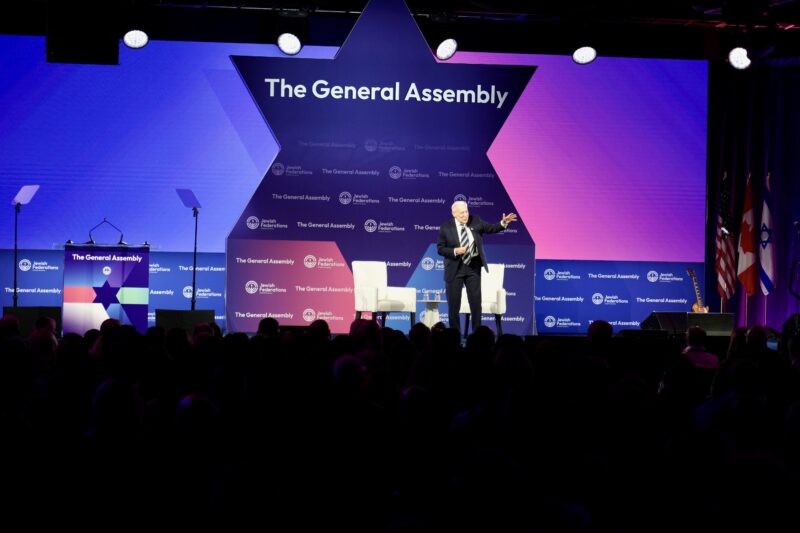
courtesy/JFNA
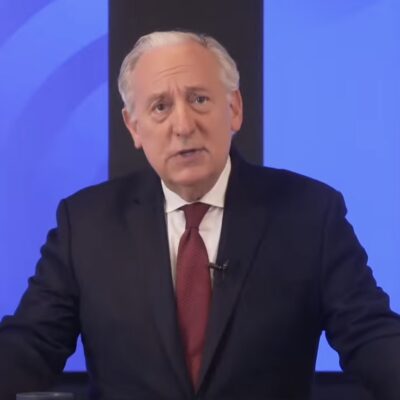
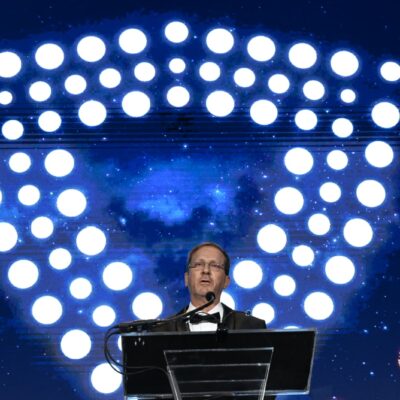
Eric Fingerthut, president and CEO of the Jewish Federations of North America General Assembly in Washington on Nov. 18, 2025.




 Add EJP on Google
National political uncertainty loomed large at this year’s Jewish Federations of North America General Assembly in Washington. The gathering convened in the nation’s capital just days after the federal government reopened — fortuitous timing for the roughly 2,000 federation professionals, Jewish communal leaders from 141 federations from across the continent who depended on air travel to make it to the capital.
But beyond travel plans, the temperature in Washington — specifically mounting antisemitism on both sides of the political aisle — was a central topic of discussion for many of the event’s main stage speakers, which included Rahm Emanuel, the former Chicago mayor and a leading Democrat, and CNN conservative commentator Scott Jennings — who participated in a conversation on right- and left-wing antisemitism during the first plenary, as well as Sens. John Fetterman (D-PA) and Ted Cruz (R-TX). Specifically, Cruz, Emanuel and Fetterman all discussed rising antisemitism and waning support for Israel among younger generations of Americans, across the political spectrum.
Emanuel described the Jewish community’s current standing and political support for Israel as being “on the precipice.” Among Democrats, Emanuel warned, support for Israel is now often seen as a political liability, which will likely be felt during the next election cycle.
“If in 2024 the Democrats didn’t have a choice, in 2028 it’s going to be like Baskin-Robbins. There’s gonna be, like, 31 flavors. Some of us are gonna be chocolate mint. Nobody is going to Jerusalem,” said Emanuel.
Across the aisle, during the closing plenary, Cruz denounced Tucker Carlson’s recent platforming of white nationalist Nick Fuentes and warned that support for antisemitic ideas is increasing among young people on the right.
“As a Republican, it’s easy to criticize the other party and their extreme positions, but I’m here to tell you, in the last six months, I’ve seen more antisemitism rising on the right than I ever have in my life,” said Cruz. “It is dangerous. It is growing, and we need to do everything necessary to stop it.”
Discussion of the increasingly narrow bridge on which the Jewish community has found itself, comes as the dust has just begun to settle a month into a ceasefire in the Israel-Hamas war and the return of the living Israeli hostages. Marking a return to some modicum of “business as usual,” JFNA officially closed out its $908 million Israel Emergency Campaign and pivoted to “Rebuild Israel,” a new phase of the organization’s grant writing focused on supporting Israel’s long-term recovery.
“We don’t know everything today that is needed and it’s going to be needed in Israel over the course of these next couple years….we’re just beginning to see the full extent of not just the physical damage, but the psychological damage, the cost to families and to businesses, and as those things become better known and better understood, then we have the opportunity together to think through what other big projects and initiatives we should undertake, And that’s why we have the rebuild Israel task force,” Eric Fingerhut, JFNA’s president and CEO, said during a briefing on “Rebuild Israel” ahead of the opening plenary.
The end of “emergency mode” also marks a renewed focus on both long-term strategy, and the issues facing North American Jewry. That dynamic was highlighted in many of the smaller sessions throughout the conference. During a session on navigating Israel education after the war and increased engagement due to the “Surge,” Mark Charendoff, president of the Maimonides Fund, discussed the limitations of a foundation during moments of crisis.
“I think foundations are really terrible in crisis mode. That’s what federations are good for. We’re not good [at it]. We tend to be long term and strategic. And now we’ve jumped from COVID to Ukraine to Oct. 7 in crisis mode, and we have to figure out the muscles to keep focused on this issue, but to move from crisis to normal,” said Charendoff. “We need to move from six-week plans to six-year plans and 10-year plans. Because this is not a short term problem that, as we heard earlier in the panel, that’s ending with the ceasefire.”
Sessions covered a broad range of topics. On the North American front, those included Jewish education, new approaches to Israel education, security infrastructure, civic engagement, the “Surge” and antisemitism. A number of sessions also focused on problems facing Israeli Jewry, including the ongoing mental health crisis, support for Israel’s reservists, new philanthropic models, and Israel’s long-term recovery.
Unlike last year, when Israeli President Isaac Herzog delivered an address, no Israeli government officials attended the conference in person, nor did any Trump administration figures. However, both Herzog and Prime Minister Benjamin Netanyahu delivered prerecorded speeches. In his speech during the closing plenary, Herzog addressed the antisemitism North American Jewry faces, thanked the community for their support throughout the war and thanked President Donald Trump for his role in brokering the ceasefire and hostage deal.
“I’m deeply hopeful that this same spirit of optimism and faith that is bringing change in our region will continue to resketch the region with the constructive tools of cooperation, brotherhood and the pursuit of peace, all of these can write a day after that is radically different and radically better than the one we’ve all been living,” said Herzog. “Better for Israelis, better for our neighbors, including the Palestinians, better for our entire region and better in the Jewish communities all over the world.”
Related News
EXCLUSIVE
Detroit-based philanthropists Nancy, James Grosfeld donate $8M to renovate JDC’s Israel campus
EXIT INTERVIEW
Elizabeth Sokolsky, longtime EVP of Birthright Israel, to retire next year

MAJOR GIFTS
Center for Jewish History celebrates 25 years with a $25M matching grant
ADVANCING A VISION
N.Y. federation donates $1M toward building shared-society center named for peace activist killed on 10/7
PRESIDENTIAL REBUKE
Israel’s Herzog: Mamdani ‘makes no effort’ to hide disdain for Israel, Jews must fight back