Q&A
Photographer Bill Aron on capturing, and donating, decades of images documenting Jewish life
The Jewish sociologist and street photographer recently gifted 417 exhibition-quality prints, 2,765 work prints and 158,000 negatives to the American Jewish Historical Society
Nira Dayanim/eJewishPhilanthropy
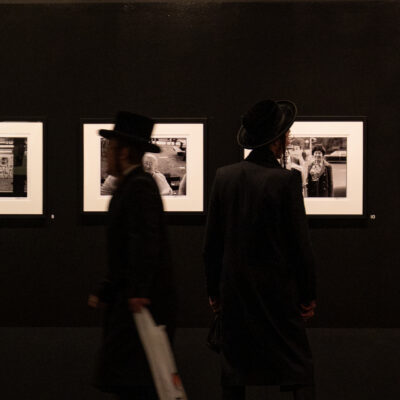
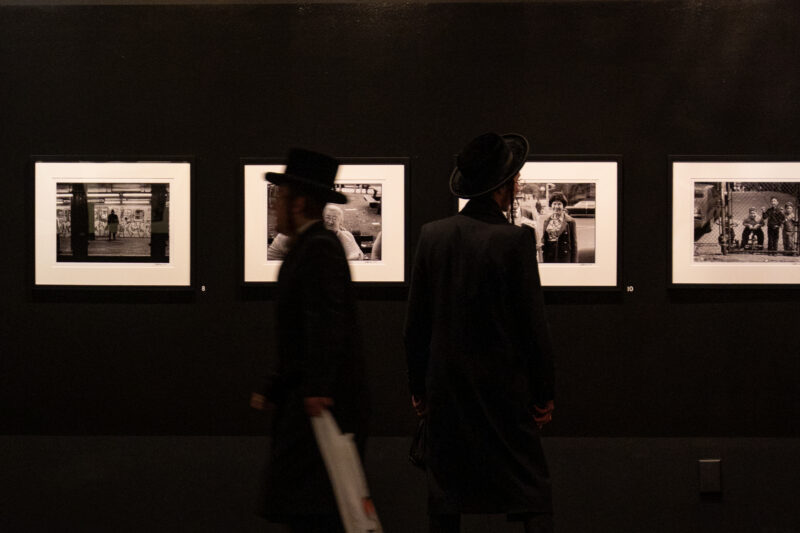
Two young men peruse a gallery of Bill Aron’s prints at the Center for Jewish History in New York City on Feb. 26, 2026.




 Add EJP on Google
Bill Aron, the Jewish sociologist and street photographer known for his images of Jewish life throughout the 1970s and 1980s, is not a philanthropist. At least not in the traditional sense.
But earlier this year, he donated his work — a collection of 417 exhibition-quality prints, 2,765 work prints, 158,000 negatives, and personal essays and publications documenting decades of Jewish life — to the American Jewish Historical Society, a gift that is potentially worth millions of dollars. Several dozen of these prints are on view at the Center for Jewish History through early June in an exhibition titled “The World in Front of Me,” its walls painted black to evoke a roll of film.
It’s not uncommon for photographers to donate their art to archives or museums. Many do, hoping for their work to live on in perpetuity, either displayed for new audiences or as a primary source for researchers seeking to understand a particular historical moment. But many of the photographs Aron created, and now donated, are pieces of Jewish history seen by few others. In 1978, he documented the small remaining Jewish community in Cuba, operating under state-enforced atheism. In 1981, he photographed the Jewish community living behind the Iron Curtain, where his fanny pack of film was nearly confiscated by the KGB on his way out of the country.
In the United States, Aron’s lens also turned to the Havurah movement, a countercultural Jewish revival in the 1960s and ’70s composed of small, lay-led communities that emphasized egalitarianism and active participation, alongside his portraits of Holocaust survivors, Jews in the Deep South and Jewish New York.
Last month, Aron spoke with eJewishPhilanthropy about his donation, the Havurah movement and what makes a Jewish photograph.
Nira Dayanim: Why did you decide to donate your collection to the American Jewish Historical Society?
Bill Aron: I was encouraged to do something about my work by Bernie Pucker from the Pucker Gallery, and to look around at photography archives. At the same time, a friend, Riv-Ellen Prell, works with AJHS, and she suggested that I consider them. And Melanie Myers wrote me a very nice email, and it occurred to me that in a photography archive, I would just be in an archive, but at AJHS, the photographs, my images, will have a good chance to be used. Someone may be doing research, for instance, on the New York Havurah or the Havurah movement of the ’60s and ’70s in general, and they’ll do a keyword search for Havurah and not only will they get the articles and all the text they want, but my images will also pop up, so it gives me a little reassurance that after I’m not here, my images will still be seen and be used.
ND: So more than art, you want them to be history?
BA: Well, history might be a broader term, but yes, seen as art and as historical documents. I know several places that I photographed where nobody else was, the Havurah being one of them. That’s why that came to mind. But I hope, as they come up in a textual context or historical context, that people will also see them as art, right?
ND: Your work has taken you to Jewish communities around the world — including the Deep South, behind the Iron Curtain, and in Cuba, many of which were rarely photographed at the time because of political constraints. Were there any Jewish communities in the 1970s and ’80s, or even today, that you wanted to document but didn’t or haven’t yet?
BA: Oh, another tough question. I mean, after having had two retrospectives, I’m faced with the opportunity, but also the quandary of what to do with the rest of my life. So where would I like to photograph? One of the things that has intrigued me is that I’ve had a physical therapist, a beautiful woman, very talented in her art, who has helped me a lot. And through a conversation, it became apparent that she was trans. And so we began talking about that. I’ve known trans people. A few children of friends of mine are trans. I’ve known gay people, but I’ve never been inside that world. And what I like to do is step inside where I’m photographing and try to see it from not only my perspective, but from the subject’s perspective.
When I was doing my series on Holocaust survivors, and I would visit people in their homes, if they didn’t ask me if I’d like something to drink or a cup of tea within the first 5-10 minutes, I would ask them for a cup of tea, because that would preclude going right to the photography. And so we would have a chance to talk, and I mean, I feel the outgrowth of our conversation, they also became participants in how the photograph developed and how the photography developed and was done. And so I have talked with my therapist about the community and about the possibilities of going into that community to photograph. That would take me a little more broadly than the Jewish community, but I believe she is Jewish, so that would be a part of it, and I certainly would focus on that, where I found it. So that’s what intrigues me right now. I’m not sure how it would develop. I hope it does.
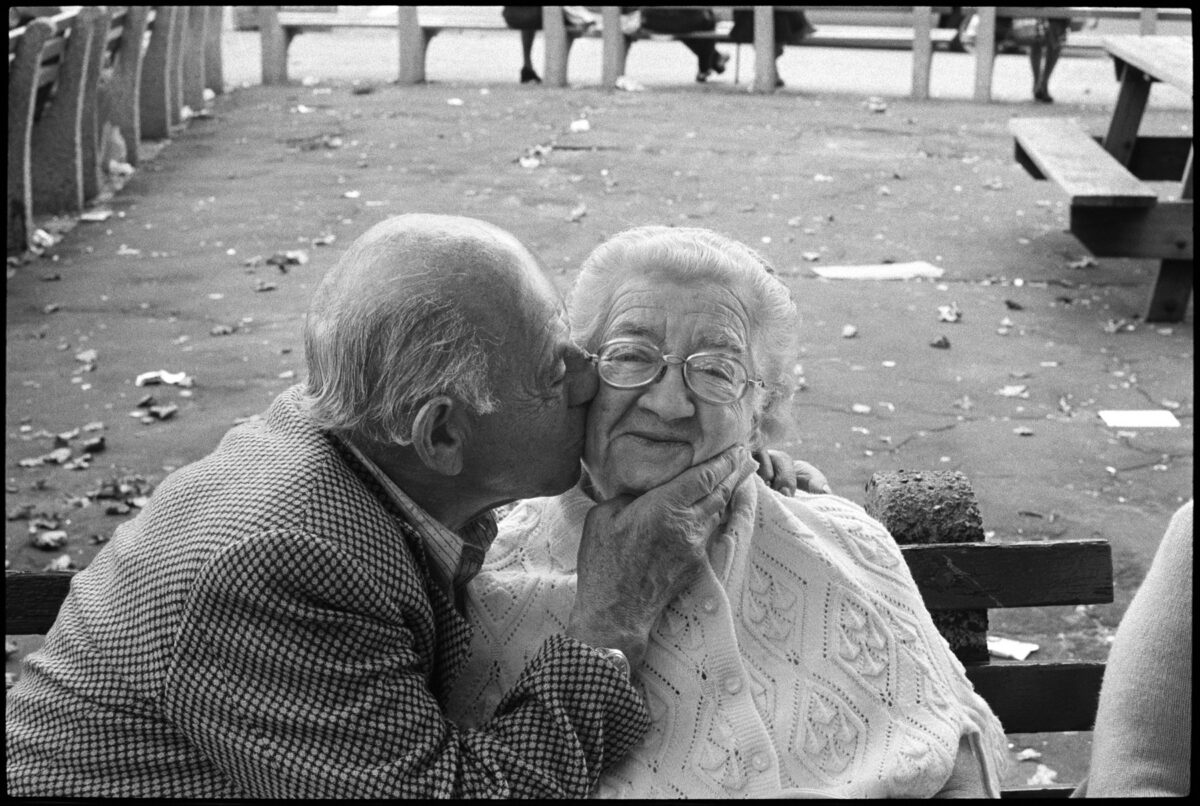
In my life, though, I have to emphasize that I want to have fun with my art. I love photographing, I love that feeling of my camera in front of my face. I came of age photographically in the heyday of the street photography movement, and New York was the major place where it was, where I lived at the time, and that ethos was not to be an intruder, but to photograph from a distance so people didn’t know. I just thought that was silly, because they’re going to know the camera’s there. Ninety-nine percent of the people know it’s there, and they react accordingly. So why not use it as a vehicle to help reveal or to help the people reveal who they really are?
ND: Much of your work intersected with Jewish communities supported by philanthropy, particularly during your visit to the Soviet Union. At the time, how aware were you of the potential impact of your photography, and what influence, if any, do you think it ultimately had?
BA: I was not aware. I mean, I was doing what I love to do. I would say, in the last 10 years, there was an idea growing that I should do something with the work that I have so that it just doesn’t die with me. As I began to think about my work as a succession of the people who came after the Second World War and developed what we call modern-era photography, I realized that I had a place in that history. So it’s only then that I began to think of my work and in the way that you asked. When I began to organize my archive, a very good friend of mine began to challenge me to put together a booklet for the surviving members of the Havurah [movement]. And as I began to do that, I realized that nobody else had photographed the Havurah, that these were really unique images, not only artistically… well in photography, most of the people I know don’t refer to their work as artistic, but rather as “strong photographs,” but only in having that challenge, and as I was putting together this booklet, I began to think of my work as having a unique place, and not only in the history of photography, but in the history of the Jewish people.
ND: So you also mentioned in the interview series you did through AJHS, the complexity of photographing Jewish ritual practice, and how at many moments you made the decision to photograph, even when a community might have felt some friction with that decision. Beyond religious rituals, are there other aspects of the Jewish experience that rarely get documented, but you think are essential to understanding Jewish life?
BA: When I first started, I was very taken by photographing Jews who looked like Jews, the Hasidim, the Modern Orthodox people with kippahs. Then, after a while, I began to feel that, well, I don’t look like those people, but I’m Jewish, so where’s my place in the pantheon, so to speak, of the Jewish people? So I began to look for ways to make Jewish photographs without having obvious symbols of Judaism in the photographs. Very hard, not always successful. For instance, from when I was in the Havurah I have a whole series of pictures of people smoking joints. Is that a Jewish photograph or not? It’s a challenge.
ND: You also had the unique opportunity to capture Jewish communities or subjects over time. I’m wondering, also looking back, if there’s any subjects that you returned to years later that felt fundamentally different from your earlier visits.
BA: I found the Havurah extremely meaningful. It changed the way I practice Judaism. Basically the leaders of the Havurah movement were sort of Camp Ramah-based. And at camp, they were pushed to and challenged to observe Judaism in an aesthetically beautiful and meaningful way, rather than just standing up and by rote, saying the prayers. And they brought that into and started the Havurah movement, saying synagogues weren’t expressing what we were feeling and what we wanted to feel and to do. The Havurah changed how I thought about being Jewish, basically. I was just in Boston visiting with former members of the Havurah, and we all talked about how after 1980 we spent the rest of our lives looking for a place to have that kind of experience and not finding it. So some of what you ask, I think I would approach from a sadness. Perhaps even some of the children, they also have felt that lack in their lives, of not being able to find a place to continue to practice Judaism in that kind of meaningful way. So I look at it as a change in American Judaism that had a brief generational moment. Certainly, although I found meaning here in Los Angeles, I haven’t found that kind of experience.
ND: Outside of your own work, what is your favorite photograph, and which of your own photographs do you like best?
BA: I did some research, and I’ve put together a slide lecture on the role of Jewish photographers in developing modern post-World War II photography. Many of them were Jewish. In fact, one of the major people, Garry Winogrand, because so many of his fellow photographers were Jewish, it led him to famously remark that to be a great photographer, you have to be Jewish. He was joking, but in putting together that slide presentation, there are two photographs that I absolutely adore by a photographer named George Krause. One is of an African American boy standing under a waterfall, with water over his face and the light… I mean, this photographer is unbelievably sensitive to, and a genius with, light, and the light is hitting the water in such a way that it makes it feel like he’s looking through a glass cover. And there’s another photograph of an old woman, I believe he took it in Mexico City. She was walking along with a cane, and it’s a low sun, because the setting sun, or a rising sun, is hitting her in such a way. So there’s this giant shadow on the wall just in front of her, but the shadow is in the shape of a dragon because of, you know, the way her body is shaped.
So I called him up. I wanted to include it, and… this is a long-winded answer, but I wanted to include him. And I asked him if he was Jewish without telling him why. We talked a little about photography. He’s in Philadelphia, I’m from Philadelphia, and I said, “Oh, listen, by the way, are you Jewish? And he says, ‘Wow, it’s interesting you say that because I just got a letter from my dad telling me that his grandmother was Jewish.’” So I decided that was permission enough, and I do include him, but there are other photographs that I love and admire, but if I could have two to hang on my wall, those would be it.
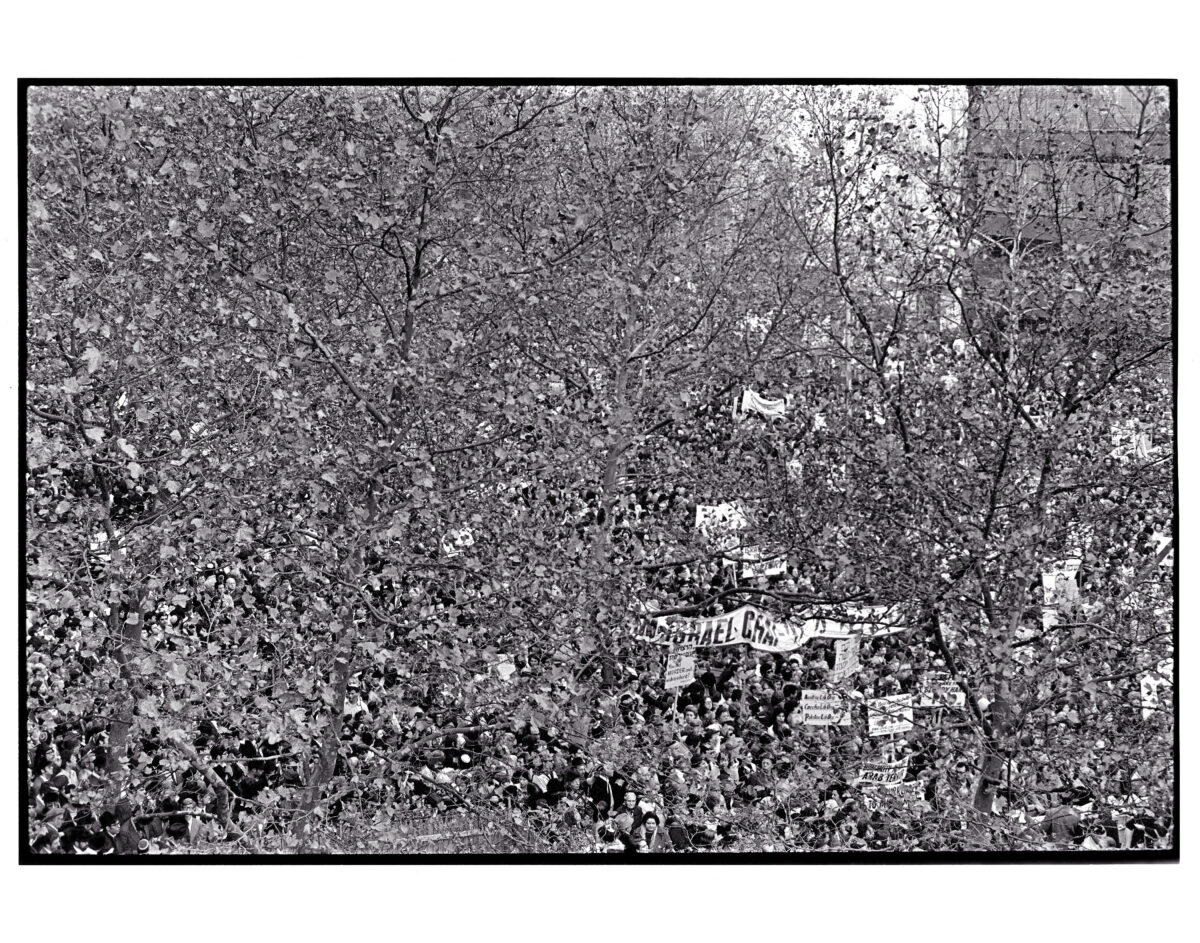
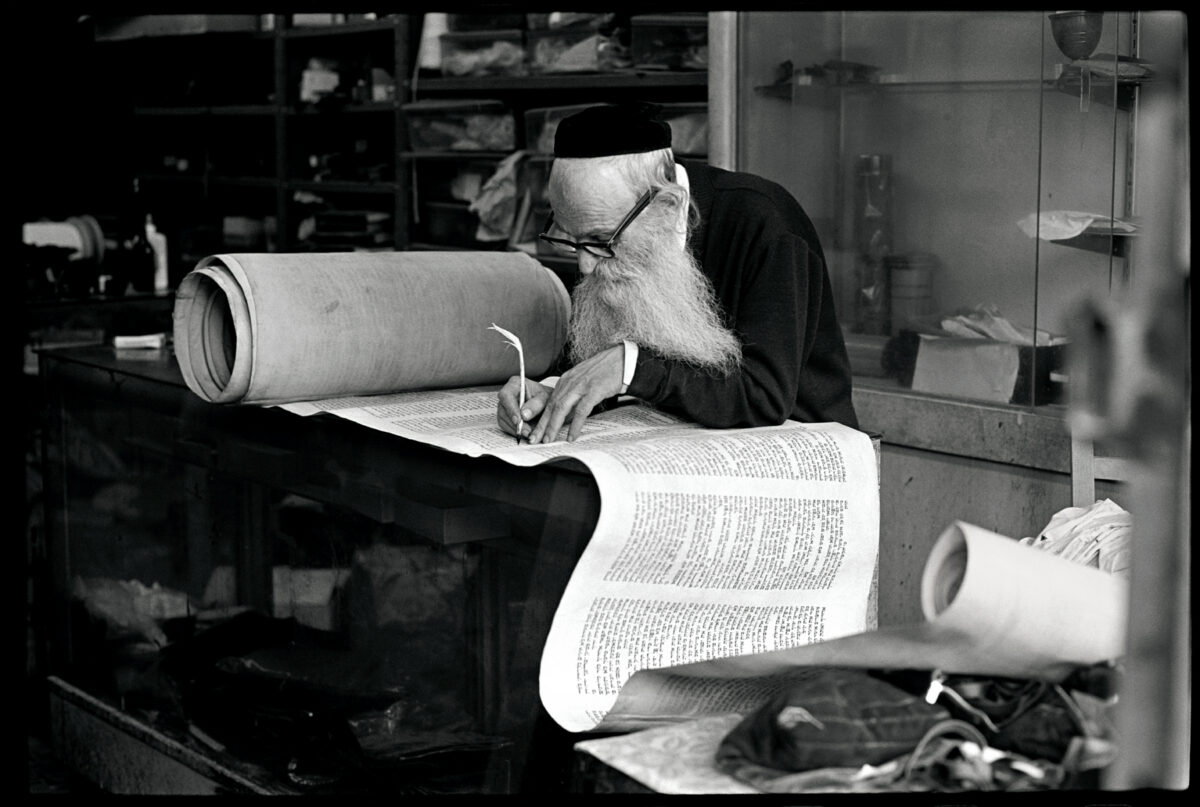
My own photographs. I have this one photograph that has almost never been seen, and it’s in the New York exhibition. It’s the protest of [PLO leader Yasser] Arafat’s visit to the U.N., [in 1974] and it takes place in the U.N. Plaza. And when he came he was wearing his gun on his hip, and the Jewish community was just outraged that he was addressing the General Assembly. So there was a big demonstration called for the plaza by the U.N. I guess I hadn’t been doing this long enough, I couldn’t get a press pass to be up by the podium and where all the speeches were. So I’m wandering around, and I find an open office building. The plaza is like a valley. There are two tall buildings on both sides of it. So I wandered up to the roof, and I looked down, and at first, all I could see were the tops of trees. It was the fall, and there are some old leaves there, dying leaves hanging from the trees sporadically. But all I could see were these few leaves and the twigs of the trees, the bare twigs. And then I looked through and I saw the people underneath. In the photograph, flattening it to a two-dimensional frame, you have to really look at the photograph to see the people, and when you do, it’s a totally different experience. In fact, my 8-year-old grandson, he went through the exhibit in New York with his dad pretty carefully, and he just fell in love with that picture and asked for a copy. But you have to look at it, and that’s probably my favorite image. My best-known images [are] of the scribe on the Lower East Side of New York.
ND: How do you think being Jewish impacted the way you captured the Jewish community?
BA: That’s a good question. That’s a great question, which I’m not sure I can answer. The early photographers post-World War II, in the ’60s and ’70s, were photographers who cloaked their Judaism, largely because I think they just wanted to be seen as Americans. In fact, one of them remarked, “We’re not Jewish, we’re leftist,” and so one of the questions I try and address in this lecture is, “Was there really a Jewish consciousness behind the creation of their art?” And it’s a tough question. A lot of these photographers focused on questions of social justice, equality, I think for myself, it’s become, what I love to do. My first serious photographs were on the Lower East Side of New York. I was introduced there by Misha Avramoff, a fellow Havurah member. He had started this organization to work with the Jewish elderly poor on the Lower East Side, it being the first area of immigration for Jews. And something just clicked. I’d go around with him, sometimes by myself, visiting the elderly poor there, and I just felt like it was the thing that I had to do. I’m sure it has to do with the way I was raised, the deaths of my parents, the move from a Conservative to a Reform synagogue. I’m sure all that plays a part, but an articulation of that I cannot come up with. Sorry, I’d love to be able to tell you something erudite and brilliant, but it’s just not there.
ND: The last question that I always like to ask is if there’s anything I didn’t ask.
BA: Well it’s been delightful talking to you and it’s always a pleasure to make me think about what it is that I do, and I like that challenge, so I appreciate that.
… Oh, you didn’t ask me about my first camera.
ND: By all means.
BA: This presaged my entire life. I was 9 years old. Just after my dad died, my mom took me to Atlantic City because she thought that would cheer me up. And she was talking to some friends. There’s a big boardwalk in… — you know Philadelphia, so you must know Atlantic City. And I was free to walk, and I walked down a ways, and I came across Steel Pier, and I walked into the pier, and it’s like an arcade. As soon as I walked in, there was this huge roulette wheel off to the right, and it cost a nickel for a chance, and I had a nickel in my pocket. I put it on No. 48, and the roulette wheel landed on 48, and the guy was kind of annoyed, but he had to deal with it. And he looked at me, I’m a kid, and he went to take down one of the huge stuffed teddy bears from the top shelf. And I said, “I don’t want that.” And he sort of growled at me, “Oh what do you want?” And I looked around, and there was one, and only one, Brownie Hawkeye camera kit. I want that. And that was the start of a beautiful relationship.
Took me a while, though, for me to figure out that I really could be a photographer. I mean, I just wasn’t raised with the idea that I could do that and that that could be a profession. So it took me a while to get there and to figure out that I could really do what I wanted to do.
ND: You’ve got to be a photographer-doctor-lawyer.
BA: My mom was a doctor-lawyer, without the photographer. I remember the first time somebody asked me what I do after I said, “OK, I’m dropping sociology, and I’m going to do this seriously.” I said, “Well, I used to be a sociologist, I’m a sociophotographer” back and forth between sociology and photography. So I finally got out “photographer,” this was in the office of Project Ezra, on the Lower East Side, a place I worked, and a friend of mine who was in the office just burst out into the biggest laughter.
Related News
EXCLUSIVE
Detroit-based philanthropists Nancy, James Grosfeld donate $8M to renovate JDC’s Israel campus
PRESIDENTIAL REBUKE
Israel’s Herzog: Mamdani ‘makes no effort’ to hide disdain for Israel, Jews must fight back
HIGHER EDUCATION
As Jewish donors reconsider academia, Jan Koum doubles down, endowing Israel studies at Stanford
CLOSING WORDS
In AZM address, Cosgrove links communal ‘orthodoxy’ on Israel to rising anti-Zionism among young Jews

MAJOR GIFTS
Center for Jewish History celebrates 25 years with a $25M matching grant