Opinion
COMMUNITY MAINTINANCE
The Listening Project




 Add EJP on Google
This is an abridged version of a longer article. Readers interested in the tangible steps used to implement the Listening Project and its impact and outcomes can find the full article on the CLI Spiritual Innovation Blog.
The Jewish Community of Greater Stowe (JCOGS, affectionately called “Jay Cogs”), nestled in the natural beauty of rural, mountainous Vermont, has members with long-held views that span a remarkably broad spectrum of beliefs on Israel and Palestine.
Courtesy
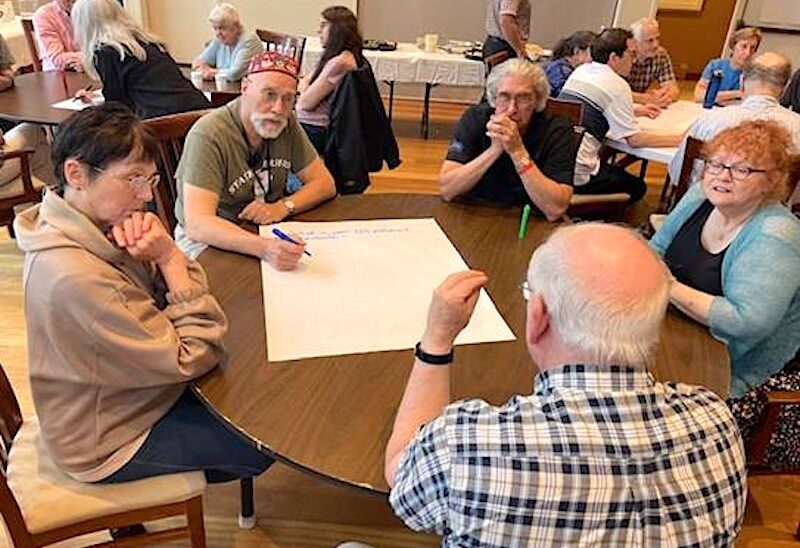
Participants brainstorm open-ended questions as part of an initial Listening Project session.
Since the horrific events of Oct. 7, 2023, in Israel and the devastating war and humanitarian crisis in Gaza that followed, as the only synagogue in town — and with emotions running as high as ever — our leadership has fielded the passionate but often conflicting imperatives and needs of our diverse membership, challenged to find a way to respond with sensitivity and prudence. The initiative that helped to stabilize our fragile synagogue ecosystem was the Listening Project, a series of one-on-one and group courageous conversations to honor the sacred act of listening to one another across our differences.
The need to hear each other
Rural Jewish life is just different. Urban-centered Jews often don’t fully get it (and I used to be one of them).
As the only synagogue within a 25-mile radius, with members traveling as much as one hour to gather, pray and learn, we are the one-stop spot for Jewish and interfaith families — locals, second homeowners and tourists alike. Our geographical diversity is accompanied by wide differences in socio-economic status, cultural backgrounds, religious observance and life experiences.
On Israel and Palestine, our members’ experiences vary widely. Some have little personal connection; they have never traveled to the Middle East and do not feel a strong tie to the state or land of Israel. Other members include those who feel deeply connected to Israel, have friends or family in the country, have visited multiple times or even lived there. Our community also includes Israeli-American members.
And yes, our diversity shines through in our members’ politics too. Our community includes people who use very different language to describe their politics and their relationship to Israel — terms like Zionist, progressive, anti-Zionist, conservative, Democrat, Republican, independent — alongside other members who reject labels even as they hold strong, sometimes conflicting convictions.
What we have at JCOGS is not unique — but it is increasingly rare. Some American Jews are all in for unquestioning support for the State of Israel and its policies. Others are adamantly opposed to even its existence. The majority sit somewhere on a spectrum between. Jewish life is fracturing into a growing number of ideological silos.
Vermont is well known as a progressive stronghold (think Bernie Sanders and Ben & Jerry). In a Jewish community with a growing commitment to curb the climate crisis, fight racism, antisemitism and bigotry and stand up clearly for immigrant and LGBTQ+ rights, the moral lenses many of us bring to the world are shaped by these values. But JCOGS reflects a more diverse range of views on Israel and Palestine. As we sought to shape a meaningful communal response to the post-Oct. 7 world, we knew that we needed to honor that wide range of viewpoints — especially because we risked the fracturing of a community that is the only synagogue in our region. Our congregants needed to have a place of belonging that could feel safe.
But we hoped for more than just shalom bayit, peace in our communal home. We also wanted to live out our own shared communal values.
Eilu v’eilu: Diversity as vitality
A new JCOGS mission and values statement was codified in June 2023, just months before Oct. 7. It included the value of “diversity as vitality.”
As a pluralistic, egalitarian community welcoming wide-ranging beliefs, identities and practices, we value human diversity as the source of our collective vitality. We actively listen to and value each other’s perspectives in an environment of mutual respect. We seek to understand differing and even challenging points of view while celebrating the dignity and unique gifts of each individual.
Our members pray side by side, visit each other when sick, comfort one another when grieving and eat at the same table — in a truly heimish, welcoming community. This is no small feat. But the devastating attack of Oct. 7, 2023, and the war in Gaza put this core value to the test.
Could we remain one vibrant community with so many competing needs expressed by our members? In a community like ours, and in a post–Oct. 7 Jewish world, could we avoid splintering into ideological camps? Fracture was not a hypothetical risk; it was a real and present danger.
We knew what was at stake if we failed. Adults — including parents of young children — quietly walking away from Jewish life; children growing up without B-Mitzvah ceremonies or meaningful Jewish bonds; unaffiliated Jews in our area, already alienated by early childhood Jewish experiences, steering clear of our doors; and a shrinking sense of shared responsibility for sustaining community itself.
All of this unfolded amid rising antisemitism locally and globally — at a time when the Jewish people could least afford to fracture. There are enormous pressures on Jewish communities from the outside world, from political pressure to real violence. The question was not only how we would survive internally, but how we would stay in coalition, in partnership — even in friendship with one another and with our neighbors. How would we remain a beloved community? These realities demanded that we work on our own house, to see one another in our differences. We resolved that we would not allow the outside world to tear us further apart. We also resolved to affirm the inherent dignity and worth of our fellow co-religionists.
For our JCOGS leadership, it was like leading a daily communal version of Thanksgiving dinner. Would politics sour an otherwise lovely meal? Should we — could we — just avoid the topic, just this one time?
That’s when we learned the special sauce of our unique community: everyone — leadership included — needs to be at least a little bit uncomfortable.
For months after Oct. 7, we offered special prayers during services, made pastoral calls, created a hostage display and letter-writing campaign to the hostage families and offered adult education classes on the issues of the day. We took a stand in this moment: we stood squarely with our family, friends and people in Israel as they endured the single greatest rupture of their (our) Jewish lives; and we also showed unfailing compassion for those suffering in Gaza. All of this through prayer, learning, humanitarian fundraising and more. For us, compassion knows no sides.
But our members kept saying that it was not enough. We heard a call to focus on community: who was hurting, who felt unheard, who was at risk of disconnecting. And from the beginning, we knew this could not be a top-down solution; the burden of holding community could not rest on leadership alone. This would require shared responsibility, mutual courage and collective care.
Among the numerous ways we responded, our leadership sought to provide a safe and brave space for our members to express themselves and to listen to one another. Around this time, we learned about the work of Andy Robinson, a seasoned Vermont Jewish community leader, whose approach to careful, courageous listening gave language to the work we were already being called to shape. His framing helped us recognize that listening itself could be a communal practice, not just a personal virtue. We came to call this work the Listening Project.
Especially in times of struggle, at the heart of the human experience is a need to be listened to and heard. This is where we knew we could make the most difference. While some of our members were (and some still are) too tender to engage across differences, a majority, including members with strongly held views, expressed a need, not only to be heard, but also to hear and learn from others. Not to argue. Not to try to convince. But to actually meet one another where they were at.
As one of our Listening Project participants said, “It’s important to start having a conversation and to learn how to listen. If we’re going to be a community, we can’t be afraid to talk to each other.” Here we were in the most difficult and fragile moment of Jewish communal life in recent decades, yet our members were asking to engage with one another rather than retreat.
There is a deep vulnerability in creating a listening community. Words too often lead to division. How can we, instead, seek to change hearts by first changing how we listen with curiosity—so that we may win friendship and build toward a more equitable, fair, and just community, society, and Middle East?
After Oct. 7, we knew from our small corner of Vermont, that we would not bring about the peace, security and justice that all of us seek in Israel and Palestine. But we could listen to each other, and perhaps be a very small beacon of light in an otherwise dark world. Our primary goal with the Listening Project was to have the words we shared continue to draw us closer together — always remembering that a strong, interwoven community is in our hands.
Rabbi David Fainsilber has been the spiritual leader of the Jewish Community of Greater Stowe in Stowe, Vt., since 2013. An alumnus of the Clergy Leadership Incubator (CLI) rabbinic fellowship, directed by Rabbi Sid Schwarz, heis now part of CLI 2.0 program designed for CLI alumni and a contributor to the CLI Spiritual Innovation Blog.