IN THEIR OWN WORDS
On a history-heavy hill overlooking Gaza, a visitor center lets Oct. 7 massacre survivors tell their stories
Launched by the advocacy group Israel-Is, the multimedia ‘Survived To Tell’ memorial in Sderot offers a glimpse into five victims’ experiences during the attacks
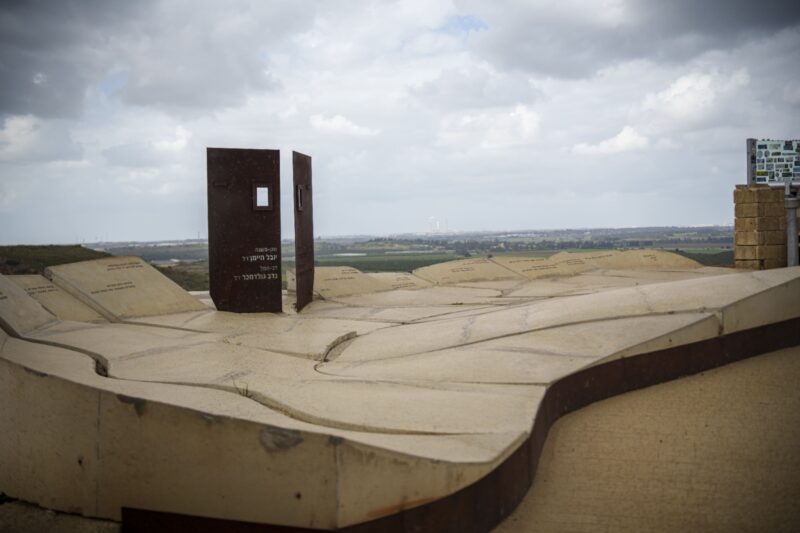
Courtesy
A view from the Survived To Tell Visitor Center in the southern Israeli town of Sderot, overlooking the Gaza Strip, which opened earlier this year.




 Add EJP on Google
SDEROT, Israel — The site was once known as Givat Kobi, literally “Kobi’s Hill.” The lookout, situated some 350 feet above sea level and less than half a mile from the Gaza border, was named for Kobi Harosh, who served as the security coordinator of the southern Israeli town of Sderot from 2001 to 2022. It earned this moniker because it was the hill that Harosh would climb to watch out for incoming rocket fire from Gaza and alert the town’s residents, beginning when the attacks first started in 2001 until a high-tech warning system was installed in 2004.
The site is also known as the Monument of the Four, commemorating four IDF soldiers killed during Operation Protective Edge in 2014. The soldiers died fighting terrorists who had emerged from a tunnel less than half a mile from the spot, intending to attack Sderot and the nearby Kibbutz Nir Am.
Today, the lookout offers a view of the smoke rising from Gaza City as the Israeli military strikes Hamas strongholds in the city as part of its latest ground campaign, Operation Gideon’s Chariots II, which launched last month.
It is from this strategic vantage point, heavy with history and conflict, that Yotam Ivry, CEO of Israel-Is, begins tours of his new visitor center. The decision to locate his organization’s center, which opened six months ago, adjacent to the Monument of the Four was intended to honor the courage and sacrifice of those who gave their lives defending Israel’s southern residents.
Israel-Is, an advocacy group, was stablished in 2017 by former elite IDF soldiers who sought to improve Israel’s global image and combat antisemitism, initially through workshops to teach young Israelis preparing to set out on post-army trips abroad how to speak about their lives in Israel. To date, the organization has trained over 130,000 young Israeli ambassadors to share authentic Israeli stories globally through direct, physical connections and online.
“On Oct. 8, we became aware of the discourse outside [of Israel],” Ivry said, speaking to journalists during a press tour of the center on Monday. “We witnessed mass denial of what happened. We understood that we must launch a battle for the truth — and we are here to tell the story.” Within 48 hours of the massacre, Israel-Is launched a “Survived to Tell” presence on Instagram and TikTok, creating a platform for survivors to share testimonies in multiple languages.
The Survived To Tell Visitor Center, in partnership with the Sderot municipality, was funded by Keren Hayesod in Australia and Mexico, along with other undisclosed philanthropic support.
“We are proud that this center has become a mainstay for all groups touring the South, from young teenagers to some of the world’s most influential policymakers,” said Ivry.
“They come here to pay their respects to the unimaginable tragedies and the inspiring acts of heroism that took place on that Black Shabbat,” he said, referring to the Oct. 7 attacks, which took place on a Saturday morning.
Speaking to reporters, educational director Ilan Turiz, an army reservist and immigrant from Silver Spring, Md., noted the complexity of visiting a memorial to an attack while the war that resulted from it is still raging. “Every great story has a beginning, a middle, and an end. Oct. 7 is just the first chapter. We don’t know the middle or end of this story yet,” said Turiz, who prepares each group before they enter.
Visitors are warned they may hear booms and sirens — some part of the programming, others all too real. During tours, sounds of explosions can sometimes be heard in the distance in Gaza itself.
The “Survived to Tell” experience takes visitors through that first chapter — beginning at 6:29 a.m. on Oct. 7, when “the birds were chirping, kids were out playing” on what seemed like a beautiful autumn morning. In addition to being the weekend, it was a holiday: Simchat Torah. During a 40-minute session, using 20 screens displaying uncut footage, VR goggles and audio, visitors witness the unimaginable through the eyes of five survivors: Mazal, Remo, Ofir, Malat and Nimrod.
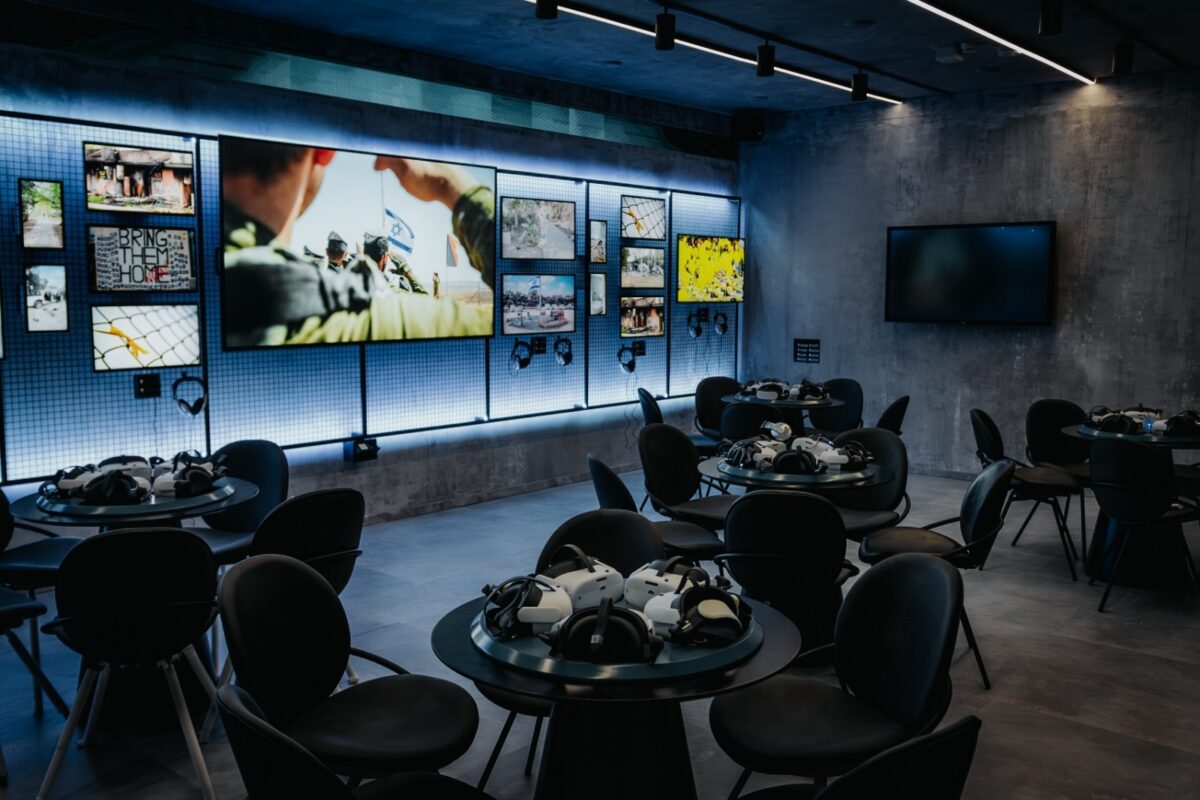
Ivry said he is deliberate about which survivors share their stories in person, matching them to the right audiences and selecting voices that challenge prevailing stereotypes about Israeli society.
Mazal Tazazo is a 35-year-old single mother whose parents immigrated from Ethiopia. Remo Salman Elhozyel is a half-Bedouin, half-Swiss police officer from a large Bedouin tribe in the southern Israeli city of Rahat. One of 2,000 grandchildren in his tribe, most of Elhozyel’s family serve in the Israeli security forces. On Oct. 7, he saved the lives of 200 people.
“Part of how we reach more progressive audiences is by exposing them to Israelis who don’t fit their stereotypes,” Ivry said. “When we bring our amazing people to a conversation, we believe others will listen.”
The organization seeks to create opportunities for young people to meet survivors, hear their stories and possibly change their minds about how they see them. Ivry said they aim to send their ambassadors to college campuses where Israel is not necessarily viewed positively. Next week, survivors connected to Israeli-Is will present their testimonies in Congress.
For the survivors, telling their stories serves a dual purpose: educating the world and processing their own trauma.
Elhozyel, the police officer, is currently on furlough from his service due to post-traumatic stress disorder. “I take it as my mission to tell my story forward,” he told reporters. About a month after Oct. 7, survivors began to identify him from photographs. “Every time I meet someone I saved, it helps me to heal.”
Tazazo tells the harrowing story of her own survival at the Nova festival. She was struck in the head and her legs were bound; she pretended to be dead for hours in an open field. After losing consciousness, she awakened to the smell of the burning fields and found her two best friends murdered beside her. “Danielle and Yochai were like my siblings. I can’t let their deaths be in vain. By living, by telling our stories, we honor them,” she said on Monday.
Tazazo and Elhozyel have been on speaking tours together since the attacks but only recently learned that they had been in the same proximity during the massacre, and that she had even captured his actions on her phone.
According to Ivry and Turiz, when visitors leave, they’re asked to share one word to describe their experience. The most common response, they said, is “hope.”
The center also incorporates the “Bring Them Home” campaign, keeping the plight of the remaining hostages in Gaza at the forefront. “Until the hostages all come back, I will not be able to feel whole,” said Tazazo. “We need them to come back.”
Since opening in April, the center has welcomed several thousand visitors so far, with the goal of reaching 40,000 annually. But the center’s leadership understands that with tourism to Israel dramatically reduced, they cannot rely solely on visitors coming to Sderot. Instead, they are taking the experience on the road — visiting college campuses and communities across the world, with plans to reach 150,000 people, particularly young adults, over the next three years.
For Israel-Is, the mission is clear. “We invite our visitors to witness with their own eyes and carry forward the story as it truly is,” said Ivry. “It’s not only a story of loss, but of resilience, hope and the lasting spirit of our people.”
Related News
CLOSING WORDS
In AZM address, Cosgrove links communal ‘orthodoxy’ on Israel to rising anti-Zionism among young Jews

MAGICAL EXPERIENCE
Shefa launches psychedelics retreat for Jewish professionals suffering burnout
ADVANCING A VISION
N.Y. federation donates $1M toward building shared-society center named for peace activist killed on 10/7
EXIT INTERVIEW
Elizabeth Sokolsky, longtime EVP of Birthright Israel, to retire next year
HIGHER EDUCATION
As Jewish donors reconsider academia, Jan Koum doubles down, endowing Israel studies at Stanford