Q&A
New translation of Hebrew works, ‘Class of 95,’ offers English speakers fresh insight into the Rabin assassination
The anthology’s editor, Barak Sella, says the works offer different perspectives on ‘one of the most important events in… Jewish history’
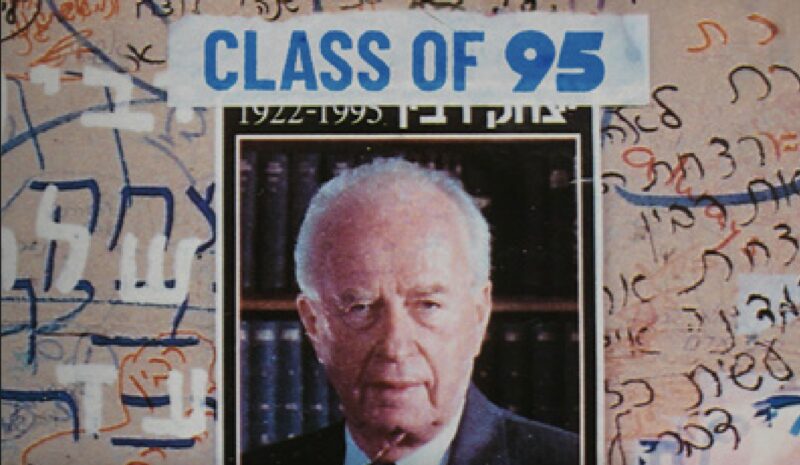
courtesy
'Class of 95'




 Add EJP on Google
The assassination of then-Israeli Prime Minister Yitzhak Rabin, 30 years ago tomorrow, remains one of the seminal moments in Israeli history. It represents the peak of domestic Israeli political violence and the beginning of the end of a two-state solution-based peace process. It also marked the last time that a fully left-wing coalition led the country.
The killing, by a religious far-right activist, Yigal Amir, who claimed to be following a religious decree designating Rabin a rodef, or a person who can be killed because of the threat they pose to others, prompted general criticism of the religious Zionist community, from which the prime minister’s fiercest critics came. This, in turn, spurred feelings of being scapegoated by the national religious camp, whose leaders have denied collective responsibility for the assassination, putting the blame solely on Amir.
The memorial day dedicated to his assassination has almost always been a political affair, with speakers at the national ceremonies often criticizing Benjamin Netanyahu, who presided over a particularly critical protest against Rabin days before the assassination and who has led the country for most of the time since the murder. Netanyahu often forgoes the events, making them even more lopsided politically. Such was the case this year as well, with a Tel Aviv rally on Saturday night, attended by some 150,000 people, which was rife with both thinly veiled and explicit criticism of the premier.
A new English translation of poetry wades into this complexity. Based on an anthology that was first published in Hebrew in 2012, Class of 95 presents 40 poems and prose that grapple with the event and its aftermath, along with a new foreword by Shalom Hartman Institute President Yehuda Kurtzer and afterword by Silvio Joskowicz, the head of the Zionist Enterprises Department in the World Zionist Organization and secretary-general of the socialist Habonim Dror youth movement.
eJewishPhilanthropy spoke with Barak Sella, the anthology’s editor and an American Israeli educator and community organizer, about the book and his goals for it, why the assassination is not widely memorialized, particularly outside of Israel, and about the particular dangers of political violence in a country like Israel. (Disclosure: Sella and this reporter are both fellows of the Jewish Federation of Tulsa, Okla.,’s Elson Israel Fellowship.)
This interview has been lightly edited for clarity.
Judah Ari Gross: What is your goal with this book? Who is the target audience?
Barak Sella: The target audience is Jews living around the world who don’t speak Hebrew, first and foremost. And I would say above that, the target audience is Jewish educators, rabbis, anyone who this book could serve as a tool to educate and speak about the assassination in a way that’s thoughtful and supports the idea of open conversation. But it’s not only for educators. I think anyone who wants to learn about the event — but also figure out what they’re feeling about it and what’s their part in the story — can find a lot of value in this book.
The way I see it, the Rabin assassination is one of the most important events in Israeli history, but also in Jewish history in the last century. And it really matters how we remember this event. First of all, that we actually even remember and commemorate it, but it matters how we remember that event and what kind of shared narrative and story we tell.
Is this a story that’s only the failure of democracy and of our ability to solve our differences in Jewish sovereignty? Or is this a story that will serve us as a warning sign… to what we need to build? Because for most of Jewish history, the Jews have not been sovereign. Jewish sovereignty is something that is on the margins of Jewish culture and history. And it’s something we need to learn. And remembering this event, not only the tragedy of losing a very important leader who, some people supported and some did not, but Rabin was also the leader of the Jewish state, and he was assassinated by a fellow Jew who did not agree was his path. So it’s our failure to govern ourselves. I think anyone who cares about Jewish sovereignty, who cares about Jewish self-determination, who cares about peace, who cares about democracy, can find a lot in this book.
The reason I put it out is that I moved to Israel from the U.S. when I was 9. I was 10 when Rabin was assassinated. And for me, the Rabin assassination was parallel with my socialization into Israeli society. And I understood what it means to be Israeli as Israeli society understood what it means to be a society post-Rabin. I was very involved my whole life because I really saw that shaping this memory is crucial to what Israel will become. And the reason I put this book out now is because, unfortunately, what I’ve encountered over the years is that the Rabin Memorial Day is really absent from American Jewish culture, from the American Jewish calendar. You don’t see Memorial Days. Educators don’t really talk about it with students or teens. It’s not something that the next generation is being educated about thoughtfully.
And there’s many reasons for this, right? It’s such a contentious topic. It’s so charged. Israel is difficult as it is. And it also seems like [people think,] “This is something that happened in Israel. Is it really our place, in world Jewry, to create events and memorials around us. But I actually think that this is not an Israeli event. I think I see it as a Jewish event.
If you want to create memory, you need a story. It’s not enough to have articles and op-eds. You need something that speaks to the heart, especially around an issue that’s so contentious. What’s beautiful about poetry is that it allows you to encounter perspectives that you might be very uncomfortable with or that might be difficult. But they’re in a way that is open and allows you to not just say, “Do I agree or not agree with this opinion?” but more like, “Do I understand what this person is experiencing or is trying to say or is feeling?” And I think that is therapeutic and needed.
JAG: Like you said, the Rabin assassination is still so loaded, it’s still such a charged topic in Israel, particularly regarding the relationship between left and right or secular and religious. Much of the secular left holds the religious right responsible for the assassination because of the incitement against Rabin, while the religious right feels scapegoated as a community. And those are such deeply felt beliefs that have permeated Israeli society, which anyone who wants to understand this place would have to understand. But this book doesn’t exactly get into that. On its own, it’s more of an artifact, a snapshot of the moment rather than an explanation of it. Are you or someone else building more of a curriculum around this to explain those dynamics?
BS: So first of all, I’m also going to develop a curriculum and I’m going to do speaking events and meet educators and students and talk to them about using this book of poems to talk about the assassination.
But also, yes, I think saying that it’s an artifact is actually a great way of putting it. It’s gonna be out there. And people will decide what to do with it. It’s poetry. You can’t tell people what to do with art. The idea is you put art out there, and you have to see what it makes people feel, what it brings up in them, and what they decide to do with it.
I do imagine that this could be something that if a rabbi is trying to think, “What do I talk about on [Yitzhak Rabin Memorial Day] in my sermon?” They can pick up Class of ‘95 and find something that speaks to them. A teacher, a parent, anyone who wants to talk to their children or their peers or with themselves can pick up this book and do some soul searching and soul sharing. That’s the way I see it.
It’s really interesting that you brought up the tension between religious and secular and right and left because the goal was to bring those tensions into the book. So one of my favorite poems in the book is by a poet called Yosef Ozer, who’s a Haredi living in Israel. And he has this extremely powerful poem called Lo Afiti Bedam, I did not bake with blood, where he talks about the feeling of going around Tel Aviv with a kippah on his head and feeling blamed for murder and being framed. And he makes a comparison between that and the blood libels of baking matzahs with blood. It gives this opening to an experience, for example, that a religious person had in Israel that I would say most non-religious people are totally unaware of. Even if they’re aware of it, it gives them the opportunity to peek into the emotional experience.
There’s a beautiful poem by Daniel Baumgarten. It’s a very short poem. It’s called Silence, and the poem is “Dear students/please raise your hands/what does it feel like to have peace/within reach?”
And that gives a perspective of an educator, a lefty, a Meretz supporter, who grew up during a time when he felt peace was in reach. And since then silence. The poem was written in 2015.
So I think the idea of the book is to invite people into conversation, into perspectives and feelings that they might not have. And many people, especially the older population, who do have personal experiences about the assassination, this book will allow them to access some of those memories and experiences and understand them in a better way.
JAG: How did you develop this project, both the book itself and the curriculum that you are preparing?
BS: So this [English] version of the book was sponsored by the Department of Zionist Enterprises at the World Zionist Organization. But this initiative has been something that’s been developing for years. The first edition was published in 2013, so 12 years ago, under the title Machzor 95. (Ed. note: This is a play on words in Hebrew, with machzor meaning both class and holiday prayer book.) It was published as part of Dror L’Nefesh (the printing press of the socialist Habonim Dror youth movement), and it was actually published almost by mistake. We were planning to do some kind of poetry night for Rabin’s 18th Memorial Day, and we went to search for the poets who wrote about Rabin because surely many people wrote poetry about such a momentous event, and we couldn’t find anything. Then we realized that it was not in the conversation in literature. And we put out a call for proposals, and we were swamped by dozens of unpublished poems and short stories. And so we decided to publish a book. The second edition came out in 2022.
This was the first time, the first attempt in Israel to put out poetry and literature around Rabin. But my ambition was always to translate it into English. And so for this edition, we selected 40 poems that we felt would fit better with the American audience, that would speak to them. And we published it in both Hebrew and English because there are still some differences. At the end, there’s a very interesting note from the translator to help also understand some of the hidden meanings and more Israeli-centric connotations.
I did editing. Yoni Hammer-Kossoy did the translation. Yehuda Kurtzer did the foreword. Silvio Joskowicz, from the WZO, did the afterword. So a lot of people fed into this, but it’s mostly an independent initiative of people over the years who wanted to support this idea.
JAG: It’s interesting that, as you say, there wasn’t a lot of art and poetry that came out of the Rabin assassination, despite it being such a significant moment in Israeli history. In comparison, it felt like in the weeks after the Oct. 7 attacks, every musician had a new song out about it, every artist was creating something related to it, and it continues today. Why do you think that is? Was the Rabin assassination too political? Too complicated because it was an internal thing as opposed to an outside attack? Or is it just a function of it being easier to self-produce art today?
BS: There are a lot of different possible reasons. One of them — and I think this is also one of the reasons that to this day the Rabin Memorial Day is not widely commemorated in the U.S. and in Israel — is that it’s still controversial and still politically charged. So there wasn’t enough of a demand for it.
Also, let’s remember what happened to Israeli society after the Rabin assassination. We went into another political revolution. We went into the collapse of the peace process and the Second Intifada. So we didn’t even have enough years to process this before we were thrown into a new world with, you could say, even more traumatic experiences that put Rabin’s assassination in the rearview mirror.
I was the spokesperson for the national memorial day for about three, four years. And there was always a tension about the purpose of the memorial day. Is it a day where one political camp says, “This is our vision and this was our leader, and you assassinated him,” and the other political camp uses it to attack and say, “You always blame us,” and to use it to talk about the failures of the Oslo Accords? Does it become a political match or are we able to say this day is not about left or right, it’s about what it means to be one Jewish people in a democracy and to be able to have a democracy.
I think Israeli society has not succeeded yet in solidifying that the Rabin Memorial Day is a day about safeguarding democracy. It’s still a day that has a lot of political warfare.
We divide the book into five chapters according to the stages of grief. And traditionally, Jewish grief ends after a year. The Jewish tradition differentiates between two types of mourning, avelut hadasha and avelut yeshana, new mourning and old mourning. New mourning is like if you lost a family member, a friend, anyone you love in your community. It’s something personal. But then you have avelut yeshana, which is something that happened a long time ago that you don’t have any personal or emotional connection to, but it’s still something that you mourn. So the best example is the destruction of the Temple. It happened 2,000 years ago. No one was there. We don’t know anyone who was murdered or massacred in the destruction of the Temple. But we mourn it because it’s a collective sort of old mourning.
The last chapter is called avelut yeshana. Yes, many people today have a personal relationship to the Rabin assassination and remember where they were on that evening. But we need to shift the Rabin assassination from avelut hadasha to avelut yeshana, to something that is part of our canon, part of our story. It’s not about what we felt about Rabin. It’s about what we feel about this event and its meaning in our shared story and history.
JAG: We are seeing a period of increased political violence around the world. And one of the goals of Zionism is to have Israel be a “normal country.” If you understand normal to be average, then maybe political assassinations — however terrible and abhorrent as they may be — are just the price of being normal.
BS: So I don’t agree that Israel is a “normal country.” I think Israel is a normal country, and it’s also not a normal country. First of all, in Jewish history, the Jews always wanted to be “ke’hol ha’amim,” “like all the nations.” And they begged [God], ‘Stop, we don’t need to be the chosen people and have these prophets. We want a king. We want to be just like everyone. We want to be normal.” And Jews, I think, are always in this tension between how we are normal and like everyone else, and how we also need to create something unique.
And in that sense, while I think a political assassination is maybe a normal thing that almost every modern democracy has had to deal with, for the Jewish people and for our specific history, it has a different meaning because the Jewish People are unlike all these other countries. We existed before the State of Israel. And if there won’t be a State of Israel, we will exist after the State of Israel. All these other nations, they exist because they have a state.
Having sovereignty is not a given for the Jewish people. And so the meaning of political assassination is unique in the structure of a Jewish democratic state, which is a complicated and fragile and delicate thing.
Political violence is even more dangerous, more charged and more unique [for us]. We have Gedaliah ben Ahikam [a biblical political official who was assassinated by Jews, which is tied to the destruction of the First Temple]. We have different events in our history that show us that when we turn against our leaders in this way, it usually leads to our demise.
In the U.S., they assassinated a president, and then they held elections and they moved forward. The Jewish people have a different fragility, have a different history.
So I think that the risks and costs of political violence in a state like Israel, which is small and surrounded by enemies, which is fragile while strong, is much more dangerous. So I think that’s why it’s a different issue.
Correction: An earlier version of this report incorrectly stated that Rabin was the last left-wing politician to lead the country. Ehud Barak was elected prime minister in 1999 as head of the Labor Party, though the coalition that he formed included non-left-wing political parties.
Related News

MAGICAL EXPERIENCE
Shefa launches psychedelics retreat for Jewish professionals suffering burnout
ADVANCING A VISION
N.Y. federation donates $1M toward building shared-society center named for peace activist killed on 10/7
HIGHER EDUCATION
As Jewish donors reconsider academia, Jan Koum doubles down, endowing Israel studies at Stanford

MAJOR GIFTS
Center for Jewish History celebrates 25 years with a $25M matching grant
EXIT INTERVIEW
Elizabeth Sokolsky, longtime EVP of Birthright Israel, to retire next year