Opinion
IN MEMORIAM
Man of God, man for good: Rabbi Moshe Hauer




 Add EJP on Google
There are no words because he is not here to write them. There are no words because he is not here to speak them. There are no words because he is not here.
This is the situation I find myself in after last week’s sudden tragic passing of Rabbi Moshe Hauer, my co-executive vice president at the Orthodox Union, who was like a brother. I am also reminded of what Rabbi Hauer said a few years ago when his father passed away, how he encouraged us all to speak no matter how difficult the topic or circumstances: “G-d gave us the power of speech in our lifetime. When we follow the mandate of “Na’aseh Adam” (“Let us make Man”), when we live our lives as we should and complete His creation, we grant ourselves the power of speech beyond our lifetime. We continue to speak, our life’s message continues to be heard, long after we are gone.” So now I feel I have an opening to say something.
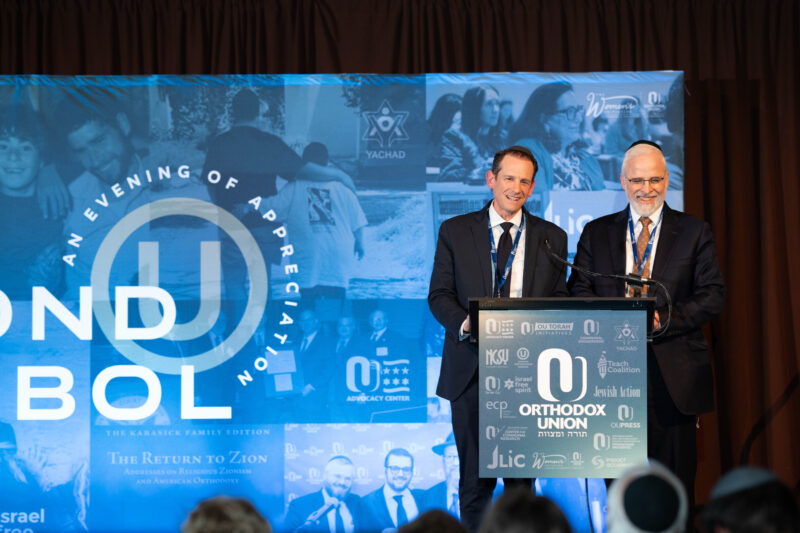
Courtesy/Orthodox Union
Rabbi Josh Joseph (L) and Rabbi Moshe Hauer at the OU Biennial Convention in February 2025 in New York City.
The first time I met Rabbi Hauer was in the summer of 2020. With the COVID-19 pandemic in full swing, we met off the New Jersey Turnpike in the middle of Thompson Park, a midpoint between Baltimore and Lawrence, on Long Island. We sat 20 feet away from each other and wore masks, but almost right away we knew we were kindred neshamos. We actually grew up less than a mile from each other in Montreal, where both of our fathers, of blessed memory, were rabbis. Though he was a couple of years ahead of me, I can’t imagine our paths never crossed as boys or young men.
The second time we met, he shared this verse from the Book of Exodus with me, “vera’acha vesamach belibo,” “and he saw you and rejoiced in his heart,” to express how happy he was to see me.
That never changed. Even during difficult moments or disagreements, we always found ways to talk things through and end with a hug. This aspect of Rabbi Hauer went far beyond me. He was a brother for so many of us.
In being a wise guide, a coach, a mentor and a friend, Rabbi Hauer was an exemplar of what it meant to be a Torah Jew. He began board meetings, retreats and conversations not just with dvar Torah, not as a formality, but with words that spoke to the moment around us.
I truly think of Rabbi Hauer as a man of G-d. It was a characteristic he expressed wherever he went. He had recently begun to say “G-d bless you” in addition to “Thank you” whenever exiting a taxi or Uber, which he did often, as he traveled frequently for work. The reactions he would get were priceless, with the drivers being so appreciative of him invoking G-d’s blessings and the respect such words showed for the wellbeing of others. When he spoke about G-d, it left an impact.
His first engagement with everyone he met bespoke a certain ease and quietness, stemming from a deep respect for people. But it would be a mistake to think that he was always calm, because calm he was not; he admired those who had what he called “fire in the belly,” passion and drive and determination to not waste a moment. He was a model for this as well. When we put “drive” as one of the core values for the OU, we all had him in mind. No project was too big or small, no deadline impossible to meet. He dreamed bigger than anyone, but also made sure things happened.
In a typical illustration of this drive, he came to me on Day 171 after Oct. 7, 2023, amid ongoing war and the horrible captivity of our hostages in Gaza, and said, “What if we try to get 180,000 letters to the White House on Day 180, advocating for the release of the hostages?” I wondered aloud if he was feeling ok. And yet we did it. We launched a massive letter-writing campaign among our communities and the public, and nine days later walked into the White House with the letters, where they welcomed us in Room 180.
“Message received,” the White House liaison told me. But for all of us involved, it was much more than just a message: it was a show of love, passion and concern, all stemming from Rabbi Hauer’s commitment and leadership.
While full of passion, he never exaggerated. This was part of his humility. When we were writing up our strategic plan, he edited out our wanting to be the voice for the Orthodox Jewish world.
“Why can’t we just be a voice? There are lots of other voices to be heard,” he said.
This humility and emotional intelligence are what allowed him to work in partnership so well with so many different people and organizations. And yet even with his humility he was never afraid to share his mind and speak to his convictions with his soft, still voice.
He passed out of this world the night after all of the remaining living hostages in Gaza came home. Some have suggested this was G-d’s way of saying “Mission accomplished.” But we are not done. Just a few weeks ago, he hauntingly titled his dvar torah for Parshat Vayeilech “Unfinished Business?” quoting the verse, “Who will live and who will die? Who will die at the predestined time and who before that time?”
Rabbi Hauer went on to write: “These words remind us of our vulnerability and of the possibility that one may leave this world with unfinished business.” He pointed out that the sages say that Moshe Rabbeinu lived to 120, indicating that G-d completes the years of the righteous. Yet, Moshe was never able to enter the land of Israel — was his life not cut short?
Rabbi Hauer then cited from Pirkei Avot: “It is not your responsibility to finish the job, nor may you neglect it.”
“Moshe may have had an unfulfilled dream for himself and Klal Yisrael, but he continued to work until his last day towards its fulfillment. Even on that last day, once he recognized that he would not finish the job himself he made sure to identify and hand off the Jewish people to their next leader, Yehoshua, who would indeed bring us to Eretz Yisrael. That is the true meaning of a complete life, not one that reaches its every goal but one that continues the march towards that goal… The remaining distance to the goal should not frustrate us; it should instead frame our strategy and approach as we plan for the long game… It is not our task to finish the job, just to continue it and never neglect it.”
The words bring both awe and chills as I reflect on the fact that Rabbi Hauer’s first name is Moshe and mine, in Hebrew, Yehoshua.
But Rabbi Hauer, achi, my brother — how do we do it without you? We completed so many of each other’s thoughts and words, I can’t remember who said what, but our saying that we shared so often was, “We are just getting started.” We were just getting started. While it will be difficult to move forward without you, we will carry on your legacy anyway, just as Yehoshua did for Moshe, because we know that’s what you would want us to do. We ask you to keep speaking, if not to us, then for us; as an advocate for the living, for all Klal Yisrael.
Rabbi Josh Joseph is the executive vice president and chief operating officer of the Orthodox Union.