WHAT YOU SHOULD KNOW
Long-simmering dispute over egalitarian prayer at the Western Wall heats up
Erik Marmor/Flash90
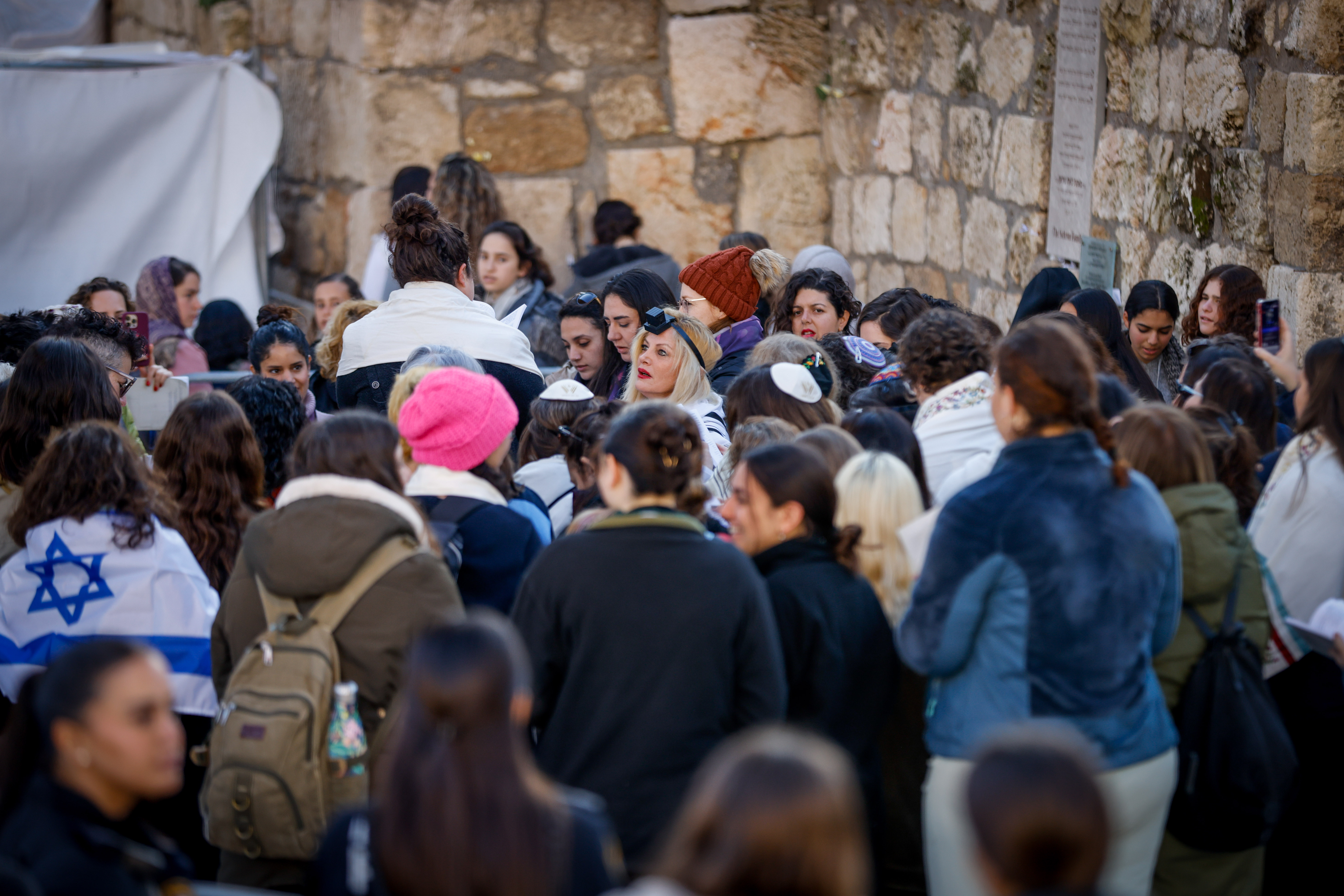
Members of Women of the Wall pray at the Western Wall in Jerusalem's Old City on Feb. 22, 2023.




 Add EJP on Google
For the past 10 years, few issues have exemplified the strains between the State of Israel and Diaspora Jewry more than the dispute over what type of prayer is permitted at the Western Wall. The disagreement — which at times even turns violent — centers around two main issues: one, mixed, egalitarian prayer at the site; and two, what women are and aren’t allowed to do at the Western Wall, particularly as it relates to reading from the Torah.
After decades of dispute and court proceedings, in early 2016, the Israeli government under Prime Minister Benjamin Netanyahu struck an agreement between the country’s Haredi leadership and the Reform, Conservative and progressive Orthodox movements, known in Hebrew as Mitveh HaKotel (literally, the Western Wall Framework) and in English as the Western Wall Compromise.
Under the deal, which was brokered over the course of 3 ½ years, the Reform, Conservative and progressive Orthodox movements ceded to the Chief Rabbinate the main Western Wall plaza, where prayers would remain segregated by gender and only men would be permitted to read from the Torah. In exchange, the so-called “egalitarian plaza” — located south of the main plaza, under Robinson’s Arch — would be upgraded and would come under the control of a dedicated council made up of representatives from the progressive movements.
Following outcry from Haredi leaders after the government’s adoption of the compromise, Netanyahu announced in March 2026 that the matter would be reconsidered, and in June 2017, Netanyahu’s Cabinet announced that the agreement was being put on hold indefinitely. The following summer, a large stone from the Western Wall came dislodged and fell into the “egalitarian plaza,” blocking direct access to the wall to this day, even as the stone has since been removed.
Since the Israeli government froze the compromise, the issue has served as a regular source of frustration and division between Israel and Diaspora Jewry, particularly American Jewry, one of the few Jewish communities in the world where non-Orthodox Jews represent the majority. This is typically seen each Rosh Hodesh, at the start of each Hebrew month, when the Women of the Wall group attempts to hold a female-led Torah reading in the women’s section of the main plaza, which are sometimes broken up by the Western Wall’s ushers or disrupted by demonstrators who blow whistles, scream, shove and, in extreme cases, throw caustic liquids on the women. At times, extreme groups have also disrupted prayers at the “egalitarian plaza.”
This simmering situation came to a head over the past week, following a hearing in a long-running case in Israel’s High Court of Justice, focused not on the implementation of the Western Wall Compromise but on the long-stalled renovations of the “egalitarian plaza.”
After the hearing, the justices ruled that the government must proceed with those renovations. However, the High Court win for the progressive religious movements may prove to be a Pyrrhic victory.
In response to the ruling, Knesset Member Avi Maoz, the leader of the far-right religious Noam party, submitted a bill that would assert full Rabbinate control over the entire Western Wall area, including the egalitarian section, and would make the “desecration” of a holy site — activities that are in violation of the Rabbinate’s rulings, including egalitarian prayer and female Torah reading — a criminal offense, punishable by up to seven years in prison. (Possibly unintentionally, the bill could also prevent Jews from visiting the Temple Mount, as this too is officially banned by the Chief Rabbinate.)
The bill, which Maoz said he plans to put up for a vote in the Knesset on Wednesday, has received the public support of the Knesset’s Haredi parties, along with the Religious Zionism Party, as well as parts of Netanyahu’s Likud Party. Curiously, Justice Minister Yariv Levin has come out as a vocal champion of the measure, despite voting in favor of the Western Wall Compromise 10 years ago.
According to Yizhar Hess, vice chair of the World Zionist Organization and former head of the Israeli Masorti Movement, Maoz’s bill could spell the end of both the Western Wall Compromise and the legal case in the High Court of Justice, which hinges on the fact that the issue remains unresolved and that the government has issued a resolution on the matter. This is true even if the bill is not signed into law and only passes an initial reading.
Were the government to go to the High Court of Justice and say that the issue is being resolved through legislation — and thus shouldn’t be arbitrated through the courts — “that would be a strong argument,” Hess told eJewishPhilanthropy.
Netanyahu does not appear to personally favor the bill and canceled a ministerial meeting in which the legislation would have been discussed. However, this does not prevent the bill from going forward. As the head of his party, Maoz can put the bill up for a vote in the Knesset on his own, and The Times of Israel reports that the Likud whip has given party members free rein to vote as they see fit.
“The risk is clear and immediate,” Hess said. “We need to ensure that if they put it up for a vote, it doesn’t pass.”
However, even if Maoz’s bill is defeated — or never comes up for a vote — the fate of the Western Wall Compromise is far from certain, even after the country goes to the polls later this year. Under a similar coalition to the current one, the agreement will almost surely not advance and may be fully, officially retracted. But even if a different coalition is installed, it is not guaranteed that the matter will be resolved.
During the prior, so-called “change government” — under Prime Ministers Naftali Bennett and Yair Lapid — both the Western Wall Compromise and the renovations to the egalitarian section did not proceed. Though some parts of that coalition did push for the agreement to be implemented, the issue was kept on ice in order both to appease the more conservative members of Bennett’s Yamina Party and to focus on other matters of religion and state, which were seen as more pressing.
Hess acknowledged that the same thing could happen again. “If the next government is without Haredi [parties], I think it has a chance. Can I say that with certainty? Of course not. Could it be that they don’t go ahead with it? It could be that they don’t. But we hope that they would,” he said.